


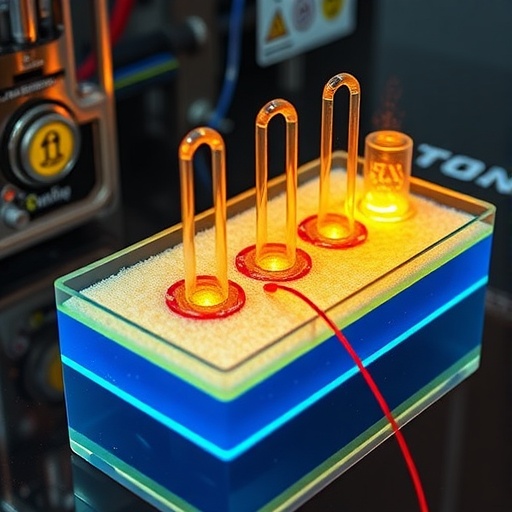
Wastewater treatment has long depended on catalysts that perform a difficult balancing act: they must destroy pollutants efficiently while surviving the chemically aggressive conditions inside treatment reactors. A new study published in Nature Communications describes a strategy designed to address one of the field’s most persistent problems—catalyst deactivation. Huang, Duan, Bai and colleagues report an in-situ electrochemical regeneration approach that allows catalysts inside packed-bed reactors to recover their activity while purification is still under way, potentially extending reactor lifetimes and reducing the need for frequent replacement.
Catalysts accelerate chemical reactions without being consumed in the idealized version of the process. In real wastewater systems, however, their surfaces can gradually become blocked or chemically altered. Organic molecules may adsorb strongly to active sites, inorganic salts can accumulate, and reaction by-products may form deposits that prevent contaminants from reaching the catalyst. Changes in oxidation state, surface structure or local chemistry can also reduce performance. Once this happens, a reactor may produce less thoroughly treated water, consume more energy, or require an expensive shutdown for catalyst cleaning or replacement.
The researchers’ solution combines catalytic treatment with electrochemical control. In a packed-bed reactor, wastewater flows through a stationary mass of catalyst particles rather than through a stirred liquid containing suspended material. This design offers a large reactive surface area and can be scaled for continuous operation, but it also makes conventional regeneration difficult. Removing and treating the catalyst can interrupt the process. By introducing electrochemical regeneration directly within the reactor, the new approach aims to restore the catalyst where it sits, without dismantling the packed bed or halting purification for extended periods.
The central concept is to use an applied electrical potential to change the chemical environment at or near the catalyst surface. Depending on the catalyst and pollutant, electrochemical reactions can oxidize accumulated organic residues, alter the surface’s oxidation state, or promote the removal of species responsible for fouling. Electrical polarization may also generate reactive intermediates that help break down deposits. Rather than treating deactivation as an unavoidable end point, the system treats it as a reversible condition that can be managed through controlled electrochemical intervention.
This is particularly important for advanced wastewater purification, where target contaminants may be present at low concentrations but resist conventional biological treatment. Pharmaceuticals, industrial chemicals and other persistent organic pollutants can pass through standard treatment stages and require oxidation-based technologies for removal. Catalytic oxidation can transform these compounds into smaller and less persistent molecules, but the same reactive environment that destroys pollutants may eventually damage or foul the catalyst. A regeneration mechanism operating in the same reactor could help maintain the high activity needed for long-duration treatment.
The study’s packed-bed configuration is also significant because reactor architecture determines how effectively a treatment technology can move from the laboratory to real facilities. A fixed catalytic bed can provide continuous flow, predictable hydraulic behavior and relatively straightforward integration into existing treatment lines. Yet it can develop concentration gradients: the front portion of the bed may encounter the highest pollutant load, while downstream regions experience different chemical conditions. In-situ electrochemical control could offer a way to respond to these changing conditions and distribute regeneration more effectively across the reactor.
The researchers describe the approach as enabling long-lived wastewater purification, suggesting that the reactor can sustain useful treatment performance over an extended operating period compared with a system in which catalyst deactivation is left unchecked. The broader value is not simply longer catalyst life. Avoiding repeated replacement could reduce material consumption, maintenance demands and the downtime associated with reactor servicing. It may also improve the economic case for catalytic technologies that are currently limited by the cost of managing spent or deactivated materials.
Electrochemical regeneration does introduce its own engineering challenges. The system must deliver enough electrical energy to restore catalytic activity without causing unwanted side reactions, excessive heating or damage to the catalyst structure. Electrode placement, current distribution and water chemistry can strongly influence performance. Salts and natural organic matter in actual wastewater may affect conductivity and compete for reactive species. A practical system must therefore balance regeneration intensity with energy use, prevent the formation of undesirable transformation products and demonstrate stable operation under variable feed conditions.
The study points toward a broader shift in environmental engineering: designing treatment systems that can adapt to their own degradation. Instead of operating a catalyst until it fails and then replacing it, future reactors could monitor performance and periodically trigger targeted recovery cycles. Such systems might combine electrochemical signals, pollutant measurements and automated controls to determine when regeneration is needed. If the approach proves robust beyond controlled experiments, it could help make advanced purification more continuous, less wasteful and more resilient to the complex chemistry of real wastewater.
The work arrives at a moment when water utilities and industries face growing pressure to remove persistent contaminants while limiting energy use and operational costs. A catalyst that can be regenerated inside a working packed-bed reactor could turn a major weakness of catalytic purification into a manageable process variable. The researchers’ findings do not eliminate the need for careful reactor design or long-term validation, but they offer a compelling blueprint: use electrochemistry not only to destroy pollutants, but also to keep the pollution-fighting catalyst alive.
Cite Scienmag News
Bethany Barker. (August 11, 2026). Electrochemical regeneration extends catalyst life, enabling durable wastewater purification in packed-bed reactors. Scienmag. https://scienmag.com/electrochemical-regeneration-extends-catalyst-life-enabling-durable-wastewater-purification-in-packed-bed-reactors/
Bethany Barker. "Electrochemical regeneration extends catalyst life, enabling durable wastewater purification in packed-bed reactors." Scienmag, 11 August 2026, https://scienmag.com/electrochemical-regeneration-extends-catalyst-life-enabling-durable-wastewater-purification-in-packed-bed-reactors/. Accessed 4 September 2026.
Bethany Barker. "Electrochemical regeneration extends catalyst life, enabling durable wastewater purification in packed-bed reactors." Scienmag. August 11, 2026. https://scienmag.com/electrochemical-regeneration-extends-catalyst-life-enabling-durable-wastewater-purification-in-packed-bed-reactors/


