


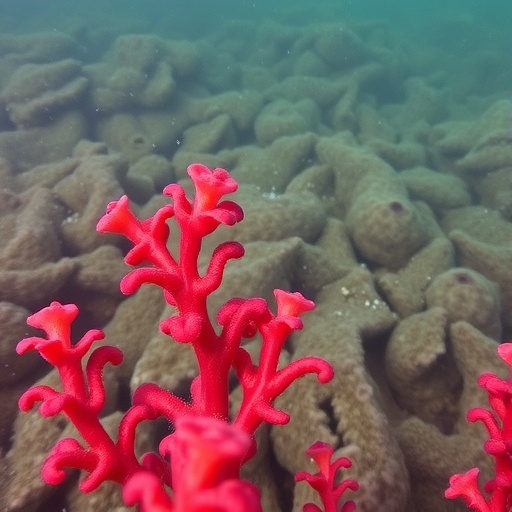
For decades, scientists have searched for natural records capable of revealing how the oceans changed before modern instruments began measuring them. Coral skeletons, shells and microscopic fossils have provided valuable clues, but many of these archives are threatened by shrinking habitats and environmental stress. Now, an international research team has shown that an overlooked ocean structure could function as a remarkably precise natural thermometer. Rhodoliths—free-living, nodule-like formations built by red algae—have been used to reconstruct seawater temperatures day by day across a 133-day period in the Red Sea.
The study, led by researchers from Johannes Gutenberg University Mainz and the Max Planck Institute for Chemistry, demonstrates that a single rhodolith can preserve a high-resolution record of changing marine temperatures. Instead of offering only broad seasonal signals, the structure captured both gradual warming and short-term fluctuations. The result could open a new way to investigate how marine ecosystems have responded to climate change in regions where conventional climate archives are rare, incomplete or increasingly vulnerable.
Rhodoliths form as red algae grow calcium-carbonate skeletons around loose fragments on the seafloor. Unlike reef-building corals, they are not permanently attached to the seabed. Waves and currents can roll them across shallow marine environments, while new layers of mineralized tissue accumulate along their branching surfaces. These structures occur around the world, from shallow coastal waters to depths of roughly 200 meters, making them potentially widespread climate archives. Their abundance, however, has also been a scientific obstacle: each rhodolith contains a complicated three-dimensional network of branches that may grow at different times and rates.
To solve this problem, the researchers combined field experiments, three-dimensional imaging, geochemistry and advanced data analysis. They first placed a dye in the Red Sea environment that selectively accumulates in calcium carbonate. The algae were then allowed to continue growing for four months. This created a time marker inside the skeleton, allowing the researchers to determine how quickly different branches developed and to establish a reference point for interpreting the rest of the structure.
The team next scanned the rhodolith with micro-computed tomography, or micro-CT. Similar in principle to medical CT imaging, this technique uses X-rays to reveal the internal architecture of the nodule without cutting it apart. The resulting three-dimensional map showed the growth layers and branching pathways hidden inside the rhodolith. Researchers could then identify sections suitable for chemical sampling while preserving the overall structure of the archive.
Using a laser, they vaporized microscopic portions of the algal skeleton along individual branches. The material was analyzed with a mass spectrometer to determine the ratio of magnesium to strontium in each layer. That ratio acts as a temperature-sensitive chemical signal because the incorporation of magnesium and strontium into calcium carbonate changes with the temperature of the seawater in which the skeleton forms. By measuring these variations along the branches, the researchers reconstructed the temperatures associated with successive stages of growth.
The central challenge was that no single branch contained the entire record. Some branches began growing earlier, others later, and their growth rates were not identical. To combine the fragmented signals, the researchers used an algorithm called dynamic time warping. Originally developed for comparing sequences that unfold at different speeds, the method mathematically aligns overlapping patterns even when one record is stretched or compressed relative to another. Applied to the rhodolith, it merged the separate branch histories into one continuous daily timeline.
The approach was tested on a rhodolith collected from a shallow reef flat in the central Red Sea, an environment known for extreme salinity, intense sunlight and limited nutrient availability. Water temperatures in the region can range from approximately 18 to nearly 38 degrees Celsius over the year, creating strong environmental contrasts. The researchers reconstructed conditions from March through July 2024 and compared the result with direct measurements from temperature loggers installed at the collection site. The rhodolith record closely followed the observed temperatures, reproducing the seasonal warming trend as well as shorter-term changes.
The findings suggest that rhodoliths could become powerful tools for studying both modern marine environments and past climates. A single nodule may preserve information at a resolution fine enough to reveal daily thermal stress, abrupt temperature events and the timing of seasonal transitions. Because rhodoliths are distributed across many parts of the world, researchers could eventually compare records from different regions to investigate how warming oceans affect vulnerable ecosystems. The same alignment strategy might also be applied to other fragmented biological archives, including multiple coral cores or overlapping records from different marine organisms.
The researchers describe the study as a proof of concept rather than a finished global monitoring system. More work will be needed to test how reliably the magnesium-to-strontium signal performs in different environments, how long individual rhodoliths can preserve continuous records and whether other factors influence their chemistry. Even so, the technique offers an unusual combination of scale and precision: a small, naturally formed algal nodule may contain a daily log of ocean temperatures, transforming a difficult-to-read geological structure into a potential archive of marine climate change.
News Publication Date: 21-May-2026
Web References: https://doi.org/10.1038/s43247-026-03603-y
References: Communications Earth & Environment, “Rhodoliths can act as daily resolution paleotemperature archives in the Red Sea,” DOI: 10.1038/s43247-026-03603-y.
Cite Scienmag News
Violet Maxwell. (August 11, 2026). Red algae reveal the ocean’s daily temperature history. Scienmag. https://scienmag.com/red-algae-reveal-the-oceans-daily-temperature-history/
Violet Maxwell. "Red algae reveal the ocean’s daily temperature history." Scienmag, 11 August 2026, https://scienmag.com/red-algae-reveal-the-oceans-daily-temperature-history/. Accessed 4 September 2026.
Violet Maxwell. "Red algae reveal the ocean’s daily temperature history." Scienmag. August 11, 2026. https://scienmag.com/red-algae-reveal-the-oceans-daily-temperature-history/


