


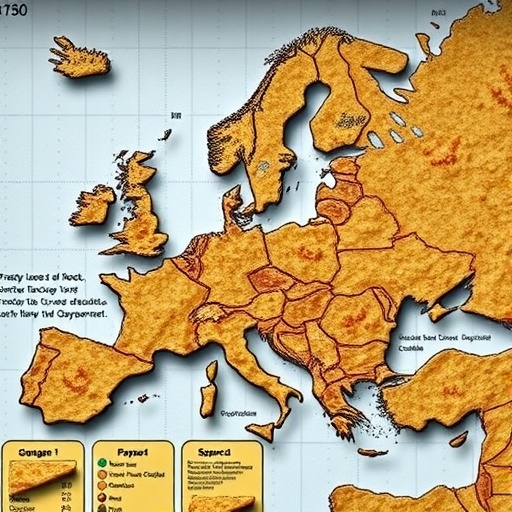
A groundbreaking study from Simon Fraser University has uncovered compelling evidence of gender-based dietary inequality spanning a sweeping 10,000-year timeline across Europe. By examining isotopic data drawn from an unprecedented sample of more than 12,000 skeletal remains, this research offers the most comprehensive analysis to date of ancient dietary patterns and sociocultural factors influencing nutritional access among men and women throughout European history.
The cornerstone of the study lies in the isotope analysis of human remains retrieved from 393 archaeological sites across the continent, with timelines extending back to the early Neolithic period. Nitrogen isotope ratios, which serve as indicators of animal protein consumption, were compared alongside carbon isotopes, which reveal the intake levels of plant-derived foods such as grains and vegetables. This dual-isotope approach enabled researchers to reconstruct complex diet profiles and infer social and economic disparities driving dietary choices.
Professor Michael Richards, the senior author and an expert in archaeology, contextualizes the findings within the broader framework of ancient economies and social hierarchies. He notes that animal proteins were historically “energetically expensive” to procure, often requiring significant labor investment and resources. Over millennia, these proteins became emblematic of higher social status and were preferentially reserved for male members of society, reflecting deeply ingrained cultural gender biases encoded in food distribution and consumption.
To quantify within-population dietary inequalities, the research team employed an innovative economic metric called the interdecile ratio. This standardized method measures the disparity between individuals at the highest and lowest ends of the dietary spectrum, effectively translating isotopic variation into a scale of economic and social differentiation within communities.
Analyses reveal that, during the early Neolithic era—between roughly 10,000 and 2,000 BCE—dietary differences between genders were comparatively modest, although not absent. As agricultural technologies advanced and complex societal structures emerged during the Bronze Age (approximately 3,300 to 1,200 BCE), nutritional inequalities intensified. These disparities further escalated during the classical antiquity period (circa 700 BCE to 500 CE), coinciding with the rise of stratified civilizations and formalized social classes.
This widening nutritional chasm challenges purely biological explanations for dietary differences. While sex-based metabolic demands partly account for some variation in caloric needs, such factors alone cannot explain the consistent elevation in animal protein intake among men or the increasing polarization of diet quality between elite and subordinate groups. Richards emphasizes that these dietary patterns mirror broader gender and class distinctions, increasingly evident in societal organization and resource allocation.
The medieval period particularly showcases pronounced dietary stratification, with isotopic evidence clearly demarcating upper-class individuals who enjoyed richer diets, abundant in animal protein, from lower-status populations reliant on plant-based sustenance. Such findings align with historical records documenting medieval social hierarchies and reinforce the notion that food has long been both a metabolic necessity and a marker of social identity and power.
Co-authored by Rozenn Colleter, a postdoctoral fellow at SFU, this research was executed in partnership with the National Institute for Preventive Archaeological Research and Géosciences Environment Toulouse. Some isotopic analyses were conducted within the Simon Fraser University Isotope Laboratory, a rare academic facility specializing in archaeological isotope research. The cutting-edge methodologies deployed in this study underscore the interdisciplinary nature of modern archaeological science, marrying biochemical techniques with sociohistorical inquiry.
By harnessing the isotopic signatures embedded within ancient bones, the team has illuminated patterns of gender-based nutritional privilege entrenched across multiple eras, offering vivid insights into how cultural constructs shaped access to essential resources. This prolonged timeline of dietary disparity also serves as a poignant reminder of the deep roots of gender inequality and social stratification, manifested even in the basic human need for nourishment.
Ultimately, this study not only advances our understanding of prehistoric and historic diets but also pioneers a novel approach to quantifying social inequality through bioarchaeology. It paves the way for future research exploring intersections of diet, culture, and power, inspiring a reevaluation of how we interpret the material remains of past societies and the invisible narratives they encode about gender, class, and survival.
News Publication Date: 7-Apr-2026.
Web References: https://academic.oup.com/pnasnexus/article/5/4/pgag033/8586686?login=false, http://dx.doi.org/10.1093/pnasnexus/pgag033.
References: Published in PNAS Nexus.
Cite Scienmag News
Daisy Hatcher. (June 17, 2026). Tracing 10,000 Years of Dietary Inequality in Europe: Insights from an SFU Study. Scienmag. https://scienmag.com/tracing-10000-years-of-dietary-inequality-in-europe-insights-from-an-sfu-study/
Daisy Hatcher. "Tracing 10,000 Years of Dietary Inequality in Europe: Insights from an SFU Study." Scienmag, 17 June 2026, https://scienmag.com/tracing-10000-years-of-dietary-inequality-in-europe-insights-from-an-sfu-study/. Accessed 3 September 2026.
Daisy Hatcher. "Tracing 10,000 Years of Dietary Inequality in Europe: Insights from an SFU Study." Scienmag. June 17, 2026. https://scienmag.com/tracing-10000-years-of-dietary-inequality-in-europe-insights-from-an-sfu-study/


