


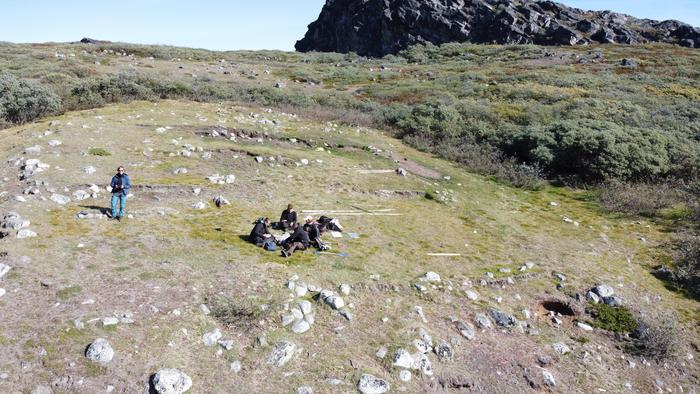
Greenland, with its vast icy expanses and challenging environment, harbors a rich tapestry of human history etched into its landscape over millennia. The island’s archaeological record tells tales of successive human inhabitations that have left behind more than just stories and artefacts; it preserves complex biological legacies embedded within ancient refuse deposits known as middens. These middens, essentially ancient domestic rubbish heaps composed of animal bones, excrement, mollusk shells, and various artefacts, offer not only archaeologists but also microbiologists a unique window into the past. Their frozen state in Arctic permafrost has allowed microbial communities trapped over thousands of years to persist, raising compelling questions about the nature and dynamics of these ancient microbial populations.
The study of microbial life within these middens is far more than a niche query; it intersects with pressing concerns about human health, ecosystem integrity, and the potentially resurging threats posed by ancient pathogens. As the Arctic warms at an alarming rate—currently estimated to be three to four times faster than the global average—the thawing permafrost raises fears that dormant microbes, including pathogens from bygone eras, might be released back into the environment. The microbial fingerprints preserved in these deposits chronicle past human and animal interactions, environmental conditions, and disease ecology, providing invaluable data to reconstruct historical microbiomes and understand their evolution through millennia.
In groundbreaking research reported recently in Frontiers in Microbiology, scientists led by Dr. Frank Møller Aarestrup of the Technical University of Denmark embarked on an ambitious project to characterize the microbial composition of Greenland’s archaeological middens. Their experimental approach involved rigorous sampling of frozen middens from multiple chronological layers spanning approximately 4,500 years of human history—from the earliest Paleo-Inuit cultures to medieval Norse settlers and early Danish colonists. Employing advanced DNA sequencing techniques and bioinformatics, the team reconstructed diverse and complex bacterial communities present in these ancient deposits and compared them with microbes from surrounding pristine permafrost soils, unperturbed by human activity.
One of the striking revelations from this study was the extraordinary microbial richness residing within the middens. From as few as nine to as many as 202 bacterial species per midden, the researchers identified an aggregate of 1,207 distinct bacterial species across all samples. Intriguingly, many species could not be identified beyond broad taxonomic categories, underscoring the vast unknown microbial diversity in Arctic archaeological contexts and the general paucity of data on cold-environment microbiomes. This discovery shines a light on the hidden microbial world preserved under layers of ice and soil, aspects that have remained largely unexplored until now.
The middens invariably featured richer bacterial communities than adjacent soils, affirming their role as biological archives chronicling the legacy of human presence and activity. Among the deposits, middens linked to the Paleo-Inuit exhibited bacterial compositions closely resembling natural soil communities, suggesting a fading microbial imprint over thousands of years. Conversely, Norse and colonial middens revealed bacterial assemblages heavily influenced by human-related waste, livestock farming, and domestic activities, evidencing the intimate connection between past humans, their animals, and local microbes.
Practically, these midden microbiomes hosted a variety of bacteria associated with human and animal hosts. Notably, the researchers detected species such as Clostridium massilliamazoniense, innocuous but indicative of human fecal matter presence, alongside more pathogenic taxa like Clostridium baratii, which can lead to botulism, and Paeniclostridium sordellii, linked to severe human illnesses including toxic shock syndrome and gas gangrene. Such findings highlight how midden microbial communities serve as time capsules, preserving signatures of diseases that may have affected historic populations, which hold relevance to the emerging field of paleomicrobiology.
Furthermore, the microbial composition differed markedly depending on the nature of the organic waste constituting each midden. Middens from Greenland’s early colonial era, particularly those in Nuuk containing decomposing seal skins, harbored Clostridium perfringens, a bacterium notorious for causing food poisoning. Meanwhile, middens filled with animal carcasses were dominated by gut bacteria such as Romboutsia species and Paraclostridium sordellii. Early Norse deposits, rich in decomposing bones, exhibited an abundance of unknown species within the Proteobacteria and Clostridiaceae groups. This substrate-specific microbial differentiation provides new perspectives on historic dietary patterns, hunting practices, and animal domestication in Greenland.
An essential aspect of the team’s work was the investigation of antimicrobial resistance (AMR) genes within these ancient bacterial genomes. The researchers uncovered a diverse array of resistance genes, demonstrating that ancient permafrost soils and middens contained bacteria equipped with antimicrobial defense mechanisms. The persistence of these genes in both ancient and modern soil layers indicates the long-term stability and environmental retention of genetic elements conferring antibiotic resistance, a critical insight into the evolutionary history of AMR and its environmental reservoirs. Despite this, spatial analyses suggested that upon thawing, microbes from the middens do not tend to disperse widely, limiting the risk of pathogen spread under current conditions.
Importantly, the authors emphasized that the immediate threat to public health from ancient pathogens emerging from Greenland’s thawing middens is currently low. Dr. Saria Otani, co-author and associate professor, noted that the microbiome released from melting permafrost appears to be rapidly outcompeted or replaced by contemporary environmental microbes, reducing opportunities for ancient pathogens to proliferate. Nonetheless, this dynamic balance could shift with accelerating climate warming, necessitating vigilant monitoring.
To that end, the researchers advocate for the incorporation of microbiome characterization into routine archaeological protocols during future excavations at permafrost sites. The spatially and temporally resolved microbial data obtained could serve as early warning markers for pathogen emergence and inform conservation strategies during the rapidly unfolding Arctic environmental transition. This interdisciplinary study brilliantly exemplifies how combining microbiology, archaeology, and environmental science can unlock secrets buried in ice and soil, informing both our understanding of the past and preparations for an uncertain microbial future.
This pioneering research hence sets a precedent for microbiome-informed archaeology, where the “dustbins of history” are not merely relics of human culture but bearers of ancient microbial life, antimicrobial resistance, and metabolic potential. By resolving these ancient microbial ecosystems, scientists are better positioned to trace human-animal-environment interactions across centuries and to anticipate the potential consequences of microbial releases driven by climate change.
As global temperatures continue their inexorable rise, the Arctic remains a hotspot for uncovering hidden biogeochemical dynamics playing out beneath melting permafrost. Greenland’s middens now stand as invaluable archives that illuminate the intertwined narratives of human migration, settlement, livestock domestication, and the microbial world shaped by these processes. The revelations from these frozen repositories reinforce a broader vision of archaeology enriched by microbial ecology, where ancient microbial communities provide vital clues for understanding human history, health, and environmental change on a planetary scale.
News Publication Date: 17-Jun-2026
Web References:
Frontiers in Microbiology Article
Cite Scienmag News
Morgan Morrow. (June 17, 2026). Ancient Microbes in Greenland’s Rubbish Heaps Reveal Insights into Old Farms, Seal Hunts, and Toilets. Scienmag. https://scienmag.com/ancient-microbes-in-greenlands-rubbish-heaps-reveal-insights-into-old-farms-seal-hunts-and-toilets/
Morgan Morrow. "Ancient Microbes in Greenland’s Rubbish Heaps Reveal Insights into Old Farms, Seal Hunts, and Toilets." Scienmag, 17 June 2026, https://scienmag.com/ancient-microbes-in-greenlands-rubbish-heaps-reveal-insights-into-old-farms-seal-hunts-and-toilets/. Accessed 3 September 2026.
Morgan Morrow. "Ancient Microbes in Greenland’s Rubbish Heaps Reveal Insights into Old Farms, Seal Hunts, and Toilets." Scienmag. June 17, 2026. https://scienmag.com/ancient-microbes-in-greenlands-rubbish-heaps-reveal-insights-into-old-farms-seal-hunts-and-toilets/


