


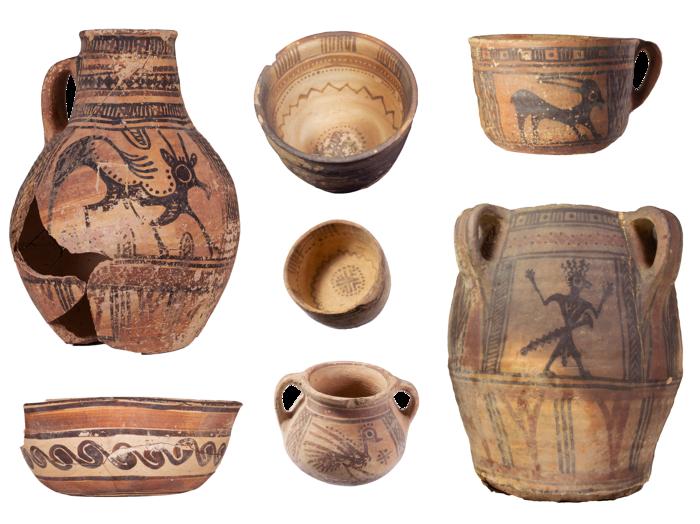
Archaeologists are rethinking the origins of branding after identifying Qurayyah Painted Ware, a distinctive class of 3,200-year-old ceramics from northwestern Arabia, as one of the ancient world’s earliest recognizable “brands.” The pottery is covered with highly controlled black-and-red geometric patterns, stylized animals and human figures that appear repeatedly across vessels produced in different places. A new study argues that these designs were not simply decorative preferences. Instead, they may have acted as a visual identity, allowing people to recognize, trust and seek out pottery linked to a particular community, production tradition or commercial network.
The research, published in PLOS One, examines the genesis, transformation and spread of Qurayyah Painted Ware, commonly called QPW. The ceramics were formerly known as “Midianite Pottery,” a label that implied a more specific cultural and geographic origin than the evidence could support. By combining archaeological analysis with the study of painted motifs, manufacturing techniques and distribution patterns, the researchers present QPW as a dynamic technological and social phenomenon rather than a static style. Their findings suggest that the pottery’s identity was created through repeated visual choices, transmitted through human movement and modified as it traveled across ancient Arabia and the wider Near East.
QPW emerged during the second millennium BCE, a period when long-distance exchange networks connected settlements across the Arabian Peninsula, the Levant and neighboring regions. The vessels were produced from clay, shaped and fired, then decorated with contrasting pigments in compositions that could include bands, triangles, zigzags, animals and human-like figures. The repeated use of these elements created a recognizable visual grammar. Although individual vessels were not identical, their shared design principles made them legible as members of the same ceramic tradition. That balance between consistency and variation is a central feature of modern brands as well: a product must be recognizable, while still allowing makers to adapt it to changing tastes and local conditions.
The researchers’ interpretation is based on more than surface appearance. Ceramic production involves a sequence of technical decisions, including the selection and preparation of clay, the addition of temper, vessel forming, surface treatment, painting and firing. Each step can leave microscopic or chemical traces. Differences in clay composition can reveal whether vessels were made locally or transported from another region, while firing conditions can indicate the technical knowledge available to potters. When these data are considered alongside stylistic similarities, archaeologists can distinguish between objects made in a single workshop, vessels produced by several communities following a shared model and items copied by people who encountered the style through trade or migration.
This distinction is crucial because the distribution of QPW is wider than would be expected for a narrowly localized household tradition. Similar painted ceramics appear across areas that were linked by routes through deserts, oases and coastal zones. The movement of the pottery may reflect the exchange of finished vessels, but it may also reflect the movement of potters, apprentices, recipes, pigments and design concepts. A visual tradition can spread without the original objects traveling very far if craftspeople carry the knowledge required to reproduce it. The study therefore treats QPW as evidence for networks of interaction rather than as a simple marker of one ethnic group or kingdom.
The concept of an ancient brand does not mean that QPW makers operated modern companies or used written trademarks. Branding, in the broader anthropological sense, involves creating a recognizable identity around goods, practices or producers. A repeated motif can communicate origin, quality, social affiliation or participation in a trusted exchange system. For an ancient consumer, a familiar painted pattern may have signaled that a vessel came from a known tradition or had been made according to valued standards. It might also have helped sellers distinguish their products in crowded marketplaces. The meaning of the designs cannot be recovered completely, but their repetition across time and space indicates that appearance carried information beyond decoration.
QPW also demonstrates how styles transform as they spread. Motifs may be simplified, rearranged or combined with local artistic conventions. Some communities may have reproduced the most recognizable features while changing vessel shapes or manufacturing methods. Others may have adopted the style to express their own identity, turning an imported visual language into something locally meaningful. Such processes are familiar in the history of fashion, graphic design and commercial products, but the archaeological record shows that they were already operating in Bronze Age societies. Innovation and imitation were not opposites; they worked together to keep the tradition recognizable while allowing it to evolve.
The study challenges older approaches that classified pottery primarily by where it was found or by assigning it to a single named people. Archaeological names can become powerful, but they may conceal complex histories of interaction. The former term “Midianite Pottery,” for example, encouraged interpretations centered on a specific cultural group, even though the vessels’ production and circulation may have involved multiple communities. Reframing the material as Qurayyah Painted Ware emphasizes the evidence from the archaeological record and avoids treating a widely distributed style as the property of one population. It also places greater attention on technological practices, exchange networks and the choices made by individual craftspeople.
Understanding QPW as an early brand could have implications beyond the history of pottery. It offers a way to study how people in the ancient Near East communicated value before mass production, standardized labels or written advertising. Objects could become socially powerful through recognizable combinations of material, technique and design. Their identities were reinforced each time a potter reproduced a pattern, a trader moved a vessel across a regional route or a consumer selected a familiar form. The researchers argue that this process helped create a durable ceramic identity that survived changes in location and use, providing a rare window into how visual signals shaped economic and cultural behavior thousands of years ago.
The findings also highlight the importance of studying ancient Arabia as an active center of innovation and connectivity. Rather than existing at the margins of better-known civilizations, Arabian communities participated in technological exchange and long-distance communication on a substantial scale. QPW records those connections in paint, clay and fire. Future analyses combining compositional chemistry, microscopy, digital documentation and spatial modeling may clarify where different vessels were produced and how their designs moved between settlements. For now, the pottery suggests that one of the earliest forms of branding did not depend on writing or formal corporate structures. It depended on a memorable image, a skilled production tradition and a network of people willing to carry that identity across the ancient world.
News Publication Date: 19-Aug-2026
Web References: https://plos.io/4hkmlXu; https://doi.org/10.1371/journal.pone.0351296
References: PLOS One article, DOI: 10.1371/journal.pone.0351296
Cite Scienmag News
Courtney Benton. (August 19, 2026). 3,200-Year-Old Qurayyah Pottery May Represent One of Antiquity’s Earliest Brands. Scienmag. https://scienmag.com/3200-year-old-qurayyah-pottery-may-represent-one-of-antiquitys-earliest-brands/
Courtney Benton. "3,200-Year-Old Qurayyah Pottery May Represent One of Antiquity’s Earliest Brands." Scienmag, 19 August 2026, https://scienmag.com/3200-year-old-qurayyah-pottery-may-represent-one-of-antiquitys-earliest-brands/. Accessed 4 September 2026.
Courtney Benton. "3,200-Year-Old Qurayyah Pottery May Represent One of Antiquity’s Earliest Brands." Scienmag. August 19, 2026. https://scienmag.com/3200-year-old-qurayyah-pottery-may-represent-one-of-antiquitys-earliest-brands/


