


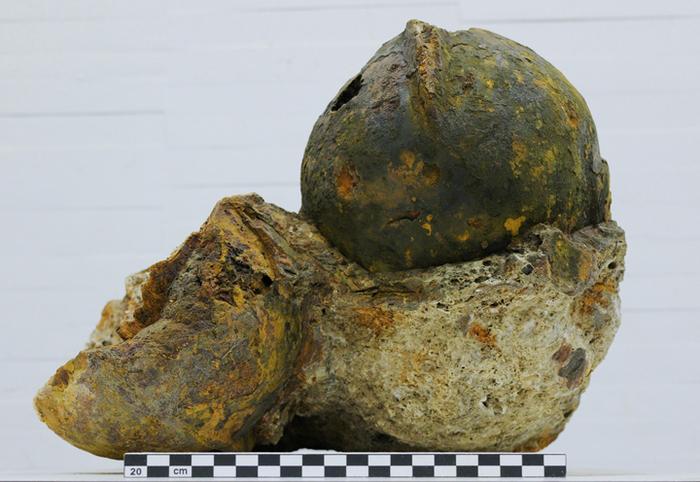
A remarkable underwater archaeological discovery off the coast of Benicarló, Spain, has rewritten our understanding of medieval military trade in the western Mediterranean. For over thirty years, a collection of 43 helmets recovered from the Piedras de la Barbada site was mistakenly thought to belong to the Roman era. Recent scientific investigations, however, spearheaded by the University of Alicante, have revealed that these artifacts date back to the late 14th and early 15th centuries, shedding new light on complex commercial and military networks operational during the Late Medieval period.
This assemblage of medieval helmets, uncovered initially in 1990 by local fishermen who accidentally caught metallic blocks in their nets, is the largest hoard of its kind ever found in the western Mediterranean. The profound importance of this find lies not merely in its quantity but in its demonstration of sophisticated arms trading routes linking the Valencian coast with prominent mercantile hubs such as Genoa. Genoa was a dominant maritime power during the time, and this shipment is indicative of meticulously structured commercial exchanges that included military equipment as integral cargo.
The study, published in the renowned Cambridge University Press journal Antiquity, was led by doctoral candidate Manuel Frallicciardi, who conducted the research under joint supervision by the universities of Alicante and Salerno. Using advanced analytical methodologies developed at the University of Alicante—techniques previously unexploited in the study of medieval weaponry—researchers applied a combination of radiocarbon dating and textile analysis to precisely determine the chronology and origin of the helmets. Textile remnants embedded within the helmets acted as key biomarkers, enabling the verification of their Late Medieval provenance.
Early hypotheses struggled to pinpoint the helmets’ origins due to their hybrid features. Some bore resemblances to both Late Roman and medieval designs, hinting at a transitional technological phase only sparsely documented in historical records. This ambiguity led the team on a comprehensive comparative analysis, exploring iconographic sources across European contexts, particularly 14th-century England, without finding exact analogues. Ultimately, carbon-14 dating placed manufacture firmly in the late 1300s to early 1400s timeframe, overturning the entrenched assumption that these helmets were Roman relics.
The hypothesis drawn from the archaeological context and preservation state suggests that this cache was a single shipment lost during maritime loading or unloading. The incident likely occurred near a shallow jetty area, at a depth of approximately six meters. The helmets’ preservation is exceptional, preserved by a combination of marine concretions and sediment that encrusted the iron, preventing decay. Remarkably, these concretions sealed the organic textiles lining the helmets’ interiors, creating stable micro-environments that halted the natural deterioration processes and allowed for the breakthrough radiocarbon analyses essential to this study.
Archaeological interpretation extends beyond mere typology, revealing profound socio-political dynamics of the Late Medieval Mediterranean. During the 14th century, the Valencia coast experienced increased threats due to the expansion of Islamic piracy and general maritime insecurity. This surge in hostility spurred the militarization of coastal defenses, heightening the demand for arms. The helmets in this cache likely belonged to shipments destined either for local militias, military orders within the Kingdom of Valencia, or hired armed companies engaged in frontier protection, underscoring the militarized commercial climate of the period.
The findings emphasize not only the technological evolution of medieval armaments but also the commercial sophistication underlying arms distribution networks. Through the lenses of archaeological science and historical inquiry, the University of Alicante team revealed that arms trading in the Mediterranean was tightly integrated with broader mercantile circuits. These routes connected diverse regions, allowing for the transfer of military equipment alongside other goods—a reality that challenges simplistic conceptions of medieval commerce and warfare as separate spheres.
Manuel Frallicciardi’s detailed examination revealed that the helmet typology represents a fleeting technological phase, seemingly a dead-end in the evolution of military headgear, lacking any discernible descendants in later periods. This shapes a compelling narrative of transitions within medieval military technology, where some innovations flourished while others vanished into obscurity. The discovery thus contributes to filling a significant gap in late medieval military archaeology, illustrating complex processes of innovation, adoption, and abandonment in armor design.
The maritime accident that led to the helmets sinking provides a unique temporal capsule. The helmets remained hidden beneath layers of marine sediment for centuries before their serendipitous recovery disrupted historical assumptions. This accidental preservation highlights the critical importance of underwater archaeological sites in understanding past commercial and military interactions that leave minimal traces in terrestrial records. The findings further advocate for protective, scientific exploration of submerged cultural heritage to uncover other lost chapters in Mediterranean history.
Further interdisciplinary collaboration between archaeologists, historians, materials scientists, and textile experts proved crucial to the success of the investigation. By leveraging cutting-edge analytical technologies alongside traditional archaeological methods, the team reconstructed not only the helmets’ provenance but also the broader narrative of arms trading and warfare readiness in a turbulent medieval Mediterranean environment characterized by piracy, political fragmentation, and evolving military demands.
This innovative study exemplifies the transformative potential of employing multidisciplinary approaches to revisiting long-standing archaeological collections. It underscores the necessity of integrating scientific innovation with historically informed frameworks to generate holistic insights, revising established chronologies and cultural attributions. Ultimately, the Benicarló helmets challenge entrenched narratives while opening new avenues for understanding commerce, conflict, and material culture in Late Medieval European history.
The integration of textile analysis into artifact studies represents a pioneering aspect of the research, given the rarity of preserved organic materials in marine archaeological contexts. These textile remnants reveal not only dating information but also production techniques and regional textile traditions, thereby enriching our understanding of medieval military attire and manufacturing processes. The presence of well-preserved fabrics within the helmets marks an extraordinary archaeological stroke, offering a layered perspective on armament use, maintenance, and cultural symbolism.
The discovery underscores the importance of Mediterranean maritime routes as vectors of military and commercial connectivity during the Late Medieval period. It reflects a socio-economic landscape where warfare and trade were deeply intertwined, with military equipment acting as both commodity and strategic resource. This integrated view challenges simplistic dichotomies, portraying the Mediterranean as a dynamic arena of interaction where merchants, military forces, and local powers intersected through complex, reciprocal relations evidenced in artifacts like these helmets.
The Benicarló helmets find inject fresh perspectives into medieval Mediterranean history, illustrating how archival silences can be counterbalanced by scientific inquiry into material culture. As these rigorously dated artifacts redefine regional military history, they invite a reevaluation of Mediterranean commercial patterns, piracy countermeasures, and late medieval military innovations, encouraging historians and archaeologists alike to reconsider narratives shaped by incomplete evidence.
News Publication Date: Not specified in the provided content.
Web References:
Cite Scienmag News
Courtney Benton. (June 5, 2026). University of Alicante Uncovers Groundbreaking Mediterranean Archaeological Find. Scienmag. https://scienmag.com/university-of-alicante-uncovers-groundbreaking-mediterranean-archaeological-find/
Courtney Benton. "University of Alicante Uncovers Groundbreaking Mediterranean Archaeological Find." Scienmag, 5 June 2026, https://scienmag.com/university-of-alicante-uncovers-groundbreaking-mediterranean-archaeological-find/. Accessed 3 September 2026.
Courtney Benton. "University of Alicante Uncovers Groundbreaking Mediterranean Archaeological Find." Scienmag. June 5, 2026. https://scienmag.com/university-of-alicante-uncovers-groundbreaking-mediterranean-archaeological-find/


