

Monday, July 27, 2026
Science
No Result
View All Result
  • Login
  • HOME
  • SCIENCE NEWS
  • CONTACT US
  • HOME
  • SCIENCE NEWS
  • CONTACT US
No Result
View All Result
Scienmag
No Result
View All Result
Home Science News Medicine

PIN1 boosts YAP1 SUMOylation and blocks ferroptosis through autophagy-driven ACSL4 degradation in cervical cancer

July 27, 2026
in Medicine
Reading Time: 2 mins read
0
PIN1 boosts YAP1 SUMOylation and blocks ferroptosis through autophagy-driven ACSL4 degradation in cervical cancer

PIN1 boosts YAP1 SUMOylation and blocks ferroptosis through autophagy-driven ACSL4 degradation in cervical cancer

65
SHARES
587
VIEWS
Share on FacebookShare on Twitter
ADVERTISEMENT

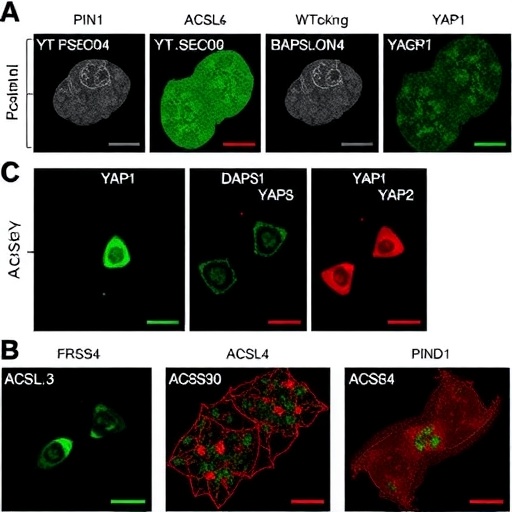
In a new study published in Cell Death Discovery, researchers report that the prolyl isomerase PIN1 can tip the balance between survival and death in cervical cancer cells. The work connects three molecular themes—YAP1 regulation, ferroptosis suppression, and lipid metabolic control—into a single mechanistic storyline.

At the center is YAP1, a transcriptional co-activator widely implicated in tumor progression. The authors show that PIN1 increases the SUMOylation of YAP1, a reversible post-translational modification that can alter protein stability, subcellular dynamics, and transcriptional output. By strengthening YAP1 SUMOylation, PIN1 appears to reshape downstream signaling programs linked to aggressive growth.

But the study’s most striking finding concerns ferroptosis, an iron-dependent, lipid peroxidation–driven form of cell death. Cervical cancer cells treated or conditioned under ferroptosis-relevant stress typically undergo membrane damage marked by lethal accumulation of lipid reactive oxygen species. Here, PIN1 acts as a brake, lowering susceptibility to ferroptosis.

The pathway the team proposes involves autophagy, the cellular “recycling” machinery. Instead of directly neutralizing lipid radicals, PIN1 indirectly reduces the availability of a key lipid enzyme that fuels ferroptosis vulnerability. Specifically, autophagy-dependent turnover leads to degradation of ACSL4, an acyl-CoA synthetase that promotes incorporation of polyunsaturated fatty acids into membranes—substrates that are readily oxidized during ferroptosis.

Mechanistically, the data support a model in which PIN1-driven SUMOylation events help establish conditions that promote autophagic targeting of ACSL4. When ACSL4 levels fall, the cellular membrane lipid landscape becomes less permissive for the oxidative chemistry required to execute ferroptosis.

Importantly, the authors connect this molecular axis to functional outcomes in cervical cancer contexts, using cellular assays designed to track ferroptosis hallmarks and viability changes. Together, the results suggest that PIN1 is not merely associated with tumor phenotypes but actively orchestrates a protective death-resistance mechanism.

The findings also raise the possibility that targeting PIN1 could re-sensitize cervical tumors to ferroptosis-inducing therapies. If PIN1 can be inhibited to restore ACSL4 abundance and lipid peroxidation capacity, therapeutic strategies may shift from generic stress induction to pathway-specific vulnerabilities.

For viral science news readers, the message is clear: PIN1 acts at the crossroads of post-translational regulation and metabolic death control. By enhancing SUMOylation of YAP1 and triggering autophagy-dependent degradation of ACSL4, PIN1 creates a ferroptosis-resistant cellular state. The study therefore identifies a promising molecular lever for future translational work.

Subject of Research: PIN1-mediated regulation of YAP1 SUMOylation and ferroptosis control in cervical cancer
Article Title: PIN1 enhances SUMOylation of YAP1 and inhibits ferroptosis via autophagy-dependent degradation of ACSL4 in cervical cancer.
Article References: Liao, D., Shi, L., Cui, Y. et al. Cell Death Discovery (2026). https://doi.org/10.1038/s41420-026-03257-x
Image Credits: AI Generated
DOI: https://doi.org/10.1038/s41420-026-03257-x

Tags: ACSL4 role in ferroptosisautophagy and lipid enzyme regulationautophagy-mediated protein degradationcervical cancerferroptosis inhibition in cancer cellslipid metabolism in cancermolecular mechanisms of cervical cancer survivalPIN1 protein function in cancerpost-translational modifications in cancer signalingprotein SUMOylation and tumor growthtargeting ferroptosis in cancer therapyYAP1 regulation in tumor progression
Share26Tweet16
Previous Post

Trisomy 13 and 18 Patient Outcomes in a Center With Perinatal Palliative Care Program

Next Post

Immunogenicity and Safety of BNT162b2 in Juvenile Immune-Mediated Inflammatory Disease Patients

Related Posts

AI Redesigns Starting Conditions to Improve Protein Evolution Outcomes
Medicine

AI Redesigns Starting Conditions to Improve Protein Evolution Outcomes

July 27, 2026
Multicenter Large Language Model Predicts Acute Kidney Injury and Explains Risk
Medicine

Multicenter Large Language Model Predicts Acute Kidney Injury and Explains Risk

July 27, 2026
Trisomy 13 and 18 Patient Outcomes in a Center With Perinatal Palliative Care Program
Medicine

Trisomy 13 and 18 Patient Outcomes in a Center With Perinatal Palliative Care Program

July 27, 2026
Altered heart-brain communication in awake patients with isolated REM sleep behavior disorder
Medicine

Altered heart-brain communication in awake patients with isolated REM sleep behavior disorder

July 27, 2026
Preoperative Model Predicts In-Hospital Major Cardiovascular Events After Hip Fracture Surgery
Medicine

Preoperative Model Predicts In-Hospital Major Cardiovascular Events After Hip Fracture Surgery

July 27, 2026
Recombinant Interleukin-11 Prolonged Therapy Linked to Cardiac Effects in Severe Thrombocytopenia
Medicine

Recombinant Interleukin-11 Prolonged Therapy Linked to Cardiac Effects in Severe Thrombocytopenia

July 27, 2026
Next Post
Immunogenicity and Safety of BNT162b2 in Juvenile Immune-Mediated Inflammatory Disease Patients

Immunogenicity and Safety of BNT162b2 in Juvenile Immune-Mediated Inflammatory Disease Patients

  • Mothers who receive childcare support from maternal grandparents show more

    Mothers who receive childcare support from maternal grandparents show more parental warmth, finds NTU Singapore study

    27656 shares
    Share 11059 Tweet 6912
  • University of Seville Breaks 120-Year-Old Mystery, Revises a Key Einstein Concept

    1061 shares
    Share 424 Tweet 265
  • Bee body mass, pathogens and local climate influence heat tolerance

    682 shares
    Share 273 Tweet 171
  • Researchers record first-ever images and data of a shark experiencing a boat strike

    546 shares
    Share 218 Tweet 137
  • Groundbreaking Clinical Trial Reveals Lubiprostone Enhances Kidney Function

    531 shares
    Share 212 Tweet 133
Science

Embark on a thrilling journey of discovery with Scienmag.com—your ultimate source for cutting-edge breakthroughs. Immerse yourself in a world where curiosity knows no limits and tomorrow’s possibilities become today’s reality!

RECENT NEWS

  • AI Redesigns Starting Conditions to Improve Protein Evolution Outcomes
  • Gate-Tunable Mid-Infrared Electroluminescence via Te/MoS2 p-n Heterojunctions
  • High-Throughput Chip Delivers Full-Frequency Encoded Illumination Super-Resolution Imaging
  • Lifestyle Factors and BrainAGE Linked to Depression in Adults

Categories

  • Agriculture
  • Anthropology
  • Archaeology
  • Athmospheric
  • Biology
  • Biotechnology
  • Blog
  • Bussines
  • Cancer
  • Chemistry
  • Climate
  • Earth Science
  • Editorial Policy
  • Marine
  • Mathematics
  • Medicine
  • Pediatry
  • Policy
  • Psychology & Psychiatry
  • Science Education
  • Social Science
  • Space
  • Technology and Engineering

Subscribe to Blog via Email

Enter your email address to subscribe to this blog and receive notifications of new posts by email.

Join 5,146 other subscribers

© 2025 Scienmag - Science Magazine

Welcome Back!

Login to your account below

Forgotten Password?

Retrieve your password

Please enter your username or email address to reset your password.

Log In
No Result
View All Result
  • HOME
  • SCIENCE NEWS
  • CONTACT US

© 2025 Scienmag - Science Magazine

Discover more from Science

Subscribe now to keep reading and get access to the full archive.

Continue reading
