


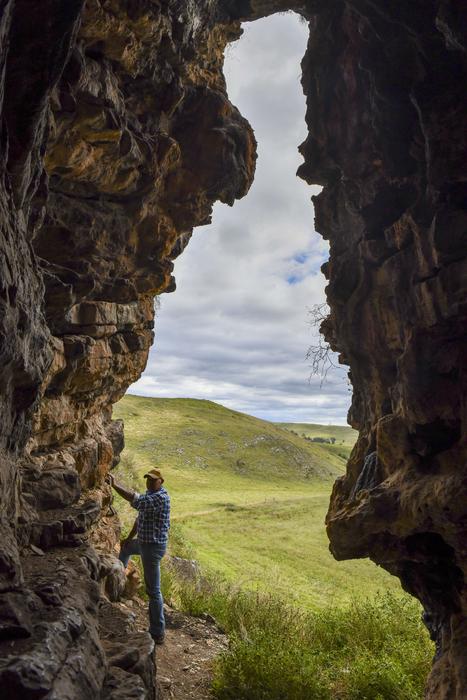
GunaiKurnai peoples, the recognized Traditional Owners of Gippsland and the southern Victorian Alps, have long described caves in their Country as places where powerful practitioners performed ritual magic, healing, and protective or harmful ceremonies. Now, new archaeological evidence from Cloggs Cave adds material detail to those oral histories—showing how plant material was intentionally gathered and burned inside the cave for tens of millennia.
The study, led by Dr Elle Grono of the Australian National University, analyzed phytoliths: microscopic silica structures formed within plant tissues and preserved in sediments. Because phytoliths generally accumulate where plants decay—while no plants grow in the cave due to lack of light—the researchers could infer that the silica traces must have been brought in by people, or possibly by animals moving plant material into the site.
To distinguish human activity from other pathways, the team focused on half-burnt phytoliths embedded in ashy layers. Such partially combusted signatures are unlikely to originate from wind- or insect-dispersed pollen and, importantly, could not easily result from non-human deposition for the same reasons.
Excavations in 2019 and 2020 produced two deep pits, dated using optically stimulated luminescence and accelerator mass spectrometry carbon dating. The upper strata contained dozens of thin ashy layers laid down between roughly 4,400 and 1,600 years ago. Within this sequence, researchers identified an unexpected 28-centimeter-tall standing stone erected by “Old Ancestors” for ritual purposes around 2,000 years ago.
Across the deposits, 29 phytolith types were identified from grasses, herbs, and woody plants. Grasses dominated overwhelmingly, with the largest share coming from Pooideae and Panicoideae—plant groups associated with temperate/cool and warm/humid environments respectively. Drought-tolerant Chloridoideae grasses appeared less frequently, while woody plants and herbs were rare.
Crucially, the phytoliths reflected selective harvesting: different parts of entire grass plants—stems, leaves, flowers, and even roots—were deposited, indicating whole plants (including inedible components) were brought into the cave rather than only discarded fragments.
Nearly a fifth of the recovered phytoliths were burnt or melted, and their presence throughout the dated sequence suggests that plant burning was practiced repeatedly across the past 25,000 years. The findings imply sustained ritual activity rather than a single event.
The results also align with GunaiKurnai traditional uses of ash in magic and ceremony, including methods described for marking or tracking presence, and they complement other botanical traces—such as fat-smeared trimmed wooden sticks from Casuarina—in older layers.
Overall, the work provides a high-resolution botanical map of ritual plant processing at Cloggs Cave, transforming long-held cultural accounts into testable evidence written in silica.
Cite Scienmag News
Courtney Benton. (July 27, 2026). Australian Cave Finds Evidence of 25,000-Year Grass Burning for Rituals. Scienmag. https://scienmag.com/australian-cave-finds-evidence-of-25000-year-grass-burning-for-rituals/
Courtney Benton. "Australian Cave Finds Evidence of 25,000-Year Grass Burning for Rituals." Scienmag, 27 July 2026, https://scienmag.com/australian-cave-finds-evidence-of-25000-year-grass-burning-for-rituals/. Accessed 3 September 2026.
Courtney Benton. "Australian Cave Finds Evidence of 25,000-Year Grass Burning for Rituals." Scienmag. July 27, 2026. https://scienmag.com/australian-cave-finds-evidence-of-25000-year-grass-burning-for-rituals/


