

Monday, July 27, 2026
Science
No Result
View All Result
  • Login
  • HOME
  • SCIENCE NEWS
  • CONTACT US
  • HOME
  • SCIENCE NEWS
  • CONTACT US
No Result
View All Result
Scienmag
No Result
View All Result
Home Science News Athmospheric

Adaptive ionosphere uncertainty maps improve fast, reliable GNSS positioning

July 27, 2026
in Athmospheric
Reading Time: 2 mins read
0
Adaptive ionosphere uncertainty maps improve fast, reliable GNSS positioning

Adaptive ionosphere uncertainty maps improve fast, reliable GNSS positioning

65
SHARES
587
VIEWS
Share on FacebookShare on Twitter
ADVERTISEMENT

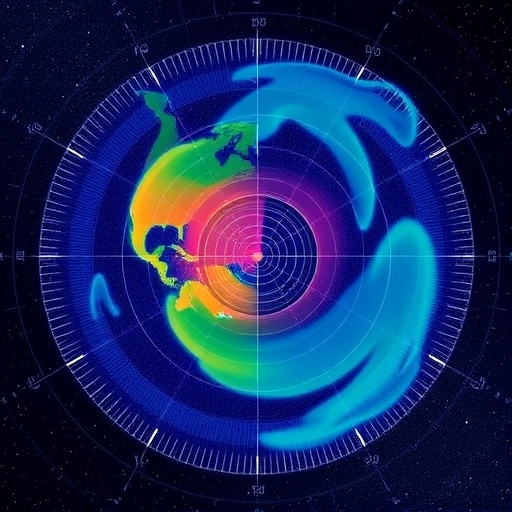
A breakthrough for satellite navigation is emerging from an unexpected bottleneck: the way Global Ionospheric Maps (GIMs) quantify uncertainty. Researchers have shown that the RMS layers bundled with GIM products often fail to match the real, messy behavior of ionospheric correction errors—errors that can be heavy‑tailed, spatially uneven, and peppered with repeatable sub‑daily signals.

The new approach, Factor-Adjusted Ionospheric Residual Statistics (FAIRS), targets a core problem in ionosphere modeling. Ionospheric Associated Analysis Centers (IAACs) generate GIM accuracy products using different algorithms and assumptions. Some uncertainties reflect only internal fitting performance and can understate risk, while others are overinflated so much that they lose value for high‑precision users.

To build a more trustworthy uncertainty model, the team examined unmodeled ionospheric errors across multiple rapid GIM products. Using observations from 26 globally distributed IGS stations between 2016 and 2021, they extracted Total Electron Content (TEC) via Carrier-to-Code Leveling (CCL), then aligned map values with each observation through spatial and temporal interpolation.

The residuals revealed a familiar but dangerous pattern: values were often bounded within about −5 to 5 TECU, yet the distributions were symmetric and leptokurtic—far from Gaussian. After filtering extreme outliers at three standard deviations, the central residual behavior could be approximated as normal, but the tails remained a major determinant of reliability.

FAIRS goes further by diagnosing structure in the errors. Spectral and variance analyses (including FFT and Allan variance) identified deterministic components tied to fractions of a day (one‑sixth, one‑third, and two‑thirds), alongside shifting noise regimes. The method then scales uncertainty using distribution-aware metrics such as skewness and kurtosis, guided by residual statistics around ionospheric pierce points.

Crucially, FAIRS adapts to where observations exist. It distinguishes monitored grid points—where nearby GNSS observations support responsive updates—from unmonitored regions, where conservative uncertainty estimates are retained rather than smoothed into uniform “one size fits all” maps.

Validation using the Ionospheric Error-Accuracy Diagram and RMS Bounding Percentage metrics showed strong coverage performance. For slant TEC residuals, coverage reached 81.78% within one RMS bound, 96.85% within two RMS bounds, and 98.96% within three. For differential slant TEC (dSTEC), coverage climbed even higher, reaching 97.96%, 98.96%, and 99.04% respectively.

In ionosphere-constrained Precise Point Positioning (PPP), FAIRS-based weighting improved early positioning behavior and accelerated convergence under both quiet and geomagnetically active conditions, while maintaining dependable uncertainty bounds. The authors emphasize that the key advance is not merely inflating numbers, but making RMS maps react to real ionospheric behavior and observation density.

Looking ahead, the team plans to test FAIRS with multi-GNSS and multi-frequency data and explore extensions such as adaptive smoothing and dynamic parameter tuning for better TEC modeling in real time. If adopted broadly, uncertainty maps could become a more active component of positioning decisions—boosting trust and performance for everything from surveying to autonomous navigation.


Subject of Research:
Ionosphere; GNSS ionospheric RMS mapping; uncertainty modeling

Article Title:
FAIRS: a factor-adjusted ionospheric residual statistics approach for global ionospheric RMS mapping

News Publication Date:
15-Jul-2026

Web References:
https://link.springer.com/article/10.1186/s43020-026-00209-9

References:
DOI: 10.1186/s43020-026-00209-9

Image Credits:
Not provided

Keywords:
GNSS, GIM, ionospheric uncertainty, RMS mapping, TEC, PPP, residual statistics, FAIRS, heavy tails, pierce points

Tags: Factor-Adjusted Ionospheric Residual Statistics (FAIRS)Global Ionospheric Map uncertainty modelingGNSS positioning accuracy enhancementhigh-precision satellite navigationionosphere correction error analysisionosphere modeling improvementsionospheric error characterizationionospheric uncertainty quantificationreal-time GNSS correction risk managementspatial-temporal interpolation of TECTEC residual analysisunmodeled ionospheric error patterns
Share26Tweet16
Previous Post

Researchers Thwart Hidden Resume Hacks Targeting AI Hiring Tools

Next Post

Australian Cave Finds Evidence of 25,000-Year Grass Burning for Rituals

Related Posts

Study Finds Marine Heatwaves Driven by Hotter, Longer Conditions
Athmospheric

Study Finds Marine Heatwaves Driven by Hotter, Longer Conditions

July 27, 2026
Biochar Makes Green Roofs Potent Methane Sinks
Athmospheric

Biochar Makes Green Roofs Potent Methane Sinks

July 27, 2026
Why River Management Is Vital to Protecting a World-Important Wetland
Athmospheric

Why River Management Is Vital to Protecting a World-Important Wetland

July 27, 2026
Youth and Aging Populations Drive Global Dietary Emissions
Athmospheric

Youth and Aging Populations Drive Global Dietary Emissions

July 26, 2026
Teen diets boost emissions; older adults drive global climate surge
Athmospheric

Teen diets boost emissions; older adults drive global climate surge

July 26, 2026
Local rules reshape global emissions: unintended carbon costs of livestock-free zones
Athmospheric

Local rules reshape global emissions: unintended carbon costs of livestock-free zones

July 26, 2026
Next Post
Australian Cave Finds Evidence of 25,000-Year Grass Burning for Rituals

Australian Cave Finds Evidence of 25,000-Year Grass Burning for Rituals

  • Mothers who receive childcare support from maternal grandparents show more

    Mothers who receive childcare support from maternal grandparents show more parental warmth, finds NTU Singapore study

    27656 shares
    Share 11059 Tweet 6912
  • University of Seville Breaks 120-Year-Old Mystery, Revises a Key Einstein Concept

    1061 shares
    Share 424 Tweet 265
  • Bee body mass, pathogens and local climate influence heat tolerance

    682 shares
    Share 273 Tweet 171
  • Researchers record first-ever images and data of a shark experiencing a boat strike

    546 shares
    Share 218 Tweet 137
  • Groundbreaking Clinical Trial Reveals Lubiprostone Enhances Kidney Function

    531 shares
    Share 212 Tweet 133
Science

Embark on a thrilling journey of discovery with Scienmag.com—your ultimate source for cutting-edge breakthroughs. Immerse yourself in a world where curiosity knows no limits and tomorrow’s possibilities become today’s reality!

RECENT NEWS

  • Link Between Carotid Hemodynamics and Cerebral Blood Flow in Early Simulated Microgravity
  • Wearable ring monitors glucose and ketones in sweat simultaneously
  • Two Cancer Signaling Pathways Enable More Personalized Treatment for Papillary Thyroid Cancer
  • Fabric Enables Multiple Stable Shapes Using Snap-Like Structural Design

Categories

  • Agriculture
  • Anthropology
  • Archaeology
  • Athmospheric
  • Biology
  • Biotechnology
  • Blog
  • Bussines
  • Cancer
  • Chemistry
  • Climate
  • Earth Science
  • Editorial Policy
  • Marine
  • Mathematics
  • Medicine
  • Pediatry
  • Policy
  • Psychology & Psychiatry
  • Science Education
  • Social Science
  • Space
  • Technology and Engineering

Subscribe to Blog via Email

Enter your email address to subscribe to this blog and receive notifications of new posts by email.

Join 5,146 other subscribers

© 2025 Scienmag - Science Magazine

Welcome Back!

Login to your account below

Forgotten Password?

Retrieve your password

Please enter your username or email address to reset your password.

Log In
No Result
View All Result
  • HOME
  • SCIENCE NEWS
  • CONTACT US

© 2025 Scienmag - Science Magazine

Discover more from Science

Subscribe now to keep reading and get access to the full archive.

Continue reading
