


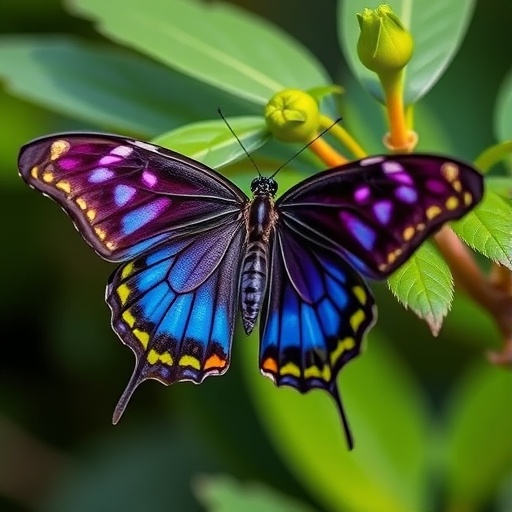
In the ever-changing realms of the Peruvian Amazon, a groundbreaking study reveals that nymphalid butterflies are exhibiting an extraordinary evolutionary response to climate variability, reshaping our understanding of reproductive adaptation in tropical insects. This research, led by PhD candidate Marcus Hicks from Queen Mary University of London, unveils how these butterflies modulate their reproductive strategies in tune with seasonal extremes, highlighting the subtle interplay between environment and biology that may dictate species resilience amid escalating climate disruption.
The Amazon basin, often perceived as a humid and stable environment, paradoxically experiences marked wet and dry seasons. Despite the region’s ecological complexity, the adaptive responses of its insect fauna to such pronounced seasonality have, until now, remained immensely underexplored. Hicks and his collaborators, drawing expertise from institutions across Peru, Sweden, and the United Kingdom, embarked on an in-depth investigation of brush-footed butterflies (family Nymphalidae), specifically focusing on two species within the genus Catonephele.
Central to this inquiry is the concept of seasonal reproductive plasticity, an adaptive mechanism wherein non-genetic factors—such as fluctuating ambient temperatures—trigger alterations in an organism’s reproductive timing and output without changes to its DNA sequence. Unlike rigid genetically encoded behaviors, plastic responses offer phenotypic flexibility that can be crucial for survival in heterogeneous landscapes. This study elucidates how such plasticity operates within neotropical contexts previously thought to exhibit less dramatic seasonal cues compared to temperate zones.
Detailed phenological observations and reproductive assessments disclosed that both butterfly species diminish egg production during prolonged dry spells. However, intriguingly, only one species enters a reproductive diapause state — a form of temporary reproductive shutdown marked by halted oogenesis and reduced copulation activities. The other species, in stark contrast, continues mating and producing offspring, albeit at attenuated levels. This divergence suggests species-specific evolutionary strategies finely attuned to microclimatic conditions and ecological niches within the rainforest.
These reproductive behaviors appear intricately linked to the maximum daily temperature, a pivotal environmental cue that governs developmental and behavioral outcomes even among phylogenetically proximate species. The disparity in response underscores a sophisticated ecological hedging strategy, wherein populations maintain reproductive heterogeneity to buffer against unpredictable and fluctuating environmental conditions. This phenomenon may confer resilience by distributing reproductive effort temporally, reducing the risk of total reproductive failure during adverse periods.
Such a spectrum of reproductive tactics within a single butterfly community challenges prevailing assumptions based primarily on temperate models where diapause is nearly absolute during colder months. In tropical species, this mixed strategy could represent an adaptive bet-hedging mechanism aimed at optimizing fitness under increasingly variable hydrological and thermal regimes. By “playing both sides,” butterflies effectively insurance against the vagaries of an evolving climate, a testament to the nuanced and multifaceted nature of biological adaptation.
Beyond expanding our fundamental understanding of insect life histories in tropical rainforests, these findings carry profound implications for predicting ecological trajectories under climate change. Given the Amazon’s role as a global biodiversity hotspot and its influence on planetary climate systems, discerning how keystone taxa like insects respond to environmental pressures is vital. Insects are ecosystem engineers and pollinators, and their reproductive success underpins broader trophic dynamics and ecosystem stability.
Furthermore, shifts in seasonal timing and reproductive output reverberate through population dynamics, potentially affecting species interactions, community compositions, and evolutionary pathways. As anthropogenic pressures continue to modulate temperature patterns and rainfall seasonality, such plasticity could determine the adaptive potential or vulnerability of tropical insect populations. This work thus signals an urgent call for expanded longitudinal studies integrating climate models, ecological monitoring, and mechanistic biology.
Commenting on these revelations, Hicks emphasizes the significance of recognizing intra-population variability in reproductive strategies, cautioning against oversimplified models of tropical insect biology. He advocates for an integrative perspective that appreciates environmental complexity and biological nuance, essential for building robust conservation strategies amid uncertain climatic futures. Co-author Jamal Kabir highlights the increasing necessity for understanding tropical insect responses as climate-related perturbations intensify across global ecosystems.
Published in the esteemed journal Ecology Letters, this research embodies a pivotal advancement in tropical ecology. It bridges critical knowledge gaps about how climate-driven seasonality shapes insect phenotypes and behaviors in one of Earth’s most biodiverse regions. The study’s insights not only illuminate ecological and evolutionary mechanisms but also serve as a foundation for proactive environmental stewardship in the Anthropocene.
As scientists continue to unravel the delicate threads linking climate, behavior, and survival in tropical insects, the Amazon’s vibrant butterfly populations emerge as both sentinels and specialists, narrating stories of resilience and adaptation that resonate far beyond the rainforest canopy. Their dynamic reproductive strategies epitomize life’s enduring capacity to confront change, offering hope and guidance for safeguarding ecological integrity in an increasingly unstable world.
News Publication Date: 25-May-2026
Web References: http://dx.doi.org/10.1111/ele.70401
References: Hicks, M., Oostra, V., et al. (2026). Evolution of Reproductive Plasticity in a Seasonal Tropical Environment. Ecology Letters. https://doi.org/10.1111/ele.70401
Cite Scienmag News
Gavin Prescott. (May 26, 2026). Tropical Butterflies Use Diverse Mating Strategies to Adapt to Extreme Seasonal Changes. Scienmag. https://scienmag.com/tropical-butterflies-use-diverse-mating-strategies-to-adapt-to-extreme-seasonal-changes/
Gavin Prescott. "Tropical Butterflies Use Diverse Mating Strategies to Adapt to Extreme Seasonal Changes." Scienmag, 26 May 2026, https://scienmag.com/tropical-butterflies-use-diverse-mating-strategies-to-adapt-to-extreme-seasonal-changes/. Accessed 4 September 2026.
Gavin Prescott. "Tropical Butterflies Use Diverse Mating Strategies to Adapt to Extreme Seasonal Changes." Scienmag. May 26, 2026. https://scienmag.com/tropical-butterflies-use-diverse-mating-strategies-to-adapt-to-extreme-seasonal-changes/


