


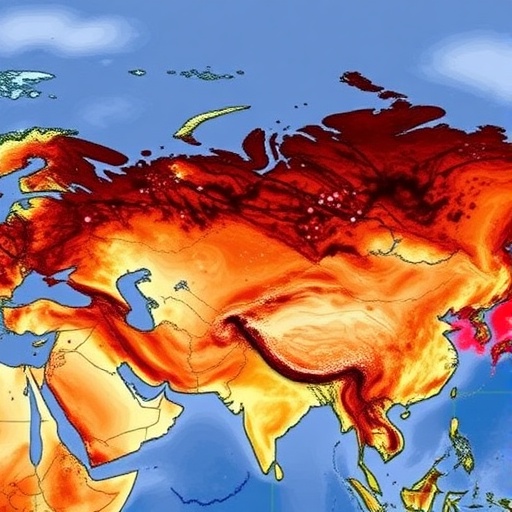
Northern Eurasia holds roughly one-fifth of the planet’s forests, yet pinning down how much carbon these ecosystems absorb is a scientific challenge with real consequences for climate projections. The region’s “land carbon sink” does not respond to temperature in a simple way; it is shaped by intertwined pressures such as rapid warming, wildfire activity, shifting land use, and uneven observational coverage across an enormous geography.
In a new multi-evidence synthesis, researchers combined satellite observations, data-driven products, atmospheric inversion models, dynamic global vegetation models, and Earth System Models. Each approach has distinct strengths—ranging from mapping vegetation patterns to estimating fluxes by tracking atmospheric CO₂ gradients—so the study effectively triangulates the carbon sink from complementary angles. While the datasets differ substantially, the central result converges.
Across Northern Eurasia, ecosystems absorb about 0.47 ± 0.20 billion tonnes of carbon per year, representing nearly one-third of the global terrestrial carbon sink. This quantified baseline is crucial, because policy-relevant scenarios depend on whether carbon uptake continues, accelerates, or weakens as climate conditions evolve.
A key test for long-standing assumptions emerges from the spatial pattern. It is often expected that faster warming boosts carbon uptake in colder regions. Instead, the strongest sinks appear in the western and southern parts of Northern Eurasia, while uptake progressively weakens toward the colder northeast—even as that area experiences some of the most rapid warming on Earth.
The study suggests that forest productivity, often described in forestry terms as “site quality” or bonitet, helps explain this mismatch. More productive forests store larger carbon stocks and respond to changing conditions with greater net uptake, whereas less productive forests show limited enhancement despite warmer temperatures.
Seasonality further complicates the picture. Much of the warming occurs during winter, but frozen soils restrict microbial activity and plant access to water and nutrients, constraining CO₂ assimilation. As a result, temperature increases alone do not translate into proportional gains in carbon uptake.
The synthesis therefore points to an important message for climate and land models: productivity limits how warming can be converted into carbon sequestration. If productivity declines or disturbances intensify, the regional sink may weaken even under continued warming.
By integrating diverse lines of evidence, the work reframes Northern Eurasia’s future as a productivity-governed system rather than a simple thermometer-driven response—an insight that will sharpen forecasts of the global carbon cycle.
Cite Scienmag News
Sloane Callahan. (July 27, 2026). Climate Change Reshapes Carbon Sink Across Northern Eurasia. Scienmag. https://scienmag.com/climate-change-reshapes-carbon-sink-across-northern-eurasia/
Sloane Callahan. "Climate Change Reshapes Carbon Sink Across Northern Eurasia." Scienmag, 27 July 2026, https://scienmag.com/climate-change-reshapes-carbon-sink-across-northern-eurasia/. Accessed 4 September 2026.
Sloane Callahan. "Climate Change Reshapes Carbon Sink Across Northern Eurasia." Scienmag. July 27, 2026. https://scienmag.com/climate-change-reshapes-carbon-sink-across-northern-eurasia/


