


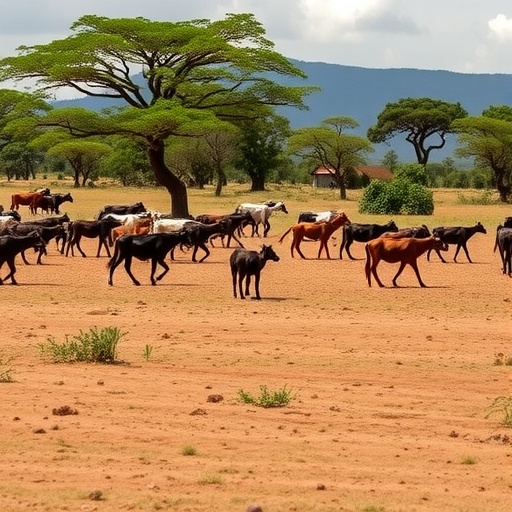
Pastoral and agro-pastoral communities across drylands are experiencing intensifying climate pressure, including land degradation and shifting land-use patterns. In Tiaty, Baringo County, Kenya, researchers documented how households are reworking land use, livestock strategies, and livelihood decisions as local environmental conditions change.
A study published in Risk Sciences investigated how climate variability and land-use dynamics jointly shape pastoral and agro-pastoral adaptation. Using long-term evidence from Landsat satellite imagery, the team evaluated how the spatial structure of vegetation and exposed surfaces evolved between 1994 and 2024.
To connect landscape change with drivers, the researchers integrated climate records, agroecological indicators, livestock market signals, population data, and socioeconomic surveys. This multi-source approach allowed them to assess both ecological transitions and human responses in the same analytical frame.
The results show a clear reorganization of Tiaty’s land cover. Areas dominated by dense shrubland and exposed land increasingly shifted toward a mosaic of shrublands, grasslands, and cultivated plots. Rather than a uniform pattern of decline, the trajectory points to complex, location-specific transformations.
Statistical associations indicated that rainfall pattern changes and rising heat-related stress coincided with adjustments in farming and grazing practices. Cultivation expansion was concentrated in agroecological zones with relatively higher agricultural potential, suggesting selective adaptation where conditions allow.
Livestock distributions mirrored these land-cover transitions. Goats, sheep, and camels aligned more strongly with shrub- and grass-dominated landscapes, consistent with functional suitability under dry and variable conditions. In contrast, cattle showed stronger sensitivity to changes in forage quality and water availability.
Settlement organization also reflected adaptation. Over time, spatial clustering near services and markets gave way to more dispersed settlement arrangements, consistent with mobility, risk spreading, and changing constraints on land access under climate uncertainty.
Overall, the authors argue the observed transformations should not be interpreted as purely linear degradation. Instead, they describe an ongoing process of autonomous, incremental adaptation that may provide short-term resilience while introducing new trade-offs.
The study further highlights potential short-run costs, including increased pressure on water resources and ecological risks in shrub-dominated landscapes. These dynamics underline the need for adaptation strategies that manage both people’s livelihoods and ecosystem stability.
The findings support targeted interventions such as drought-tolerant crops, climate-resilient livestock options, strengthened veterinary and extension services, community-managed water systems, early warning mechanisms, and improved rangeland governance. Integrated planning will be essential to balance cultivation, livestock movement, conservation, and long-term sustainability.
Cite Scienmag News
Russell Cooper. (July 27, 2026). Climate and land shifts reshape pastoral livelihoods across Kenya. Scienmag. https://scienmag.com/climate-and-land-shifts-reshape-pastoral-livelihoods-across-kenya/
Russell Cooper. "Climate and land shifts reshape pastoral livelihoods across Kenya." Scienmag, 27 July 2026, https://scienmag.com/climate-and-land-shifts-reshape-pastoral-livelihoods-across-kenya/. Accessed 4 September 2026.
Russell Cooper. "Climate and land shifts reshape pastoral livelihoods across Kenya." Scienmag. July 27, 2026. https://scienmag.com/climate-and-land-shifts-reshape-pastoral-livelihoods-across-kenya/


