


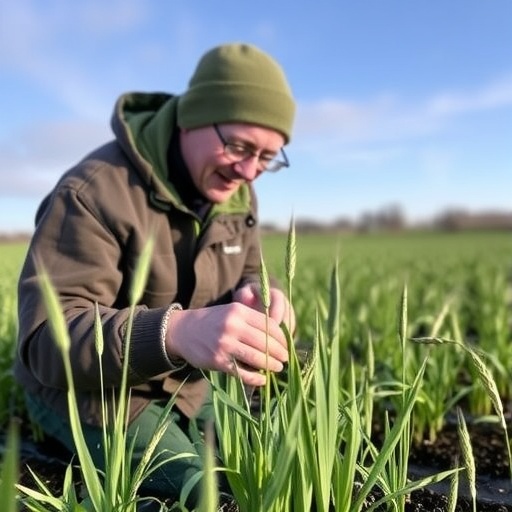
Winter wheat’s status before overwintering strongly influences safe survival and eventual yield, making leaf age a crucial indicator of seedling condition. Yet conventional leaf-age assessments depend on manual field observations, limiting timely monitoring and large-scale, near-simultaneous surveys. Automated segmentation approaches from imagery also struggle with ambiguous boundaries, overlapping leaves, and high computational costs, constraining operational deployment.
To address these limitations, a research team led by Dr. Zhenhai Li from Shandong University of Science and Technology developed a monitoring strategy that fuses remote sensing phenology, vegetation index dynamics, and accumulated thermal information. The work, published online on May 28, 2026 in The Crop Journal, aims to support regional-scale evaluation of overwintering seedlings and to enable future cross-region extension and long-term observation.
The method starts with MODIS remote sensing to extract the emergence date of winter wheat, using ERA5-Land reanalysis temperature data to compute growing degree days (GDD). It then characterizes vegetation development through temporal change in NDVI, summarized by a parameter denoted as β. By combining emergence timing, thermal accumulation, and NDVI dynamics, the team constructs two complementary leaf-age estimators.
The first is a physiologically based GDD leaf age model (LA_GDD), grounded in the relationship between thermal time and developmental progress. The second is a random forest model (LA_RF) that integrates multi-source predictors, capturing nonlinear effects and improving robustness under variable field conditions.
Validation used leaf-age samples measured in the field to quantify accuracy. Results showed that LA_RF markedly outperformed LA_GDD, which relies on GDD alone. The LA_RF approach achieved an R² of 0.67 and an RMSE of 0.56 leaves, indicating a significantly tighter match between modeled and observed leaf age.
The authors also highlight emergence date as a decisive driver of leaf age before overwintering. Earlier-emerging wheat accumulates more GDD prior to the overwintering window, leading to higher leaf age and improved seedling condition.
This effect was especially visible in 2021 in Shandong Province, where continuous rainfall delayed sowing and emergence across the region. The resulting reduction in accumulated thermal development corresponded to a generally lower leaf age, underscoring how weather-driven agronomic timing can propagate into crop establishment outcomes.
Overall, the study demonstrates that integrating phenological timing, thermal accumulation, and vegetation index dynamics can deliver practical, stable monitoring for major winter wheat regions. As Dr. Li notes, the framework offers a new technical solution for regional seedling assessment that can support more precise management decisions.
Cite Scienmag News
Alan Morgan. (July 27, 2026). Combining phenology and temperature data to gauge overwintering wheat seedling health. Scienmag. https://scienmag.com/combining-phenology-and-temperature-data-to-gauge-overwintering-wheat-seedling-health/
Alan Morgan. "Combining phenology and temperature data to gauge overwintering wheat seedling health." Scienmag, 27 July 2026, https://scienmag.com/combining-phenology-and-temperature-data-to-gauge-overwintering-wheat-seedling-health/. Accessed 7 September 2026.
Alan Morgan. "Combining phenology and temperature data to gauge overwintering wheat seedling health." Scienmag. July 27, 2026. https://scienmag.com/combining-phenology-and-temperature-data-to-gauge-overwintering-wheat-seedling-health/


