

Tuesday, July 28, 2026
Science
No Result
View All Result
  • Login
  • HOME
  • SCIENCE NEWS
  • CONTACT US
  • HOME
  • SCIENCE NEWS
  • CONTACT US
No Result
View All Result
Scienmag
No Result
View All Result
Home Science News Biology

Chitosan Hydrogel Stabilizes Red Blood Cell Membranes for Environmental Sensors

July 28, 2026
in Biology
Reading Time: 2 mins read
0
Chitosan Hydrogel Stabilizes Red Blood Cell Membranes for Environmental Sensors

Chitosan Hydrogel Stabilizes Red Blood Cell Membranes for Environmental Sensors

65
SHARES
587
VIEWS
Share on FacebookShare on Twitter
ADVERTISEMENT

Natural cell membranes excel at biological recognition, but translating their sensing abilities into practical devices is notoriously difficult. Once embedded in artificial materials, biomembranes often lose stability, disrupt their structure, and fail to preserve key enzyme conformations—leading to weak signal quality and poor long-term performance.

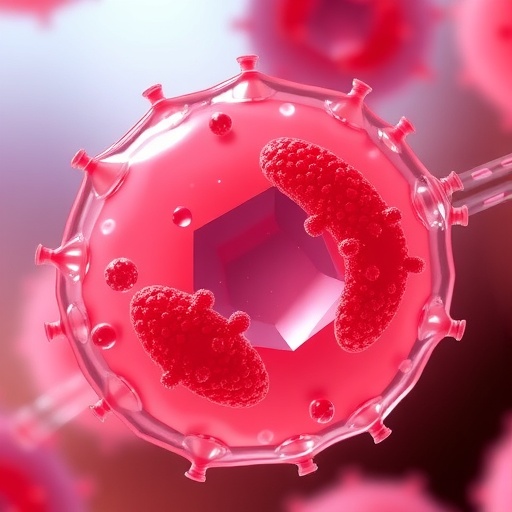
A new study in the Journal of Bioresources and Bioproducts proposes a bio-based stabilization strategy built around a chitosan hydrogel. The researchers engineered a conductive composite interface designed to protect red blood cell membranes while enabling electrochemical readout.

At the core of the approach is the electrostatic pairing between the positively charged chitosan network and negatively charged features on the red blood cell membrane surface. This interaction acts like molecular “clamping,” anchoring membrane fragments within a three-dimensional hydrogel architecture.

Crucially, the hydrogel is not merely a physical support. Its microenvironment is tuned to preserve membrane fluidity and maintain the native structural state of membrane-bound acetylcholinesterase (AChE), a biomolecular recognition element central to organophosphate detection.

To convert the biological interface into an efficient electronic sensor, the team introduced carboxylated multi-walled carbon nanotubes into the hydrogel matrix. The nanomaterials create improved electron-transfer pathways while remaining compatible with the bio-interface.

The resulting biosensor showed robust operational stability, retaining 85.8% of its original electrochemical response after seven days of continuous testing. Such durability is a meaningful step toward translating membrane-based sensing into real-world monitoring systems.

Beyond performance metrics, the platform demonstrated practical analytical capability. It was applied to detect organophosphate pesticides in real agricultural matrices, including apples, oranges, and tomatoes.

Organophosphates remain widely used due to their insecticidal effectiveness, but residues can pose health risks by inhibiting acetylcholinesterase activity. Conventional detection methods can be hampered by sensitivity limits, interference, or operational complexity, motivating interest in electrochemical biosensing for portable and rapid screening.

By pairing chitosan hydrogel stabilization with conductive nanomaterials and functionalized cell-membrane recognition, the study offers a viral-ready blueprint for building more reliable biomimetic interfaces. It broadens how natural polysaccharides can be deployed in electrochemical environmental sensing rather than limiting them to traditional biomedical or packaging roles.

Subject of Research: Not applicable
Article Title: Chitosan Hydrogel-Stabilized Red Blood Cell Membrane Interface for Robust Electrochemical Sensing of Environmental Contaminants
News Publication Date: 18-Jul-2026
Web References: https://www.sciencedirect.com/journal/journal-of-bioresources-and-bioproducts
References: 10.1016/j.jobab.2026.100283
Image Credits: N/A
Keywords: Hydrogels; chitosan; red blood cell membrane; electrochemical sensing; biosensors; acetylcholinesterase; carbon nanotubes; electrochemistry; biocompatible composites; organophosphate pesticides

Tags: bio-based sensor interfacebiomimetic sensorschitosan hydrogel for biosensor stabilizationconductive composite biointerfaceselectrochemical biosensors for organophosphate detectionelectrostatic membrane anchoring techniquesenvironmentally stable bio-recognition elementslong-term stability of bioelectronic devicesmembrane protein preservation in sensorsmulti-walled carbon nanotubes in biosensorsnanomaterials in biosensingred blood cell membrane stabilization
Share26Tweet16
Previous Post

Maternal, Neonatal Cytokine Signals in Twins Suggest Immune Dysregulation in Autism

Next Post

Family Medicine Residency Directors Say Programs Do Not Assess Self-Directed Learning Directly

Related Posts

Nagoya Institute Scientists Identify Molecular Basis of Red-Green Color Vision
Biology

Nagoya Institute Scientists Identify Molecular Basis of Red-Green Color Vision

July 28, 2026
Rapid path to antibiotic resistance accelerates spread and treatment failures
Biology

Rapid path to antibiotic resistance accelerates spread and treatment failures

July 28, 2026
Study Finds Casdatifan Produces Durable Tumor Responses in Advanced Kidney Cancer
Biology

Study Finds Casdatifan Produces Durable Tumor Responses in Advanced Kidney Cancer

July 28, 2026
Senolytic PROTAC Slows Age-Related Intervertebral Disc Degeneration in Male Mice
Biology

Senolytic PROTAC Slows Age-Related Intervertebral Disc Degeneration in Male Mice

July 28, 2026
Nuclear Escape Accelerates as Stress Builds Inside the Atomic Nucleus
Biology

Nuclear Escape Accelerates as Stress Builds Inside the Atomic Nucleus

July 28, 2026
Lipid Regulator Modulates Sonic Hedgehog Pathway, Shaping Heart and Lungs
Biology

Lipid Regulator Modulates Sonic Hedgehog Pathway, Shaping Heart and Lungs

July 27, 2026
Next Post
Family Medicine Residency Directors Say Programs Do Not Assess Self-Directed Learning Directly

Family Medicine Residency Directors Say Programs Do Not Assess Self-Directed Learning Directly

  • Mothers who receive childcare support from maternal grandparents show more

    Mothers who receive childcare support from maternal grandparents show more parental warmth, finds NTU Singapore study

    27656 shares
    Share 11059 Tweet 6912
  • University of Seville Breaks 120-Year-Old Mystery, Revises a Key Einstein Concept

    1061 shares
    Share 424 Tweet 265
  • Bee body mass, pathogens and local climate influence heat tolerance

    682 shares
    Share 273 Tweet 171
  • Researchers record first-ever images and data of a shark experiencing a boat strike

    546 shares
    Share 218 Tweet 137
  • Groundbreaking Clinical Trial Reveals Lubiprostone Enhances Kidney Function

    531 shares
    Share 212 Tweet 133
Science

Embark on a thrilling journey of discovery with Scienmag.com—your ultimate source for cutting-edge breakthroughs. Immerse yourself in a world where curiosity knows no limits and tomorrow’s possibilities become today’s reality!

RECENT NEWS

  • Tailored Cu-N2S single atoms boost photo-Fenton activity via d–p hybridization
  • Clonal Division Memory in Humans Splits Between Healthy Blood Formation and AML
  • Crystal Dislocations Govern Sc Incorporation in Hydrothermally Modified Beryl
  • New initiative aims to secure AI systems used in scientific research

Categories

  • Agriculture
  • Anthropology
  • Archaeology
  • Athmospheric
  • Biology
  • Biotechnology
  • Blog
  • Bussines
  • Cancer
  • Chemistry
  • Climate
  • Earth Science
  • Editorial Policy
  • Marine
  • Mathematics
  • Medicine
  • Pediatry
  • Policy
  • Psychology & Psychiatry
  • Science Education
  • Social Science
  • Space
  • Technology and Engineering

Subscribe to Blog via Email

Enter your email address to subscribe to this blog and receive notifications of new posts by email.

Join 5,146 other subscribers

© 2025 Scienmag - Science Magazine

Welcome Back!

Login to your account below

Forgotten Password?

Retrieve your password

Please enter your username or email address to reset your password.

Log In
No Result
View All Result
  • HOME
  • SCIENCE NEWS
  • CONTACT US

© 2025 Scienmag - Science Magazine

Discover more from Science

Subscribe now to keep reading and get access to the full archive.

Continue reading
