


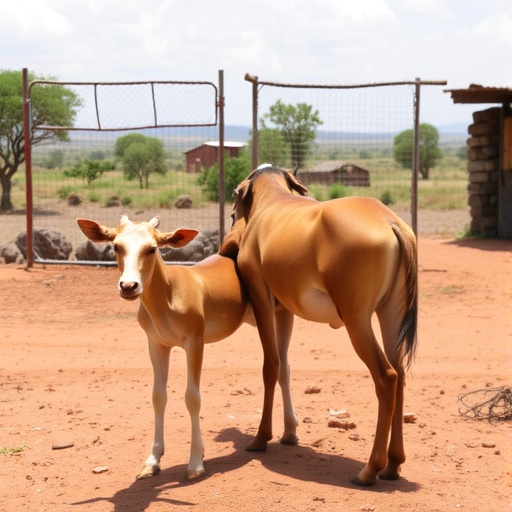
In the highland districts of West Shewa Zone in Ethiopia’s Oromia region, livestock are more than animals. They are savings accounts, plows, dowries, and insurance policies for millions of smallholder farming families. But when a cow falls sick or a flock of sheep begins to die, the systems meant to protect them are, according to a new study, fundamentally broken. Veterinary clinics lack the most basic instruments to examine animals. Private drug sellers operate without oversight, dispensing medicines to farmers who have learned to diagnose and treat their own livestock. Laboratory diagnostics — the backbone of modern animal healthcare — are so underused that many diseases go unidentified before treatment begins. And the farmers, caught between empty clinics and unregulated pharmacies, have adapted in ways that may be quietly worsening the very problems they are trying to solve.
These findings come from a cross-sectional survey conducted between November and December 2024 in three districts of West Shewa Zone: Bako Tibe, Toke Kutaye, and Ambo. A team of Ethiopian researchers from Wollega University and elsewhere, led by Isayas Asefa Kebede, administered a semi-structured questionnaire to 100 purposively selected respondents — a group that included 62 livestock-owning clients, the operators of 12 public veterinary clinics, 13 private veterinary pharmacists, and 13 government administrative employees. The researchers then analyzed the responses using STATA version 14, summarizing the data with descriptive statistics and testing associations between hypothesized factors and service-delivery outcomes using the chi-square test and Fisher’s Exact Test. The results, published as an open-access article in the journal Discover Animals, paint a detailed and sobering portrait of animal healthcare at the front lines of Sub-Saharan Africa’s livestock economy.
The most immediate and most consistently reported problem was the absence of basic veterinary equipment. Across all three districts, a majority of respondents agreed that animal health facilities simply did not have the tools needed to deliver competent care — though the intensity of that agreement varied from district to district, a difference the researchers confirmed with Fisher’s Exact Test. In practical terms, this means clinics that cannot perform routine physical examinations, cannot restrain animals safely, cannot collect samples, and cannot administer even routine treatments with confidence. The deficiency is not glamorous, and it does not make headlines the way a disease outbreak does, but it is the kind of infrastructure gap that quietly degrades every other layer of the veterinary system. A clinician without equipment is, in effect, reduced to guesswork, and guesswork in veterinary medicine carries a heavy price: incorrect treatments, wasted drugs, prolonged illness, and avoidable deaths among herds that families depend upon for their livelihoods.
The second major finding concerns the informal pharmaceutical market that has grown up in the vacuum left by under-resourced public services. The survey revealed strikingly high awareness of illegal drug sellers among the communities studied. Private veterinary pharmacists, 13 of whom participated in the study, occupy a precarious position in this landscape: they provide access to medicines that public clinics often cannot supply, but they operate within a regulatory gray zone where quality control, cold-chain management, and professional supervision are inconsistent at best. Farmers know these sellers exist, know where to find them, and — crucially — use them. The researchers emphasize that this awareness is not merely anecdotal; the pattern was documented across the respondent groups, indicating that the informal market is not a fringe phenomenon but a central channel through which veterinary drugs reach animals in the zone.
Perhaps the most consequential behavioral finding is the prevalence of self-medication among livestock owners. Rather than presenting sick animals to a professional, many farmers diagnose the problem themselves and administer drugs — often obtained from the very illegal sellers the study documented — without clinical guidance, without dosage precision, and without any laboratory confirmation of what is actually wrong with the animal. This practice has a cascade of downstream effects. It drives antimicrobial misuse, one of the principal engines of antimicrobial resistance, a global public health threat that disproportionately burdens low- and middle-income countries. It masks disease presentations, making later professional diagnosis harder. It wastes money on ineffective treatments. And it undermines the economic case for investing in formal veterinary services, because farmers who have “made do” on their own come to see professional care as an unnecessary expense rather than an essential one.
Underlying all of this is a third structural failure: the chronic underutilization of laboratory diagnostics. Animal health systems around the world depend on laboratories to confirm infections, identify parasites, guide drug selection, and support surveillance for transboundary diseases. In the West Shewa districts surveyed, laboratory services played a marginal role in routine veterinary practice. Treatments were being initiated on the basis of visible symptoms alone. The consequence is a system that can react to what it can see but cannot detect what it cannot — subclinical infections, emerging resistance patterns, or the early stages of an outbreak. For a country whose livestock sector underpins national food security and export ambitions, that diagnostic blind spot represents a strategic vulnerability, not merely a local inconvenience.
The researchers are careful to situate these findings in their broader context. Ethiopia maintains one of the largest livestock populations in Africa, and livestock contribute substantially to household income, nutrition, draft power, and foreign exchange. Yet livestock diseases continue to threaten production across Sub-Saharan Africa precisely because veterinary services remain inadequate — and, as this study demonstrates, the inadequacy is not a single problem but a bundle of interlocking ones. Equipment shortages depress the quality of public care. Poor public care pushes farmers toward informal markets. Informal markets enable self-medication. Self-medication erodes trust in formal diagnostics and accelerates drug resistance. Each link reinforces the next, producing a self-perpetuating cycle that no single intervention — a new clinic building, a drug donation, a training workshop — can break on its own.
What makes the study methodologically valuable is its breadth of perspective. By surveying not only farmers and clinicians but also private pharmacists and government administrators, the researchers captured how the same dysfunction looks from four different vantage points within the system. The statistical analysis, combining descriptive statistics with chi-square and Fisher’s Exact tests, allowed the team to move beyond anecdote and test whether perceived limitations genuinely differed across districts and respondent categories — and in several cases, they did, with district-level variation in equipment-related responses reaching statistical significance. This kind of evidence matters for policy: a problem that varies by district demands locally tailored solutions, not a one-size-fits-all national directive.
The study’s implications point toward several concrete directions for intervention. Strengthening the supply and maintenance of basic veterinary equipment in public facilities would directly address the most widely reported deficiency. Establishing effective regulatory frameworks for private veterinary pharmacies could convert the informal drug market from a liability into a managed asset — bringing quality assurance, professional oversight, and traceability to a channel that farmers will continue to use regardless of its legal status. Expanding access to laboratory diagnostics, even at a modest level, would ground treatment decisions in evidence rather than guesswork. And targeted education campaigns could address self-medication directly, giving farmers the knowledge to understand why professional diagnosis protects both their animals and their communities from the escalating threat of drug-resistant pathogens.
There is also a lesson here for the international research and development community. Livestock health in low-income countries is often framed primarily as a disease problem — a matter of vaccines, outbreak response, and pathogen surveillance. This study reframes it as a service-delivery problem: the pathogens are only part of the story, and arguably not the decisive part. The decisive factors are equipment on the clinic shelves, regulation of the pharmacies, availability of laboratory tests, and the trust and behavior of farmers navigating a system that has, for too long, left them to fend for themselves. Until those service-level constraints are addressed, vaccines and medicines will continue to underperform, and livestock-dependent families across the region will continue to absorb losses that better-functioning systems could prevent.
The West Shewa Zone is, in one sense, a case study of a single corner of Oromia. In another sense, it is a mirror. The pattern it reveals — under-equipped public facilities, thriving informal drug markets, widespread self-treatment, and sidelined diagnostics — recurs across much of Sub-Saharan Africa wherever livestock matter most and veterinary infrastructure matters least. The researchers’ data give that pattern a precise, local, statistically grounded shape, and in doing so, they offer something policymakers rarely have: a clear map of where the system breaks, drawn by the people who live and work inside it. Fixing it will not require a single dramatic breakthrough. It will require the unglamorous, essential work of equipping clinics, regulating pharmacies, building laboratory capacity, and listening to farmers — one district at a time.
Cite Scienmag News
William Thompson. (September 6, 2026). Barriers to veterinary service delivery in West Shewa Zone, Ethiopia. Scienmag. https://scienmag.com/barriers-to-veterinary-service-delivery-in-west-shewa-zone-ethiopia/
William Thompson. "Barriers to veterinary service delivery in West Shewa Zone, Ethiopia." Scienmag, 6 September 2026, https://scienmag.com/barriers-to-veterinary-service-delivery-in-west-shewa-zone-ethiopia/. Accessed 6 September 2026.
William Thompson. "Barriers to veterinary service delivery in West Shewa Zone, Ethiopia." Scienmag. September 6, 2026. https://scienmag.com/barriers-to-veterinary-service-delivery-in-west-shewa-zone-ethiopia/


