


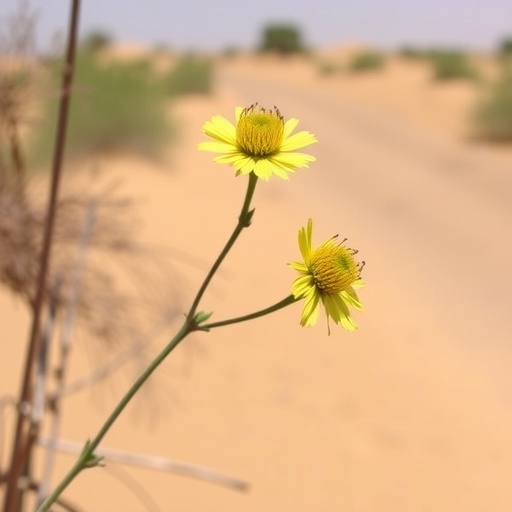
The Thar Desert, stretching across vast tracts of northwestern India and southern Pakistan, has long been perceived as a barren expanse of sand and scrub. Yet a sweeping new review published in The Science of Nature reveals it to be a botanical treasure trove of remarkable ecological and pharmacological significance, one whose flora is far more imperilled than previously understood. Researchers led by Ummar Iqbal of The Islamia University of Bahawalpur compiled an exhaustive synthesis of literature spanning more than four decades, drawing on databases including Flora of Pakistan, the Global Biodiversity Information Facility and Plants of the World Online, alongside searches of Google Scholar, Scopus, PubMed, Web of Science and ScienceDirect covering the years 1980 through 2024. Their findings document 162 plant species across 69 families, paint a detailed picture of the desert’s botanical architecture, and deliver a stark warning about the fragility of this ecosystem and the indigenous knowledge systems that depend upon it.
The structural composition of Thar vegetation is dominated by three plant families that have proven masters of arid survival. Grasses of the family Poaceae account for 27 percent of documented species, legumes of the Fabaceae make up 16 percent, and the daisy relatives of the Asteraceae contribute 11 percent. These are not merely the most numerous lineages; they are the functional backbone of the desert’s ecology. The grasses, equipped with specialised xerophytic anatomy including narrow leaves, silica-rich tissues and efficient water-conserving photosynthetic pathways, stabilise shifting sand dunes and provide critical forage for livestock and wildlife alike. The legumes, meanwhile, carry out the desert’s most important fertilisation service. Through symbiotic associations with nitrogen-fixing bacteria in their root nodules, species such as Acacia and Prosopis convert atmospheric nitrogen into soil-available forms, enriching substrates that would otherwise remain nutrient-poor. Halophytic members of the flora, tolerating salt concentrations that would kill most plants, colonise saline depressions where few other organisms can persist, while simultaneously sequestering salt in specialised glands and vacuoles.
The life-form spectrum of the Thar flora tells its own story of adaptation. Nearly half of the documented species, 45 percent, are therophytes, plants that complete their entire life cycle from germination to seed production within a single brief season, surviving the hostile remainder of the year as dormant seeds. This strategy allows them to exploit the erratic and unpredictable rainfall that characterises desert environments, essentially gambling on the arrival of moisture and withdrawing into dormancy when it fails. Chamaephytes, low-growing woody perennials that keep their buds close to the protective boundary layer of air near the soil surface, constitute the second-largest group at 28 percent. Larger trees and shrubs, the phanerophytes, represent just 10 percent of the flora, a proportion that reflects the extreme limits on vertical growth imposed by water scarcity and high evaporative demand. Hemicryptophytes, cryptophytes and a small contingent of parasitic species round out the spectrum.
Beyond their ecological roles, many of these plants harbour chemical arsenals of profound pharmacological interest. The review catalogues an impressive abundance of terpenoids, flavonoids, tannins and alkaloids across the Thar flora, compound classes with well-established activities including antioxidant, antimicrobial, anti-inflammatory, antidiabetic and anticancer effects. Species such as Capparis decidua, Calotropis procera, Citrullus colocynthis, Withania somnifera and Azadirachta indica have accumulated substantial bodies of phytochemical and pharmacological research over the past decades. Alkaloids from members of the Solanaceae, flavonoid glycosides from the Apocynaceae, and terpenoid-rich essential oils from aromatic grasses have all been characterised using techniques ranging from gas chromatography-mass spectrometry to high-performance liquid chromatography. In a global context in which drug discovery increasingly returns to natural products for inspiration, the Thar flora represents a largely untapped reservoir of chemical novelty.
The human dimension of this botanical wealth is equally significant. The Thar Desert supports unique indigenous communities whose livelihoods have been shaped by centuries of coexistence with its harsh conditions. Agriculture and animal husbandry remain central to survival, while traditional crafts such as woodworking, wool weaving and jewellery making provide supplementary income. Woven through these economic activities is a rich ethnobotanical tradition: local healers and elders hold detailed knowledge of which plants treat fever, wounds, digestive complaints and respiratory ailments, which provide nutritious food during famine years, and which serve as fodder, fuel and construction material. Much of this knowledge remains undocumented, transmitted orally within families and communities. The review’s authors note that despite decades of ethnobotanical interest in South Asian deserts, comprehensive systematic documentation of Thar plant knowledge has lagged behind, leaving both biological and cultural heritage vulnerable to erosion as younger generations migrate to cities and traditional lifeways fade.
That vulnerability takes on urgent dimensions when the conservation status of the flora is examined. Alarmingly, 52 percent of the documented taxa are classified as Data Deficient, meaning that scientists simply do not know enough about their populations, distributions and trends to assess their risk of extinction. A further 3 percent are listed as Critically Endangered, teetering on the edge of disappearance. These figures represent a fundamental gap in our understanding of desert biodiversity. Species cannot be protected if their status is unknown, and the sheer proportion of Data Deficient taxa suggests that the true extent of imperilment in the Thar may be considerably worse than current assessments indicate. The review argues that filling these knowledge gaps is itself a conservation priority, requiring targeted field surveys and population monitoring across the desert’s varied habitats.
The threats confronting the Thar flora are multifaceted and accelerating. Habitat degradation driven by expanding agriculture and infrastructure fragments populations and destroys the microhabitats on which specialised species depend. Overgrazing by growing livestock herds removes vegetation cover, exposing soils to wind erosion and preventing the regeneration of palatable species. Climate change compounds these pressures, with projections suggesting more frequent droughts, higher temperatures and increasingly erratic monsoon patterns across the region. Each of these stressors operates synergistically with the others, creating a feedback loop in which degraded vegetation communities become less resilient to climatic shocks, which in turn accelerates further degradation. The desiccation-tolerant and salt-tolerant specialists that characterise the Thar flora, having evolved their remarkable adaptations over millennia, may simply lack the capacity to respond to environmental change occurring on decadal timescales.
In response to this crisis, the review lays out a coordinated conservation agenda grounded in both ecological science and social equity. Afforestation programmes using native species are recommended as a first line of defence, restoring vegetation cover while providing economic benefits to local communities. Sustainable rangeland and water management practices, including rotational grazing and traditional water-harvesting techniques, could relieve pressure on overexploited areas. For the most threatened taxa, biotechnological approaches such as micropropagation and tissue culture offer a means of multiplying scarce genetic material without further depleting wild populations. Perhaps most importantly, the authors stress the need for comprehensive documentation of indigenous medicinal practices before this knowledge is lost, arguing that ethnomedicinal records serve as both cultural preservation and a roadmap for future pharmacological research.
The institutional dimension of conservation is equally critical. Strengthening existing protected areas, including national parks, wildlife sanctuaries and biosphere reserves across the Thar region, would provide refugia for the desert’s most vulnerable species. Community-based conservation initiatives that involve local people as active stewards rather than passive beneficiaries have proven more durable in other arid ecosystems and are advocated here as well. Policy integration, ensuring that biodiversity considerations are embedded in land-use planning, agricultural policy and climate adaptation strategies at provincial and national levels, would address the systemic drivers of degradation rather than merely treating symptoms. The review’s authors emphasise that no single intervention will suffice; only coordinated action across these multiple fronts can safeguard the Thar’s biological and ethno-medicinal heritage.
The Thar Desert stands at a crossroads. Its flora embodies millions of years of evolutionary ingenuity, its communities carry knowledge accumulated over centuries, and its chemical diversity holds promise for future medical breakthroughs. Yet the same forces that threaten deserts worldwide, habitat loss, overgrazing, climate change and the erosion of traditional knowledge, are converging on this fragile ecosystem with unprecedented intensity. The comprehensive synthesis offered by Iqbal and colleagues makes clear that the window for effective action is narrowing. Whether the desert’s treasures are preserved for future generations or lost to a combination of neglect and exploitation will depend on the choices made in the coming years by scientists, policymakers and the communities who call this remarkable landscape home.
Cite Scienmag News
Margaret Porter. (September 6, 2026). Thar Desert flora: botanical treasures spanning medicine, tradition, and conservation. Scienmag. https://scienmag.com/thar-desert-flora-botanical-treasures-spanning-medicine-tradition-and-conservation/
Margaret Porter. "Thar Desert flora: botanical treasures spanning medicine, tradition, and conservation." Scienmag, 6 September 2026, https://scienmag.com/thar-desert-flora-botanical-treasures-spanning-medicine-tradition-and-conservation/. Accessed 6 September 2026.
Margaret Porter. "Thar Desert flora: botanical treasures spanning medicine, tradition, and conservation." Scienmag. September 6, 2026. https://scienmag.com/thar-desert-flora-botanical-treasures-spanning-medicine-tradition-and-conservation/


