


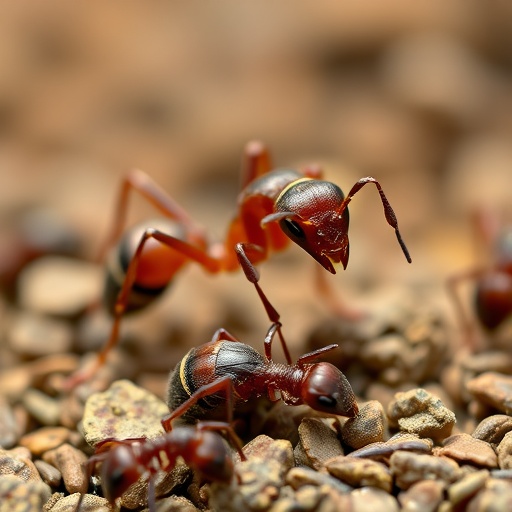
In the bustling world of an ant colony, not every worker answers the call when a nestmate is in trouble. Some ants will race to free a trapped companion, pulling at its legs and digging away the sand that holds it captive, while others walk right up to the distressed individual, inspect it, and simply walk away. This striking behavioral divide within a single colony has long puzzled scientists, and now a collaborative team from Johannes Gutenberg University Mainz in Germany and Tel Aviv University in Israel has uncovered a compelling biological explanation. According to a study recently published in the Journal of Experimental Biology, the difference between rescuers and non-rescuers in the desert ant species Cataglyphis niger does not lie in body size, physical strength, morphology, or energy reserves. Instead, it lies hidden in the intricate patterns of gene activity within the ants’ nervous systems, particularly within the brain structures responsible for processing sensory information and orchestrating behavior.
The research, led by Professor Susanne Foitzik of the Institute of Organismic and Molecular Evolution at Mainz, addresses a question that has fascinated biologists for decades: why do individuals within the same social group respond so differently to the suffering of others? Rescue behavior has traditionally been studied and documented primarily in mammals, particularly rats and mice, where rodents have been shown to free restrained cage mates even without any immediate reward. The fact that such behavior has evolved independently in insects, animals with brains containing far fewer neurons than mammals, makes ants an extraordinary model for probing the biological roots of prosocial behavior. As Foitzik explains, the willingness to help in ants is linked to measurable differences in gene activity, a finding that opens an entirely new window onto the molecular machinery underlying what might loosely be called altruism in a tiny-brained organism.
To isolate the behavioral differences in a controlled setting, the researchers designed an elegant laboratory experiment that mimicked a natural emergency. A worker ant was restrained on the floor of a sand-lined test chamber, unable to free itself, creating a standardized distress situation. Individual ants from the same colony were then introduced one at a time into the chamber, and the researchers meticulously recorded every behavior over a fifteen-minute observation window. Ants were classified as rescuers if they approached the restrained nestmate and actively attempted to free it by pulling at its body or digging in the sand around it, actions that mirror the behavior C. niger workers display when rescuing nestmates buried under soil in nature. Ants that approached the trapped individual, investigated it, but made no attempt at liberation were classified as non-helpers. This careful behavioral phenotyping created two well-defined groups whose biology could then be directly compared.
With rescuers and non-rescuers clearly identified, the team turned to the molecular level, asking whether the behavioral split would be reflected in measurable biological differences. The researchers dissected the antennae, the ants’ primary chemosensory organs, along with several brain regions, including the optic lobes and central brain areas. Special attention was paid to the mushroom bodies, paired structures in the insect brain that serve as central processing hubs integrating sensory input and playing crucial roles in learning, memory, and behavioral control. From these carefully dissected tissues, the team extracted RNA, the molecular messenger that reveals which genes are actively being transcribed into proteins in each tissue at the moment of sampling. Using RNA sequencing, a high-throughput technique that quantifies the transcriptome, the researchers then generated a comprehensive map of gene activity in both behavioral groups and compared the two profiles region by region.
The most striking differences emerged in the mushroom bodies, the very structures that integrate the sensory cues an ant perceives and translate them into behavioral decisions. Luisa Maria Jaimes-Nino, first author of the study and a member of Foitzik’s team, reports that in the mushroom bodies of rescuing ants, fifteen genes showed significantly higher activity than in non-rescuers. These genes are associated with a fascinating array of functions: odor perception, which is essential for detecting the alarm pheromones a distressed nestmate releases; hormonal regulation, which can modulate behavioral state and responsiveness; metabolic processes that fuel neural activity; and immune functions. When the analysis was extended across all the tissues examined, a total of nine genes were consistently more active in rescuing ants than in their non-rescuing colony mates, suggesting a coordinated molecular signature associated with the tendency to help.
One of the most unexpected threads in this molecular signature involves immune genes, which are traditionally understood as the insects’ defense against pathogens. However, a growing body of prior research has revealed that immune system genes in insects do far more than fight infection. Studies have shown that they can influence activity levels, sleep patterns, and even the tendency to form social groups, hinting that the immune system participates in regulating social behavior itself. The new findings extend this picture by suggesting that immune functions could play a role in modulating an ant’s social responses to distressed nestmates. There is also a plausible evolutionary logic at work: rescue behavior is inherently risky, exposing the helping ant to potential injury from the trapped individual or to pathogens in the soil. Rescuers may therefore benefit from constitutively higher activity of immune-related genes, preparing their bodies for the hazards that helping entails.
Importantly, the study rules out the simplest and perhaps most intuitive explanations for the behavioral divide. The researchers found no evidence that rescuers were physically stronger, larger, or better provisioned with energy reserves than non-helpers. The tendency to help, in other words, is not simply a matter of physical capability. Rather, Foitzik and her colleagues propose that the differences lie in how sensory stimuli are processed within the nervous system and in the state of specific molecular signaling pathways that tune an individual’s readiness to respond. An ant that perceives the chemical alarm signals of a trapped nestmate more acutely, or whose neural circuits weigh those signals more heavily against competing demands, may simply be more inclined to act. This reframes the question of helping behavior from one of strength or generosity to one of neural and molecular sensitivity.
The researchers are careful to note that their study does not identify a single molecular trigger, a lone “rescue gene” that flips the switch on helping behavior. Instead, rescue behavior appears to emerge from the interaction of multiple processes operating at different levels. The chain likely begins with the perception of alarm signals through the antennae, continues through the processing of those stimuli in the mushroom bodies and other brain regions, and culminates in the activation of molecular signaling pathways that influence the ant’s behavioral output. The nine genes identified across tissues and the fifteen differentially expressed genes in the mushroom bodies should therefore be understood as components of a broader regulatory network rather than as isolated causal agents. This systems-level view aligns with modern thinking in behavioral genomics, where complex social behaviors are rarely traceable to single genes but instead arise from coordinated patterns of expression across neural circuits.
The implications of this work extend well beyond ant biology. By demonstrating that individual animals within a single colony differ not only behaviorally but also in measurable, tissue-specific molecular profiles, the study provides a template for investigating the biological foundations of social behavior in other species, including humans. Ants, with their genetically similar workers occupying distinct behavioral roles, offer a uniquely tractable system for such research, allowing scientists to disentangle the contributions of genotype, development, and neural state without the confounding genetic variation present in mammalian studies. The project, funded by the German Research Foundation and the Israel Science Foundation, was carried out by Jaimes-Nino and Foitzik at Mainz together with Bar Adi and Inon Scharf at Tel Aviv University. As the field of social neuroscience increasingly turns its attention to the molecular underpinnings of empathy-like behaviors, this desert ant, scurrying across the sand to free a stranded companion, may prove to hold answers written in the language of its genes.
Cite Scienmag News
Juliet Wilcox. (September 7, 2026). Why Some Ants Slack While Others Work. Scienmag. https://scienmag.com/why-some-ants-slack-while-others-work/
Juliet Wilcox. "Why Some Ants Slack While Others Work." Scienmag, 7 September 2026, https://scienmag.com/why-some-ants-slack-while-others-work/. Accessed 7 September 2026.
Juliet Wilcox. "Why Some Ants Slack While Others Work." Scienmag. September 7, 2026. https://scienmag.com/why-some-ants-slack-while-others-work/


