


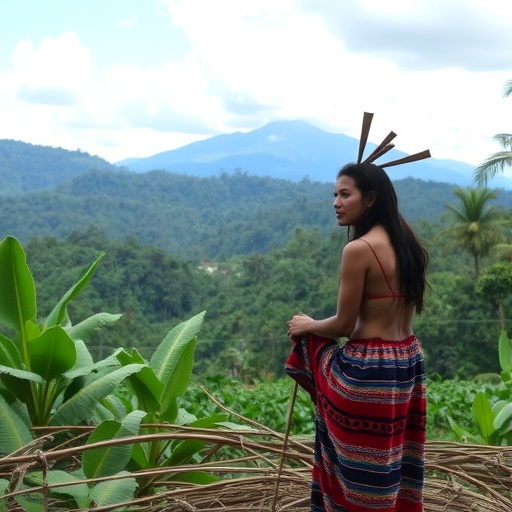
In the dense rainforests of Northwestern Amazonia, where the Caquetá River winds through some of the most biologically and culturally rich territory on Earth, a new study has delivered a finding that challenges conventional development thinking: Indigenous families who maintain their traditional economies report better quality of life than those who have become dependent on external markets and wage labor. The research, published in the Journal of Environmental Studies and Sciences, provides quantitative evidence that traditional productive practices are not relics of the past to be replaced by modernization, but living strategies that sustain both human well-being and the forest ecosystems on which that well-being depends.
The study, led by Yojan Gutiérrez-Rojas of the Norwegian Human Rights Fund in Bogotá, together with Edgar Martínez-Moyano of CONICET in Argentina and Nicole Sibelet of CIRAD and the University of Montpellier in France, set out to answer a deceptively simple question: how do you actually measure quality of life among Indigenous families whose economic lives do not fit the standard categories used by national statistics agencies? Conventional poverty metrics, built around monetary income and consumption, systematically fail to capture the realities of communities where food comes from the chagra, the ancestral polyculture garden; where housing, medicine, and tools derive from the forest; and where spiritual and social life is inseparable from the land itself. The researchers instead designed a methodological framework adapted to the actual economic dynamics of the families they studied, arguing that quality of life is closely linked to territorial autonomy, the development of traditional ways of life, and the conservation of the natural environment.
The empirical core of the research rests on 94 semi-structured interviews conducted with families from five Indigenous communities in the municipality of Solano, in the department of Caquetá, Colombia. From these interviews, the team extracted and analyzed a total of 93 variables covering what the researchers describe as Livelihoods, Livelihood Strategies, and Fundamental Human Needs. The analytical approach drew on the sustainable livelihoods framework and the community capitals framework, both widely used in rural development research, which treat households as managers of multiple asset bases: natural capital such as forest, water, and soil; physical capital such as tools and infrastructure; financial capital such as cash and credit; human capital such as knowledge and labor; social capital such as kinship networks and communal institutions; and cultural capital such as language, ritual, and traditional ecological knowledge. Using multivariate statistical methods implemented in the R computing environment, including tools for clustering and dimensionality reduction, the team grouped families into distinct economic types based on how they combined these different capitals.
The analysis revealed three clearly differentiated groups. The first, labeled the Mixed Economy, comprised families that combined traditional production with market participation, selling surpluses and periodically engaging in wage labor while maintaining their chagras and forest activities. The second, the Traditional Economy, consisted of families whose livelihoods remained anchored almost entirely in traditional productive practices: shifting cultivation of manioc and other staples, hunting, fishing, gathering, and the communal exchange relationships that bind families together. The third, the Dependent Economy, included families that had become largely reliant on external income sources, purchased food, and government transfers, with weakened connections to their own productive base. This typology allowed the researchers to move beyond averages and ask whether the way a family makes its living shapes how well it lives.
To answer that question, the team constructed four composite indices for each group. The Community Capital Index, or CCI, measured the strength of the asset base across the multiple capitals. The Livelihood Strategies Index, or LSI, captured the diversity and robustness of the economic activities a family pursued. The Fundamental Human Needs Index, or FHNI, assessed satisfaction of the categories articulated in Max-Neef’s framework of fundamental human needs, spanning subsistence, protection, affection, understanding, participation, leisure, creation, identity, and freedom. Finally, the Quality-of-Life Index, or QLI, integrated these dimensions into an overall measure of well-being designed to be meaningful within the cultural context of the communities themselves rather than imposed from outside.
The results were striking in their consistency. Families in the Traditional Economy group scored highest on the Community Capital Index, the Livelihood Strategies Index, and the Quality-of-Life Index, while the Dependent Economy group paradoxically recorded the highest values on the Fundamental Human Needs Index, a pattern the researchers interpret carefully. Higher FHNI scores among dependent families may reflect greater access to certain externally provided services and goods that map onto some need categories, yet this did not translate into superior overall quality of life. On the integrated measure that mattered most, the QLI, traditional families came out ahead. The finding suggests that dependence on external economies can inflate measures of consumption or service access while eroding the underlying capitals and strategies that sustain genuine, self-determined well-being over time.
For the researchers, the explanation lies in the internal logic of the traditional economy itself. The chagra is not simply a garden; it is a sophisticated agroecological system that embeds families within cycles of knowledge transmission, ritual obligation, and communal labor. In the communities studied, many of them belonging to the Murui-Muinaɨ people, the cultivation of coca, tobacco, and sweet manioc carries deep cosmological significance, and the chagra functions simultaneously as a source of physical food and of spiritual and social nourishment. Families practicing these systems retain control over their own food production, maintain dense social networks of reciprocity, preserve encyclopedic knowledge of forest species and their uses, and exercise the territorial autonomy that the authors identify as a precondition for quality of life. The diversity of livelihood activities within traditional economies also confers resilience, buffering families against the shocks, whether climatic, economic, or political, that devastate households dependent on a single external income stream.
The findings carry pointed implications for policy in Colombia and across the Amazon basin. The study region sits in a landscape scarred by decades of armed conflict, coca cultivation, oil exploration, and deforestation, and government programs have often treated Indigenous poverty as a problem to be solved through market integration, cash transfers, and agricultural modernization. If the authors are right, such approaches risk undermining precisely the assets and strategies that produce the best measured quality-of-life outcomes. The research instead supports policies that strengthen territorial autonomy, protect collective land tenure, and support traditional productive practices as legitimate and effective development strategies in their own right. This aligns with a growing international body of evidence that Indigenous-managed lands show lower deforestation rates and higher biodiversity than surrounding areas, and that Indigenous knowledge systems constitute critical infrastructure for climate adaptation and conservation.
Methodologically, the study also makes a contribution to how science measures human well-being. By insisting on an approach adapted to Indigenous economic dynamics, and by grounding its indices in the lived categories of the communities themselves, the research demonstrates that rigorous quantitative comparison is possible without flattening cultural difference into a single monetary yardstick. The team worked closely with the ASCAINCA association and with the Amazon Conservation Team Colombia, which facilitated field visits, and the authors emphasize that the research would not have been possible without the trust and collaboration of the participating families. The combination of ethnographic sensitivity and multivariate statistics offers a template other researchers can adapt to contexts where conventional indicators mislead.
The study is not without its limitations and complexities. With 94 households across five communities, the sample, while substantial for field research in remote Amazonian terrain, captures a specific region at a specific moment, and the cross-sectional design cannot fully disentangle whether traditional economies cause higher quality of life or whether healthier, more autonomous families are better able to maintain traditional economies. The researchers themselves frame the results as underscoring the significance of traditional productive practices rather than as a definitive causal demonstration. Even so, the pattern they document, in which the highest integrated quality-of-life scores coincide with the strongest community capitals and the most diverse livelihood strategies, is difficult to reconcile with development models that assume traditional lifeways are a stage to be outgrown.
As debates over the future of the Amazon intensify, with governments weighing extractive revenue against conservation commitments and Indigenous movements demanding a seat at every table, this study offers something rare: hard numbers in support of what Indigenous communities have long asserted. The families of Northwestern Amazonia who continue to plant their chagras, hunt and fish under ancestral norms, and govern their territories according to their own plans of life are not merely surviving on the margins of the market economy. By the measures that matter most to their own conception of a good life, they are, on the evidence of this research, living better than those who have been drawn into dependence on it. The message for science, for policy, and for anyone who cares about the future of the world’s largest rainforest is that sustainability and well-being may be two names for the same traditional strategy.
Cite Scienmag News
Sloane Callahan. (September 7, 2026). Traditional strategies sustain well-being in indigenous communities of Northwestern Amazonia. Scienmag. https://scienmag.com/traditional-strategies-sustain-well-being-in-indigenous-communities-of-northwestern-amazonia/
Sloane Callahan. "Traditional strategies sustain well-being in indigenous communities of Northwestern Amazonia." Scienmag, 7 September 2026, https://scienmag.com/traditional-strategies-sustain-well-being-in-indigenous-communities-of-northwestern-amazonia/. Accessed 7 September 2026.
Sloane Callahan. "Traditional strategies sustain well-being in indigenous communities of Northwestern Amazonia." Scienmag. September 7, 2026. https://scienmag.com/traditional-strategies-sustain-well-being-in-indigenous-communities-of-northwestern-amazonia/


