


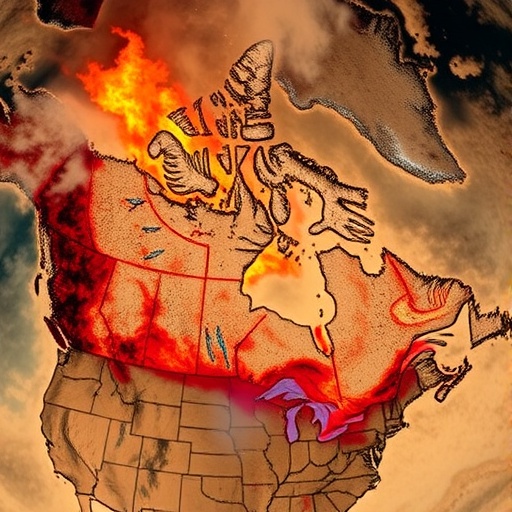
Hamilton, ON—A new study from McMaster University suggests that Canada’s record-breaking 2023 wildfire season was driven less by burning trees and more by combustion of carbon stored underground. The research, published in Geophysical Research Letters, traces most emissions to the smoldering decay of soil and peat rather than to above-ground biomass.
Using field-informed emissions accounting and carbon-source attribution, the authors estimate that underground carbon stores made up about 76% of wildfire emissions. This distinction matters because soil and peat carbon can be far older than forest carbon, with reservoirs accumulated over millennia.
The paper links the findings to the scale and persistence of the 2023 fires. Researchers estimate the wildfires burned roughly 15.1 million hectares—about seven times Canada’s 20-year average—and released approximately 554 million tonnes of carbon. Such volumes are consistent with a season in which long-lasting ground fires sustained burning after surface flames subsided.
Peatlands, which are naturally waterlogged and often resistant to fire, have become increasingly flammable as heat and drought lower water tables. When peat dries, oxygen penetrates deeper layers, enabling smoldering combustion that can continue underground for weeks, releasing greenhouse gases steadily rather than in a brief burst.
The study highlights a feedback loop: deeper soil burning emits carbon that adds to atmospheric warming, which in turn can intensify future wildfire conditions. In the worst cases, this turns landscapes that normally store carbon and dampen fire spread into persistent fuel.
Canada hosts about 1.1 million square kilometres of peatlands. The Hudson Bay Lowlands alone are estimated to store around 30 billion tonnes of carbon, underscoring the stakes of peat vulnerability at a national scale.
The authors report that one-third of all wildfire carbon emissions in 2023 were associated with peatlands. In carbon-dioxide terms, total emissions from the season were roughly three times Canada’s annual human-caused greenhouse-gas emissions reported for 2022.
While forest management can reduce certain risks, the authors argue that many of these fires occur in remote, unmanaged regions where extreme weather and dry peat conditions allow smoldering ground fires to persist. They conclude that curbing global greenhouse-gas emissions is necessary to slow the intensifying fire climate.
Cite Scienmag News
Sloane Callahan. (July 27, 2026). Flaring Soil and Peat Emissions Dominated Canada’s Record 2023 Wildfire Season. Scienmag. https://scienmag.com/flaring-soil-and-peat-emissions-dominated-canadas-record-2023-wildfire-season/
Sloane Callahan. "Flaring Soil and Peat Emissions Dominated Canada’s Record 2023 Wildfire Season." Scienmag, 27 July 2026, https://scienmag.com/flaring-soil-and-peat-emissions-dominated-canadas-record-2023-wildfire-season/. Accessed 4 September 2026.
Sloane Callahan. "Flaring Soil and Peat Emissions Dominated Canada’s Record 2023 Wildfire Season." Scienmag. July 27, 2026. https://scienmag.com/flaring-soil-and-peat-emissions-dominated-canadas-record-2023-wildfire-season/


