


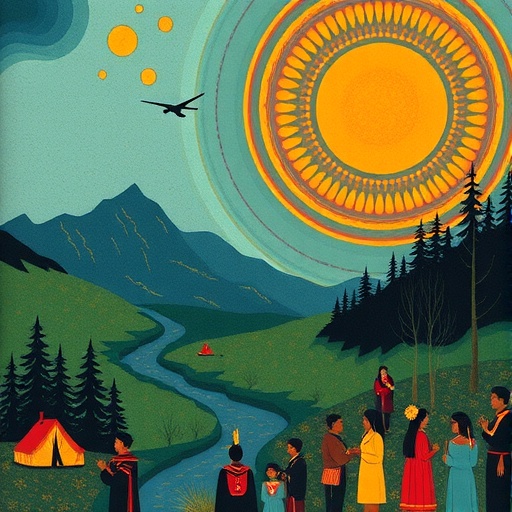
Reno, Nev (July 27) — The Desert Research Institute (DRI) Native Resilience project has released a new open-access eBook, Holding the World in Balance: Indigenous stories of climate, care and continuance. The volume gathers journalism, poetry, fiction, and artwork created by Indigenous writers, artists, and storytellers centered on climate change. Designed for both reflection and action, it offers creative prompts for readers and a teacher’s guide to support classroom use of Indigenous knowledge and ways of thinking from kindergarten through grade 12.
Rather than treating climate change solely as a set of projections, the book frames environmental shifts as lived experiences. Readers follow a photo essay journey down the San Juan River with tylee nez (Diné/Hopi), explore the implications of microplastics for Hawaiian lands and waters with poet Gina McGuire (ʻŌiwi, Native Hawaiian), and consider how relational healing can restore bonds with the natural world through the importance of the hímu (willow) plant to the Wašiw people, described by Robin Smuda (Washoe Tribe of Nevada and California).
A central concept running through the collection is the “relational worldview,” an approach that emphasizes that everything affects everything else. The book also brings Indigenous and non-Indigenous perspectives into conversation through an approach sometimes described as Etuaptmumk—“the gift of multiple perspectives,” also known as two-eyed seeing—highlighting complementary strengths of different knowledge systems.
“Two-Eyed Seeing enables us to bring together Indigenous and non-Indigenous ways of knowing and learning for the good of everyone,” said book co-editor Mary Cathleen Wilson, a resilience reporter for Native Resilience/DRI and contributing author. By pairing narrative methods with scientific framing, the book aims to make climate information both understandable and emotionally resonant.
The chapters were developed by members of the Native Resilience project’s Resilience Reporter program between 2022 and 2026, alongside Indigenous students from the All Climate is Local project (2022–2023). Participants received training in multimedia storytelling and were asked to connect Western-style climate data with personal, cultural, and community histories.
Co-editor Kelsey Fitzgerald, communication coordinator for Native Resilience and lead for the Resilience Reporter program, emphasized that graphs and technical reports can be difficult to connect with. “These stories provide vivid examples of the on-the-ground impacts that climate change is having on Indigenous communities, cultures and lands across North America,” she said, describing adaptation responses and multiple ways climate narratives can be told.
The book’s thematic structure links stories and artwork while ending each section with prompts that invite readers to generate their own accounts. Its teacher’s guide offers framing to help educators integrate interconnectedness and two-eyed seeing into lesson planning, supporting respectful engagement with Indigenous epistemologies.
In the foreword, Michael Durglo Jr of the Confederated Salish and Kootenai Tribes notes that the approach is not about merging knowledge until identities disappear. “It is about respect,” he writes—allowing each way of knowing to stand with integrity, and enabling elder stories and climate models to speak to one another in ways that strengthen understanding.
Work included in the book features contributions by Cherish Grassrope, Derrick Gonzales, Andra Hawk-Valdez, Gina McGuire, Shecota Rae Nalwood Nez, tylee nez, Robin Smuda, Mary Cathleen Wilson, Crystal Miller, and Ileah Kirchoff. The book is edited by Wilson and Fitzgerald, with the All Climate is Local project led by Rene Dubay and Kyle Bocinsky.
The eBook is free and available now via PressBooks. A print version is expected in late summer or early fall. Updates can be signed up for through Native Resilience.
Cite Scienmag News
Russell Cooper. (July 28, 2026). New book shares Indigenous stories of climate care and community resilience. Scienmag. https://scienmag.com/new-book-shares-indigenous-stories-of-climate-care-and-community-resilience/
Russell Cooper. "New book shares Indigenous stories of climate care and community resilience." Scienmag, 28 July 2026, https://scienmag.com/new-book-shares-indigenous-stories-of-climate-care-and-community-resilience/. Accessed 3 September 2026.
Russell Cooper. "New book shares Indigenous stories of climate care and community resilience." Scienmag. July 28, 2026. https://scienmag.com/new-book-shares-indigenous-stories-of-climate-care-and-community-resilience/


