


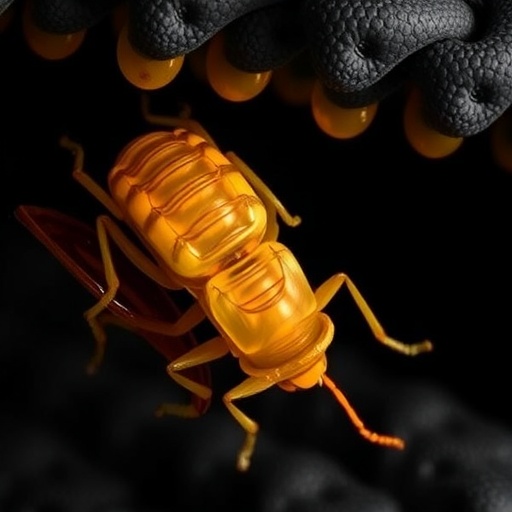
Africa’s deepest lakes may be giving insect evolution a rare loophole: a newly described fly-larva adaptation that stays intact under crushing pressure more than 200 meters below the surface. The study, published in Science, overturns a widely accepted idea that insect physiology—especially air-filled breathing structures—should fail during deep, predator-avoidance dives in the open ocean.
Aquatic insects are abundant in freshwater systems, but none are known to live in the deep pelagic ocean. The traditional explanation points to the insects’ tracheal breathing system, which uses air-filled sacs that would collapse when exposed to high hydrostatic pressure. In many lakes, larvae must either risk predation or descend to avoid fish, yet the deep ocean seems far less forgiving.
Researchers focused on Chaoborus edulis, a lake fly larva thriving in Lake Malawi, one of the deepest lakes on Earth. Instead of using modified air sacs purely for respiration, the larvae repurpose them as buoyancy-control organs. Breathing shifts to the skin, while the sacs become a mechanical tool for surviving pressure and regulating position in the water column.
To test this, the team used sonar to track larval migrations across depth layers in Lake Malawi. They also compared Chaoborus species from shallower habitats, revealing how air-sac properties change with environmental depth and pressure regimes.
The larvae descend daily into the lake’s permanently oxygen-free hypolimnion, returning to surface waters at night to feed. During the day, they routinely reach depths beyond 200 meters. The air sacs follow a two-stage strategy: they adjust buoyancy actively at shallower depths, then become rigid deeper down to resist implosion.
At extreme depths, the largest larvae showed air-sac resistance beyond 500 meters, indicating that the sacs’ materials can withstand conditions that would normally crush air-filled structures. The key lies in specialized layers of resilin, a protein known for elasticity, which flex and contract in response to chemical changes while maintaining structural integrity.
This performance suggests that deep-water insect life may be more plausible than previously assumed. As with the deepest lakes, the study implies that physiological barriers to pelagic colonization may be surmountable through evolutionary innovation—raising the prospect that insects could eventually exploit open-ocean depths.
Cite Scienmag News
Gavin Prescott. (July 28, 2026). Crush-Resistant Air Sacs Enable Insect Larvae Survival at Extreme Depths. Scienmag. https://scienmag.com/crush-resistant-air-sacs-enable-insect-larvae-survival-at-extreme-depths/
Gavin Prescott. "Crush-Resistant Air Sacs Enable Insect Larvae Survival at Extreme Depths." Scienmag, 28 July 2026, https://scienmag.com/crush-resistant-air-sacs-enable-insect-larvae-survival-at-extreme-depths/. Accessed 6 September 2026.
Gavin Prescott. "Crush-Resistant Air Sacs Enable Insect Larvae Survival at Extreme Depths." Scienmag. July 28, 2026. https://scienmag.com/crush-resistant-air-sacs-enable-insect-larvae-survival-at-extreme-depths/


