


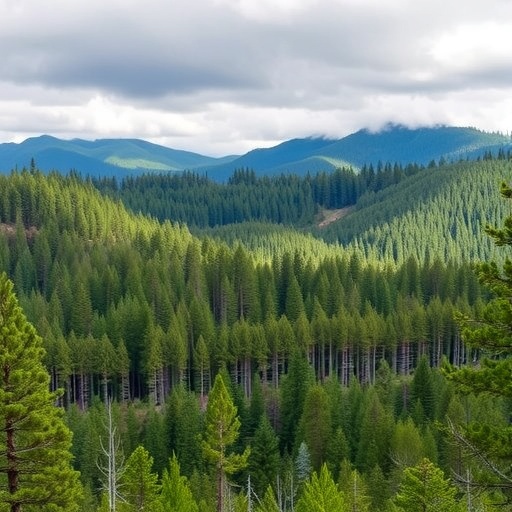
A groundbreaking study published in Communications Earth & Environment has unveiled compelling evidence showing how climate change is drastically accelerating the dynamics of deadwood in forests around the globe. The research, led by Edelmann, Rammer, and Pugh among other collaborators, sheds light on a crucial but often overlooked aspect of forest ecosystems: the turnover and decay rates of deadwood. As global forests face increasing pressures from rising temperatures and shifting precipitation patterns, this work highlights the complex interplay of environmental factors that are hastening the decomposition and cycling of dead organic matter, with profound implications for carbon storage and forest health worldwide.
Deadwood, which consists of fallen branches, standing dead trees, and other non-living woody material, plays an essential role in forest ecosystems. It acts as a carbon reservoir, a habitat for countless species, and a key component in nutrient cycling and soil formation. However, climate change is fundamentally altering the processes that regulate the accumulation and decay of deadwood. Through the integration of global forest inventory data, remote sensing technologies, and advanced modeling approaches, the study traces the intricate pathways through which warming temperatures and altered moisture regimes increase the rate at which deadwood decays and disappears from the forest landscape.
The authors meticulously analyze data spanning multiple decades and diverse forest biomes, from boreal coniferous forests in the north to tropical rainforests near the equator. Their approach leverages state-of-the-art Earth system models coupled with statistical frameworks optimized for detecting subtle trends in forest carbon dynamics. One of the pivotal findings reveals that as the climate warms, microbial and fungal decomposers become more active, accelerating the breakdown of lignin and cellulose, the key structural components of wood. This intensification of decomposition rates reduces the residence time of deadwood on forest floors, meaning less carbon remains sequestered in these natural reservoirs.
Furthermore, this accelerated deadwood turnover has ripple effects across forest ecosystems. For example, rapid decay can influence the availability of habitats for insects, birds, and fungi that depend on deadwood for shelter and food. The deterioration of these microhabitats could upset biodiversity patterns, threaten species reliant on structural deadwood components, and ultimately alter forest community composition. Additionally, faster decomposition contributes to increased carbon dioxide emissions from forests, feeding back into the climate system and potentially compounding global warming.
Another key insight gained from the study is the regional variability in how deadwood dynamics respond to climate change. In northern latitudes, where forests have historically accumulated significant deadwood biomass due to slower decay rates, warming is prompting a notably sharper increase in turnover rates. In contrast, tropical forests, already characterized by rapid wood decomposition, show more subtle but still significant shifts in the quantity and quality of deadwood. These nuanced regional responses underscore the necessity of tailored forest management strategies that consider local climate impacts and ecosystem types.
Importantly, the research also reveals the interplay between deadwood dynamics and forest disturbance regimes, such as wildfires, pest outbreaks, and storms. As climate change intensifies these disturbances, more trees die, initially increasing the deadwood pool. However, faster decay rates eventually diminish this pool quicker than forests can regenerate it. This imbalance creates a precarious situation where deadwood-dependent carbon storage potential shrinks, and forest resilience against climate stressors is compromised.
The study deploys a range of innovative remote sensing technologies, including LiDAR and hyperspectral imaging, to map deadwood spatial distribution and quantify its biomass across continents. These advancements represent a transformative leap in forest ecology research, providing more precise and scalable measurements than traditional ground-based surveys. Coupling these datasets with machine learning algorithms enables researchers to predict future deadwood trends under various climate scenarios, offering invaluable tools for policymakers.
One notable strength of this study lies in its multidisciplinary collaboration, combining expertise in ecology, climatology, soil science, and computational modeling. This holistic approach allows a comprehensive understanding of deadwood as a dynamic component of terrestrial ecosystems affected by, and affecting, global carbon cycles. Their findings emphasize that neglecting deadwood dynamics could lead to significant underestimations of forest carbon fluxes in Earth system models, thereby misinforming climate projections and mitigation efforts.
The implications of accelerated deadwood dynamics extend beyond academic discourse into practical forest management and climate policy realms. Forest managers are urged to integrate considerations of deadwood turnover rates when designing carbon sequestration projects or biodiversity conservation plans. For example, strategies that enhance deadwood retention, such as protecting fallen trees and standing snags, could mitigate some of the ecosystem service losses associated with faster decomposition.
Moreover, this study opens avenues for further research to explore how other global change factors—such as increased atmospheric CO2, nitrogen deposition, and invasive species—might interact with climate-driven deadwood dynamics. Understanding these synergistic effects will be pivotal for developing adaptive management frameworks that sustain forest carbon sinks in a rapidly changing world.
From a broader vantage point, the accelerated dynamics of deadwood underscore a fundamental truth: forests are not static repositories of carbon but highly dynamic systems influenced by multifaceted environmental pressures. The delicate balance of growth, mortality, and decay processes shapes their capacity to buffer climate change. As the planet warms, the feedback loops emanating from altered deadwood decomposition rates represent both a challenge and a call to action for scientists, managers, and policymakers.
In summary, the research by Edelmann and colleagues pioneers a critical area of forest climate science, revealing that climate change not only affects live tree growth and mortality but also profoundly transforms the fate of deadwood, a crucial carbon pool. Their comprehensive approach, integrating long-term observations, remote sensing innovations, and predictive modeling, provides robust evidence that global warming accelerates deadwood turnover, thereby influencing carbon cycling and ecosystem resilience worldwide. As the scientific community incorporates these insights, it becomes clear that preserving forest carbon storage in the Anthropocene rests on understanding and managing the hidden yet vital processes governing deadwood dynamics.
The urgency of taking account of deadwood in climate mitigation strategies cannot be overstated. The study conveys how ignoring these processes risks missing an integral piece of the carbon budget puzzle. Only through targeted research, innovative monitoring technologies, and adaptive forest management can humanity safeguard forest ecosystems and their climatic benefits amidst ongoing environmental transformations.
Ultimately, this work serves as a clarion call, underscoring the interconnectedness between forest structural components and global climate systems. It highlights the profound complexities and cascading consequences of climate change on terrestrial carbon reservoirs and enriches our understanding of how forests breathe, decompose, and respond in an era of unprecedented planetary change.
Cite Scienmag News
Sloane Callahan. (May 25, 2026). Climate Change Speeds Up Global Forest Deadwood Dynamics. Scienmag. https://scienmag.com/climate-change-speeds-up-global-forest-deadwood-dynamics/
Sloane Callahan. "Climate Change Speeds Up Global Forest Deadwood Dynamics." Scienmag, 25 May 2026, https://scienmag.com/climate-change-speeds-up-global-forest-deadwood-dynamics/. Accessed 3 September 2026.
Sloane Callahan. "Climate Change Speeds Up Global Forest Deadwood Dynamics." Scienmag. May 25, 2026. https://scienmag.com/climate-change-speeds-up-global-forest-deadwood-dynamics/


