


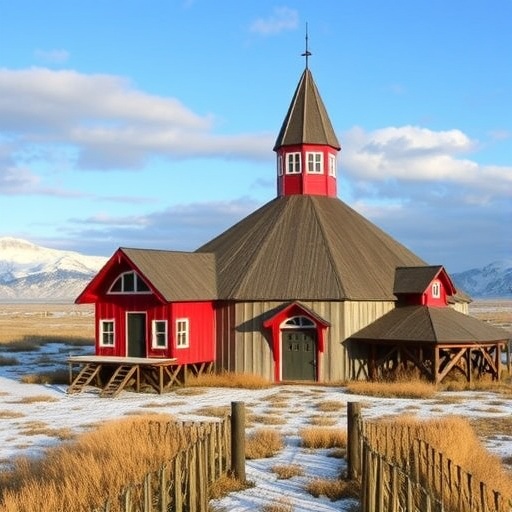
Amid the rapidly altering Arctic landscape, a silent yet profound tragedy is unfolding beneath thawing permafrost—an irreversible loss of invaluable cultural heritage. A pioneering study published in the open-access journal PLOS One on May 20, 2026, by researchers Lise Loktu of the Norwegian Institute for Cultural Heritage Research and Elin Therese Brødholt of Oslo University Hospital, Norway, exposes the devastating impacts of climate change on a 17th-century whalers’ burial site at Likneset, Svalbard. This work not only chronicles the destruction of Arctic archaeological sites but also sheds light on the harsh living conditions and occupational hardships of early modern Arctic whalers through detailed osteological and textile analyses.
The Arctic is warming at a rate significantly faster than the global average, triggering a cascade of environmental transformations that include permafrost thaw and accelerated coastal erosion. These transformations undermine the preservation of cold-sensitive archaeological sites, particularly those with biotic materials such as textiles and skeletal remains. Despite their critical importance for cultural heritage and scientific inquiry, comprehensive studies quantifying the risks of climate-driven site degradation in this fragile region have been lacking—until now.
Loktu and Brødholt’s study focuses on the whaling graveyard at Likneset, a location intrinsically tied to the economic and social history of early Arctic whaling, often regarded as one of Europe’s first “oil industries.” By comparing field excavations from the 1980s with those carried out in the 2010s, the researchers documented stark contrasts in preservation quality, especially of organic materials prone to decay. Textiles that were once remarkably preserved during earlier excavations exhibited marked deterioration in subsequent digs, underscoring the accelerating erosional forces at work along the Svalbard coastline.
This study’s detailed examination of burial phases reveals notable differences in textile preservation tied to environmental stability. Phase III burials from Field area B, for example, displayed significantly better textile integrity than earlier phases, likely due to more stable burial conditions that limited environmental disturbances. Textiles recovered from Phase III burials included a range of garments such as finely felted woollen stockings, a woollen jacket, meticulously woven trousers, fragments of a blue-striped linen shirt, and delicate blue silk scarves, providing a rare window into the material culture of the whalers.
Archaeological findings extend beyond textile remnants. Skeletal remains predominantly consist of young adult males who displayed extensive markers of physical strain and malnutrition. Stress indicators on the bones suggest chronic conditions linked to the demanding labor and harsh occupational environment encountered by these early whalers. Importantly, the data argue that premature mortality in these individuals typically stemmed from prolonged physical stress and nutritional deficiencies rather than acute traumatic events, illuminating the grueling realities behind the whaling economy.
The degradation of such sites signals not just the loss of physical artifacts, but the erasure of narrative archives crucial for historical and anthropological understanding. As the permafrost thaws and the coastline recedes, entire assemblages of cultural data—intertwining environmental, social, and health histories—face obliteration. These findings sound a powerful alarm regarding current Arctic cultural resource management strategies, which appear ill-equipped to contend with the rapid onset of climate-induced threats.
The researchers emphasize the necessity of revising Arctic heritage protocols to incorporate agile and proactive conservation frameworks tailored to the emergent risks posed by climate change. Their call for greater investment in systematic monitoring and comparative studies across multiple burial sites in the region underlines a broader imperative to prioritize at-risk archaeological assets that may serve as critical touchstones for understanding human adaptation, survival, and labor in extreme environments.
In the broader context of occupational health history, the skeletal remains offer a uniquely tangible record of early industrial labor’s human costs. These remains narrate stories of hardened workers subjected to grueling physical demands, poor nutrition, and disease—the unseen sacrifices underlying early resource extraction industries that fueled emergent economies in northern Europe. This research bridges material culture and bioarchaeology, linking environmental degradation with historical epidemiology and social history.
The study’s nuanced approach highlights that heritage loss stemming from climate change is not a mere future concern but an ongoing crisis with irreversible consequences. It amplifies the call for integrating archaeological findings within climate change discourse, urging policymakers, conservators, and scientists to jointly safeguard cultural patrimony as part of broader environmental preservation efforts. The loss of Svalbard’s whalers’ burial ground represents a microcosm of global patterns in which climate impacts jeopardize intangible cultural knowledge bonded to physical landscapes.
Furthermore, the technological methodologies employed in this research, including orthomosaic imaging and advanced osteological analyses, exemplify how modern scientific tools can enhance the detection and interpretation of subtle damage caused by environmental variables. Such methodological innovation paves the way for more sophisticated monitoring techniques that could extend to other vulnerable Arctic sites, ensuring that the rapid transformations of the physical world do not silence the historical voices preserved within.
As the researchers poignantly conclude, these skeletons encapsulate the human toll wrought by Europe’s nascent oil economy, marking the physical imprints of labor, diet, disease, and migration patterns on bodies long since interred. Their work not only encapsulates a cultural narrative frozen in time but also serves as a dire warning: without timely intervention, vital chapters of human history incised into Arctic permafrost will irrevocably vanish, erasing the voices of those who shaped the early modern industrial north.
This investigation stands as a sentinel call to the global community, urging a re-evaluation of heritage strategies amidst climatic upheaval. The loss at Likneset is emblematic of a broader, accelerating fate confronting polar heritage sites worldwide. It is a vivid reminder that cultural preservation must be tightly integrated with climate adaptation policies to avert the permanent loss of archaeological and anthropological archives crucial to understanding humanity’s intertwined past with the Arctic environment.
Cite Scienmag News
Courtney Benton. (May 20, 2026). Arctic Cultural Heritage Sites Threatened by Climate Change. Scienmag. https://scienmag.com/arctic-cultural-heritage-sites-threatened-by-climate-change/
Courtney Benton. "Arctic Cultural Heritage Sites Threatened by Climate Change." Scienmag, 20 May 2026, https://scienmag.com/arctic-cultural-heritage-sites-threatened-by-climate-change/. Accessed 3 September 2026.
Courtney Benton. "Arctic Cultural Heritage Sites Threatened by Climate Change." Scienmag. May 20, 2026. https://scienmag.com/arctic-cultural-heritage-sites-threatened-by-climate-change/


