


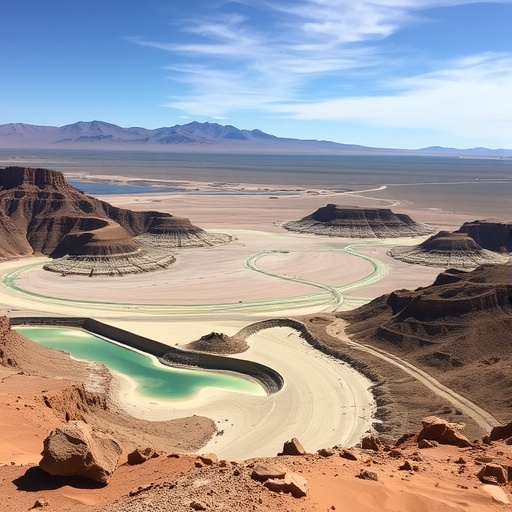
In a groundbreaking study published in Nature Communications, researchers have uncovered compelling evidence pointing to the aridification of the Atacama Desert’s hyperarid core dating back to the Eocene epoch, approximately 34 to 56 million years ago. This discovery fundamentally reshapes our understanding of the timeline and mechanisms that led to the development of one of the driest places on Earth. The Atacama Desert’s extreme aridity has fascinated scientists for decades, and this new research provides a nuanced, geochemically supported narrative of how such inhospitable conditions came to be.
The Atacama Desert, located along the western edge of South America, is renowned for its hyperarid environment, where some weather stations have never recorded rainfall. Despite its severe dryness, the desert possesses a complex geological and climatic history that has remained elusive until recent advances in geochemical analysis and stratigraphic studies allowed for more precise timeline reconstructions. The study at hand utilizes sophisticated isotopic evidence and sedimentological data to trace how the core of the desert transitioned into extreme aridity over millions of years.
Central to this new understanding is the analysis of paleoenvironmental proxies derived from sediment cores and ancient mineral deposits that capture the chemical fingerprints of their depositional environments. By examining oxygen and hydrogen isotopic compositions, alongside trace element abundances in evaporite minerals and clay sediments, the research team could infer past precipitation patterns and humidity levels. This multi-proxy approach is key to reconstructing the paleoclimatic conditions with enhanced temporal resolution, yielding insights into the gradual shift from wetter landscapes to the arid conditions characterizing the modern desert.
The study indicates that during the Eocene, the Atacama region experienced significant climatic shifts influenced by both tectonic activity and evolving atmospheric circulation patterns. The uplift of the Andes played a pivotal role by altering wind and moisture transport mechanisms. This orogeny intensified the rain shadow effect, thereby progressively limiting moisture intrusion into the Atacama basin. The research suggests that these tectonic-driven processes combined with emerging global climatic trends expedited the desiccation that culminated in the hyperarid state observed today.
Another fascinating component of the research is the documentation of transient wetter intervals during the Eocene, which punctuated the overall trend towards drier conditions. These episodes are inferred from sediment layers exhibiting relatively higher moisture indicators, suggesting that the aridification was not a linear progression but rather a complex interplay of fluctuating environmental variables. Such nuances add depth to our understanding of desert formation and highlight the importance of considering variable climatic phases when reconstructing paleoenvironmental histories.
The implications of Eocene aridification in the Atacama Desert extend beyond regional geology and climatology; they provide a valuable analogue for understanding deserts on other planetary bodies. Given the desert’s Mars-like conditions, insights into the timing and processes leading to its extreme dryness offer clues into planetary surface evolution under varying atmospheric and tectonic influences. Moreover, this knowledge can inform astrobiological explorations by defining potential habitats and the preservation of biosignatures in hyperarid environments.
From a methodological perspective, the study exemplifies how interdisciplinary scientific approaches, combining geochemistry, sedimentology, and geochronology, can unravel deep-time environmental changes with unprecedented clarity. High-precision isotopic measurements enabled the researchers to pinpoint the timing of aridification events and cross-validate these with stratigraphic markers and tectonic data. This rigorous framework sets a precedent for future paleoclimate studies focused on other arid or semi-arid regions worldwide.
Intriguingly, the research team also highlights the role of atmospheric circulation patterns, such as the Hadley Cell and shifting oceanic currents, in modulating regional moisture balance during the Eocene. Their findings suggest that global climatic dynamics intertwined with local geological processes in complex feedback loops, reinforcing drought conditions in the Atacama. Recognition of these multifaceted drivers underscores the interconnectedness of Earth’s climatic system and its sensitivity to both internal and external forcing mechanisms.
The evolutionary consequences of prolonged aridification phases for the region’s biosphere are also discussed. The gradual onset of extreme dryness would have placed considerable stress on terrestrial ecosystems, driving adaptations, migrations, or extinctions of flora and fauna. These biological responses, in turn, influenced surface processes such as soil formation, sediment transport, and even mineral deposition patterns, creating a dynamic co-evolution between the environment and life forms inhabiting the desert margin zones.
Another significant aspect of this research is the novel use of hyperarid core sediments as natural archives not only for climate but also for atmospheric chemistry reconstructions. As the hyperarid desert limits post-depositional alterations, these sediments retain pristine chemical signatures that can reflect historic atmospheric compositions. Such records could elucidate the past concentrations of greenhouse gases, aerosols, and other atmospheric constituents, granting a deeper understanding of their evolution during critical climatic transitions.
Importantly, the study contextually situates the Atacama’s aridification within global Eocene climatic trends, including greenhouse gas fluctuations, oceanic temperature shifts, and polar ice dynamics. This integrative perspective reveals that the desert’s hyperaridity is not merely a local phenomenon but part of larger Earth system transformations during the early Cenozoic. By aligning desert evolution with global climate models, researchers can better predict future aridification patterns in the face of ongoing anthropogenic climate change.
Public fascination with deserts often centers on their mystery and extremes, and this research enriches public knowledge by telling the story of the Atacama’s ancient climate dramas with scientific precision. As a journalistic effort, it bridges complex geochemical techniques and large-scale climatic narratives, making the science accessible and engaging. More than a mere academic exercise, this work redefines how we perceive deserts—as dynamic landscapes shaped by deep-time forces rather than static wastelands.
Looking forward, the insights presented by this study open avenues for exploring other ancient desert regions where similar methodologies could yield comparable revelations. Specifically, comparative work across different deserts globally could elucidate whether analogous tectonic and climatic mechanisms induced aridification elsewhere or if unique local factors dominate. Such comparative paleoenvironmental research promises to enhance our grasp of Earth’s climatic evolution and its regional expressions.
The potentially transformative implications of this research also resonate in applied sciences, influencing water resource management in arid regions, desertification mitigation strategies, and environmental conservation policies. Understanding end-member aridification processes equips scientists and policymakers with better tools to anticipate desert expansion under modern warming scenarios, fostering resilience strategies tailored to delicate desert ecosystems.
Finally, this study exemplifies the power of curiosity-driven fundamental research to uncover Earth’s ancient climatic secrets. By peering into the Eocene past, scientists have not only charted the origins of the Atacama Desert’s forbidding dryness but have also contributed to the broader narrative of planetary climate dynamics. Such discoveries underscore the profundity and interconnectedness of Earth’s natural history, affirming the enduring quest to comprehend our planet’s complex environmental heritage.
Cite Scienmag News
Violet Maxwell. (May 20, 2026). Eocene Origins of Atacama Desert’s Extreme Aridity. Scienmag. https://scienmag.com/eocene-origins-of-atacama-deserts-extreme-aridity/
Violet Maxwell. "Eocene Origins of Atacama Desert’s Extreme Aridity." Scienmag, 20 May 2026, https://scienmag.com/eocene-origins-of-atacama-deserts-extreme-aridity/. Accessed 5 September 2026.
Violet Maxwell. "Eocene Origins of Atacama Desert’s Extreme Aridity." Scienmag. May 20, 2026. https://scienmag.com/eocene-origins-of-atacama-deserts-extreme-aridity/


