


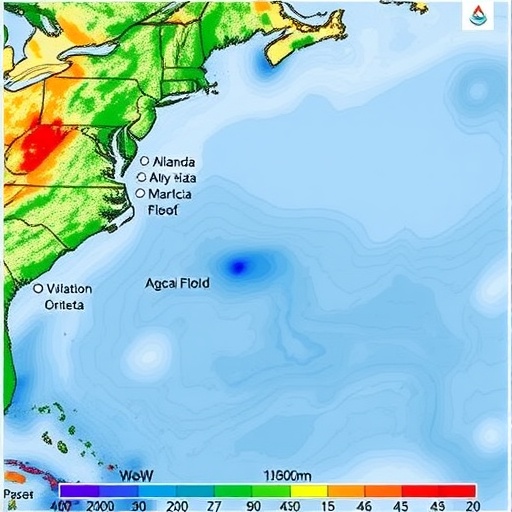
The intricate dance of ocean currents and climate variability has long fascinated scientists seeking to understand and predict extreme weather phenomena. A groundbreaking study published by Zhang, Murakami, Delworth, and colleagues in Communications Earth & Environment (2026) has shed new light on the multiyear predictability of flood frequency along the U.S. Southeast Coast by examining the variability of the Atlantic Meridional Overturning Circulation (AMOC). This research offers a transformative view on how changes deep within the Atlantic Ocean ripple outward to influence coastal flood risks over extended periods, potentially revolutionizing flood forecasting and risk management strategies.
At the heart of this study lies the AMOC, a major component of the global ocean conveyor belt, which transports warm, salty water from the tropics toward the North Atlantic, where it cools and sinks, driving a vital thermohaline circulation. Variations in the strength and structure of the AMOC have profound impacts on regional climate patterns, yet their influence on flood frequencies has remained elusive due to the complex interplay of atmospheric and oceanic processes. Zhang and the team have now made significant progress in decoding this relationship, pinpointing how multiyear to decadal fluctuations in the AMOC modulate flood risk along one of America’s most vulnerable coastlines.
The U.S. Southeast Coast, stretching from North Carolina down through Florida, is increasingly battered by recurrent coastal flooding events attributed to sea-level rise, extreme storms, and changing ocean circulation patterns. Over recent decades, these floods have jeopardized millions of residents, infrastructure, and ecosystems. Conventional short-term forecasting methods have struggled to provide sufficient lead times for effective flood mitigation. With this context, the study’s demonstration that natural oceanic variability associated with the AMOC contains signals predictive of flood frequency years in advance is a breakthrough in the field.
Using a combination of advanced climate models, ocean observations, and statistical techniques, the researchers meticulously unravel the linkage between AMOC variability and flood incidence. Their analysis reveals that when the AMOC is in a relatively strong phase, the Southeast Coast experiences a lower frequency of floods, attributable to reduced coastal sea-level anomalies and altered atmospheric conditions. Conversely, a weakened AMOC phase correlates with elevated flood risks, as the ocean circulation changes drive higher sea levels and intensify storm surges in the region.
Central to this mechanistic understanding is how the AMOC influences regional sea level through dynamic ocean height changes. The study elucidates that fluctuations in the northward transport of heat and salt alter the density gradients and ocean pressure fields along the eastern seaboard, effectively modulating local sea surface heights. These variations, combined with changes in prevailing wind patterns and atmospheric pressure induced by AMOC shifts, create a multiyear rhythm in flooding vulnerability that had been previously underestimated in predictive models.
A striking aspect of the research is the degree to which these multiyear signals enhance predictability beyond the scope of typical meteorological forecasts focusing on seasonal or annual scales. By leveraging climate model simulations validated against historical observations, the authors demonstrate the capacity to anticipate flood risk trends several years in advance with statistically significant skill. This extended predictive horizon opens new avenues for resource planning, insurance risk assessment, and urban resilience efforts in flood-prone communities.
The implications extend beyond immediate flood mitigation. Improved understanding of the AMOC’s role offers critical insights into how future climate change may alter ocean circulation patterns and, by extension, coastal flooding regimes. As greenhouse gas emissions continue to warm the planet, many climate models project a weakening of the AMOC, potentially exacerbating coastal flood risks on multiyear to decadal timescales. Zhang and colleagues’ findings emphasize the urgency of integrating ocean circulation monitoring and prediction into comprehensive climate adaptation strategies.
Technically, the study pushes the envelope on climate science methodology by integrating fine-scale ocean–atmosphere coupled models with statistical frameworks tailored to isolate the AMOC’s signal amidst natural variability and other confounding climatic factors. This interdisciplinary approach underscores the value of synthesizing physical oceanography with atmospheric science and risk modeling to unravel complex climate-flood linkages. The comprehensive datasets employed include satellite altimetry, tide gauge records, and subsurface ocean profiling, all harmonized to provide a robust empirical basis for the theoretical advances.
Moreover, the research addresses the heterogeneity in flood impacts along the Southeast Coast, noting that regional geography, coastal morphology, and local hydrodynamics interact with AMOC-driven changes, resulting in spatially variable flood risks. For example, northeastern parts of the region respond differently compared to the southern tip of Florida due to differences in coastal shelf width and ocean current pathways. Such granular understanding is critical for tailoring risk management interventions to local conditions rather than relying on broad-brush regional assessments.
The study also highlights the importance of sustained long-term ocean monitoring systems capable of capturing AMOC variability with high fidelity. Continuous observational networks, including deep-ocean moorings and autonomous floats, are essential to validate and refine predictive models, offering the possibility to establish operational flood forecasts grounded in real-time oceanographic data. Investments in enhanced AMOC observation technologies will thus play a pivotal role in translating these scientific insights into actionable early-warning systems for coastal communities.
One of the most compelling outcomes from this research is the potential to link societal impact forecasting with climate science in unprecedented ways. By furnishing stakeholders with multiyear flood probability outlooks informed by ocean circulation changes, emergency planners, policymakers, and infrastructure managers gain a valuable planning tool to balance immediate needs with longer-term resilience building. This paradigm shift could lead to more adaptive coastal defense designs, insurance frameworks that better reflect evolving risk, and informed urban development strategies resilient against future flooding.
Importantly, the article notes that while AMOC variability offers a powerful predictive lever, it is not the sole determinant of flood frequency. The authors caution that atmospheric teleconnections, storm track variability, local subsidence, and anthropogenic influences remain critical factors influencing flood regimes. Thus, the integration of AMOC signals into multifactorial predictive frameworks is necessary to capture the full complexity of coastal flood dynamics, avoiding oversimplified outlooks.
In summation, Zhang, Murakami, Delworth, and colleagues have ushered in a new era of understanding coastal flood predictability by anchoring the analysis in ocean circulation variability, specifically the AMOC. Their evidence decisively links the deep ocean’s slow-moving currents with surface-level flood risk patterns, highlighting a powerful and previously underutilized source of predictability. This nexus of oceanography and climate risk science promises to transform how societies anticipate and adapt to the growing threats posed by coastal flooding amid a changing climate.
As the impacts of climate change intensify, such integrated, forward-looking approaches to flood prediction are indispensable. The insights from this pioneering research provide a blueprint for combining ocean observation, climate modeling, and risk management to mitigate the devastating consequences of floods. The hope is that governments, research institutions, and coastal communities will leverage these findings to build smarter, more resilient futures, where ocean science directly informs the protection of vulnerable populations and vital infrastructures.
The study stands as a testament to the value of international collaboration and cross-disciplinary innovation in tackling some of the most urgent climate challenges of our time. As the Atlantic Meridional Overturning Circulation continues to be carefully monitored, the knowledge distilled from this research will doubtless inform a new generation of climate resilience policies that better anticipate and manage the ebb and flow of nature’s forces along the U.S. Southeast Coast and beyond.
Cite Scienmag News
Violet Maxwell. (June 9, 2026). Atlantic Circulation Drives Multiyear Southeast Flood Predictability. Scienmag. https://scienmag.com/atlantic-circulation-drives-multiyear-southeast-flood-predictability/
Violet Maxwell. "Atlantic Circulation Drives Multiyear Southeast Flood Predictability." Scienmag, 9 June 2026, https://scienmag.com/atlantic-circulation-drives-multiyear-southeast-flood-predictability/. Accessed 4 September 2026.
Violet Maxwell. "Atlantic Circulation Drives Multiyear Southeast Flood Predictability." Scienmag. June 9, 2026. https://scienmag.com/atlantic-circulation-drives-multiyear-southeast-flood-predictability/


