


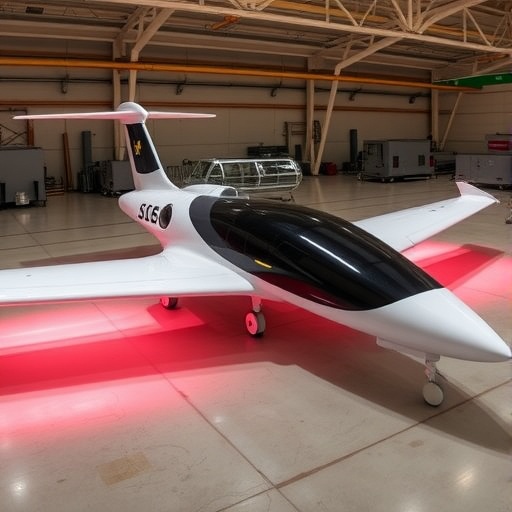
In a groundbreaking development showcased at the recent AIAA AVIATION Forum, a novel turboelectric airliner concept has emerged, promising to revolutionize the future of commercial aviation with a remarkable 17% efficiency improvement over current 2050 projections for standard airliners. Spearheaded by the innovative hybrid-electric aviation company Electra, this cutting-edge aircraft design represents a pivotal step toward sustainability in the aerospace industry. Integral to this advancement was the significant contribution from the University of Michigan’s Aerospace Engineering team, whose expertise in multidisciplinary design and optimization catalyzed the exploration and refinement of a broader spectrum of design possibilities than previously achievable.
This visionary aircraft concept aligns with NASA’s Advanced Aircraft Concepts for Environmental Sustainability (AACES 2050) initiative, underscoring an industry-wide commitment to slashing carbon emissions and enhancing aircraft performance through electrification. What separates this endeavor from prior efforts is the intricacy of simultaneously balancing aerodynamics, structural integrity, propulsion efficiency, and thermal regulation—factors that are inherently interconnected. Modifications in any one domain ripple across others, influencing engine placement, thrust demands, and weight distribution, among other critical parameters. The University of Michigan team, led by assistant professor Gökçin Çınar and the distinguished Pauline M. Sherman Collegiate Professor Joaquim Martins, engineered sophisticated extensions to NASA’s open-source Aviary design platform. These enhancements enable concurrent optimization across all primary aircraft systems, facilitating a holistic and finely tuned developmental process.
Over the course of this rigorous study, the research team meticulously evaluated twenty divergent aircraft architectures under more than one hundred thousand varied scenarios, employing both low- and high-fidelity simulation models to balance computational feasibility with detailed accuracy. Initial insights drawn from simplified models favored designs incorporating highly distributed propulsion systems, characterized by numerous electric propellers strategically arrayed across the wings and tail sections. However, the deeper insights gleaned from advanced and higher-fidelity simulations painted a more nuanced picture. These revealed the complex trade-offs involving increased structural weight, aerodynamic drag, and the formidable challenges associated with managing dissipated heat, collectively tipping the balance in favor of a distinctly different aircraft configuration.
The final design framework settled on a hybrid approach, integrating conventional turbofan engines under each wing complemented by electric fans installed near the rear fuselage. This partially electrified system strategically leverages the benefits of electric propulsion while circumventing some of the inherent limitations of full electrification, including current battery energy density constraints and thermal management complexities. A unique feature of this design is the adoption of a “double-bubble” wide-body fuselage, initially conceptualized by researchers at MIT. This fuselage innovatively contributes to the overall lift generation, transcending the conventional role of the aircraft body as mere payload carrier.
Furthermore, the rear-mounted electric fans harness the principles of fuselage boundary-layer ingestion, an advanced aeropropulsion technique that accelerates slower-moving air flowing over the aircraft’s upper surfaces. By ingesting this boundary-layer air, the fans reduce the energy losses typical of aircraft wake turbulence, thereby decreasing the thrust burden on the underwing turbofans. This elegant synergy between aerodynamic shaping and propulsion integration exemplifies the multidisciplinary optimization strategy that underpins the project.
Complementing the aerodynamic and propulsion innovations, the team also integrated cutting-edge battery modeling techniques to address power storage and thermal dynamics, essential in hybrid-electric propulsion design. Under the guidance of Professor Venkat Viswanathan, the battery systems were rigorously analyzed to determine optimal pack size, weight, performance characteristics, and longevity, including robust assessment of heat dissipation dynamics and capacity degradation over time. This rigorous energy systems modeling ensured realistic performance parameters and avoided overly optimistic assumptions that have previously hampered the development of electric aviation technologies.
In parallel, market dynamics and adoption timelines were scrutinized under the stewardship of assistant professor Max Li, who developed predictive models to explore when and which commercial airline routes are likely to embrace next-generation, eco-efficient aircraft. These forward-looking market studies provided vital contextual frameworks for aligning technological development with real-world operational requirements and demand patterns, ensuring that the novel turboelectric design meets not only engineering excellence but also commercial viability.
The integration of these diverse research strands dramatically broadens the conceptual design space, facilitating an iterative refinement process informed by both technological feasibility and pragmatic market considerations. This holistic approach stands in sharp contrast to earlier design efforts that often considered propulsion, structure, aerodynamics, or market factors in isolation, underscoring the power of multidisciplinary collaboration in advancing aerospace innovation.
Recognizing the complexity inherent in optimizing for multiple interdependent subsystems, the team emphasized the necessity of multi-fidelity simulations – a methodological approach combining broad exploratory models with detailed analyses of specific aspects. This allowed for early elimination of unpromising concepts followed by deep dives into promising designs, thus efficiently navigating the trade-off landscape shaped by weight, drag, thermal challenges, and propulsion system scale.
The unveiling at AIAA also highlighted the collaborative ecosystem fueling this project, involving prominent industry leaders such as American Airlines, Honeywell Aerospace, Lockheed Martin’s Skunk Works, and Hinetics, alongside academic powerhouses like MIT and the University of California, Irvine. This convergence of expertise from academia, industry, and government underscores the importance of coordinated efforts to confront the multifaceted challenges of sustainable aviation.
Moreover, the recognition of emerging talent was underscored by Ph.D. student Sinan Abdulhak, who received the Neil Y. Chen Memorial Best Student Paper Award for his substantial contributions in market modeling. His work illustrates the critical role of integrating economic and operational forecasting in technological innovation pathways.
In summary, Electra’s turboelectric airliner concept, with its innovative hybrid propulsion system, advanced aerodynamic features, and wide-body lift-augmenting fuselage, embodies a visionary yet practical approach to decarbonizing aviation. Supported by University of Michigan’s profound contributions in multidisciplinary design optimization, battery modeling, and market analysis, the project signifies a meaningful stride toward realizing sustainable air travel by 2050. This unification of analytical granularity, system integration, and market foresight establishes a new benchmark for future aircraft design—one where electrification’s benefits are harnessed judiciously within complex, real-world constraints.
As this project progresses through additional presentations and panel discussions at the ongoing AVIATION Forum, it will continue to inspire innovations that blend scientific rigor with ambitious environmental goals. The strategic combination of propulsion technologies and aerodynamic refinements showcased here marks a promising direction toward reducing aviation’s environmental footprint without compromising performance or commercial feasibility. Through continued interdisciplinary collaboration and advanced computational methodologies, the dream of efficient, sustainable, and economically viable airliners for the mid-21st century edges ever closer to reality.
News Publication Date:
June 2026 (AIAA AVIATION Forum coverage)
Web References:
https://aviation.aiaa.org/
https://electra.aero/
https://aero.engin.umich.edu/people/cinar-gokcin/
https://aero.engin.umich.edu/people/martins-joaquim-r-r-a/
https://aero.engin.umich.edu/people/viswanathan-venkat/
https://aero.engin.umich.edu/people/li-max/
https://aero.engin.umich.edu/2026/06/10/michigan-aerospace-team-helps-shape-nasa-backed-vision-for-efficient-airliners-of-2050/
Cite Scienmag News
Denise Maddox. (June 10, 2026). U-M Engineers Collaborate on Next-Generation Advanced Airliner Concept. Scienmag. https://scienmag.com/u-m-engineers-collaborate-on-next-generation-advanced-airliner-concept/
Denise Maddox. "U-M Engineers Collaborate on Next-Generation Advanced Airliner Concept." Scienmag, 10 June 2026, https://scienmag.com/u-m-engineers-collaborate-on-next-generation-advanced-airliner-concept/. Accessed 3 September 2026.
Denise Maddox. "U-M Engineers Collaborate on Next-Generation Advanced Airliner Concept." Scienmag. June 10, 2026. https://scienmag.com/u-m-engineers-collaborate-on-next-generation-advanced-airliner-concept/


