


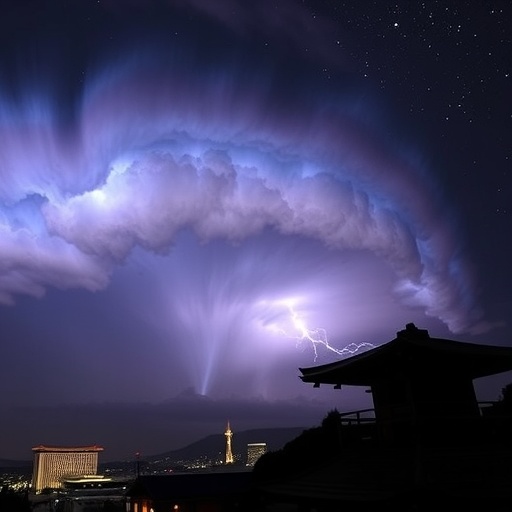
On an extraordinary evening, if fortune favors the keen observer, the skies over Japan may reveal a faint red glow at low latitudes, a subtle crimson haze quietly spanning the horizon. This delicate phenomenon, often overlooked due to its diffuse and subdued nature, is in fact a manifestation of complex space weather processes driven by countless charged particles originating from the Sun. These particles travel through the solar wind, interact with Earth’s magnetosphere, and ultimately collide with oxygen atoms high in Earth’s upper atmosphere, in layers where the air is exceedingly thin. The collisions excite oxygen atoms, which then emit energy in the form of dim red light—producing the ethereal auroras glimpsed from Earth’s surface.
Recent research conducted by scientists from Hokkaido University and the Okinawa Institute of Science and Technology sheds new light on the altitude and intensity of low-latitude auroras observed in Japan, particularly red auroras stretching to altitudes ranging between 500 and 800 kilometers above Earth. Such altitudes are remarkably higher than the traditionally accepted range of 200 to 400 kilometers for auroras in these regions, challenging long-held assumptions about where and under what conditions these celestial lights can be observed.
Auroras are primarily associated with geomagnetic storms, which are disturbances in Earth’s magnetic field caused by enhanced fluxes of charged solar particles. Typically, these captivating light displays are confined near polar regions where the interaction between the solar wind and Earth’s atmosphere is most intense. When auroras appear at mid to low latitudes—such as those occasionally seen over Japan—they usually signify the occurrence of powerful geomagnetic storms, capable of pushing the auroral oval far from its polar boundaries and manifesting at comparatively lower altitudes.
The groundbreaking findings from Nakayama and colleagues, however, reveal that faint and extended red auroral structures can materialize even during storms classified as moderate by conventional geomagnetic indices. This revelation upends the traditional framework which correlates auroral intensity and altitude strictly with storm magnitude. Such storms, barely registering as severe, still produce auroras at extraordinary heights, suggesting that our current metrics may underestimate the actual energy and geomagnetic impact of solar-terrestrial interactions during these events.
One key factor emerging from the study is the role of magnetospheric compression—a process whereby dense streams of solar wind intensify the pressure on Earth’s magnetic shield, forcing it inward. This compression heats the upper layers of the atmosphere, causing the region where red auroras form to expand vertically. Simultaneously, an outflow of charged particles from the heated atmosphere can obscure the true severity of the storm when measured by traditional indices, creating a misleading picture of geomagnetic disturbance strength.
To verify their observations, the researchers employed an innovative combination of satellite-based data and ground-level photographs submitted by citizen scientists distributed across Japan. This collaborative approach enabled a three-dimensional reconstruction of auroral elevations by analyzing the angle of appearance relative to observers’ geographic locations and tracing auroral emission lines along established magnetic field trajectories. The network of distributed observers was crucial—the rarer the aurora, the more vital widespread coverage becomes in capturing its variation and extent with precision.
The implications of this study extend beyond the scientific intrigue of auroral physics. The expansion and heating of the upper atmosphere during such magnetospheric compressions increase atmospheric drag on satellites operating in low Earth orbit. This drag can alter satellite trajectories, causing orbital decay and necessitating more frequent adjustments to maintain operational paths. Consequently, understanding these dynamics better is essential for satellite navigation, longevity, and the safety of space-based infrastructure.
Moreover, the results call for a reassessment of space weather forecasting models. Present-day geomagnetic storm indices may provide insufficient detail about the true energetic effects impacting Earth’s magnetosphere and ionosphere. Incorporating parameters related to magnetospheric compression and particle outflows into forecasting algorithms could improve predictions of auroral phenomena and their associated geomagnetic impacts, ultimately benefiting technological systems vulnerable to space weather events.
The study also underscores the power of integrating citizen science with advanced observational platforms. Empowering the public to contribute to complex scientific investigations fosters societal engagement, enriches data collection especially in sparsely instrumented regions, and accelerates discovery by multiplying observational perspectives. This democratization of science exemplifies modern approaches to studying transient, global phenomena like auroras.
In essence, the faint red auroras glimpsed from Japan are not mere picturesque curiosities but windows into the intricate dance of solar wind dynamics, magnetospheric physics, and atmospheric responses. These events reveal how even moderate geomagnetic disturbances produce effects complex enough to reach altitudes previously thought exclusive to more intense storms. This challenges our understanding of space weather and calls attention to the hidden intricacies governing Earth’s plasma environment.
As humanity’s dependence on satellite technology escalates with burgeoning constellations for communication, navigation, and Earth observation, unraveling the nuances of space weather becomes more critical than ever. The findings from Japan’s skies provide pivotal insights into how subtle, yet potent, geomagnetic processes can influence both natural atmospheric phenomena and human-made systems operating at the edge of space.
Future research spurred by this study will likely explore global occurrences of these high-altitude red auroras during moderate storms and refine models to better capture magnetospheric compressions’ role. By expanding the geographic and temporal scope of observations, scientists aim to develop robust predictive capabilities that can mitigate the risks posed by the dynamic space environment enveloping our planet.
In conclusion, the observation of faint red auroras at unexpectedly high altitudes over Japan represents a paradigm shift in auroral science and space weather understanding. It invites us to reconsider how magnetic storm intensity is assessed and highlights the profound interconnectedness between solar activity, Earth’s magnetosphere, and human technological endeavors in space.
News Publication Date: 19-May-2026
Web References: 10.1051/swsc/2026004
Cite Scienmag News
Russell Cooper. (May 20, 2026). Spectacular Space Storms Illuminate Japan’s Night Sky. Scienmag. https://scienmag.com/spectacular-space-storms-illuminate-japans-night-sky/
Russell Cooper. "Spectacular Space Storms Illuminate Japan’s Night Sky." Scienmag, 20 May 2026, https://scienmag.com/spectacular-space-storms-illuminate-japans-night-sky/. Accessed 3 September 2026.
Russell Cooper. "Spectacular Space Storms Illuminate Japan’s Night Sky." Scienmag. May 20, 2026. https://scienmag.com/spectacular-space-storms-illuminate-japans-night-sky/


