


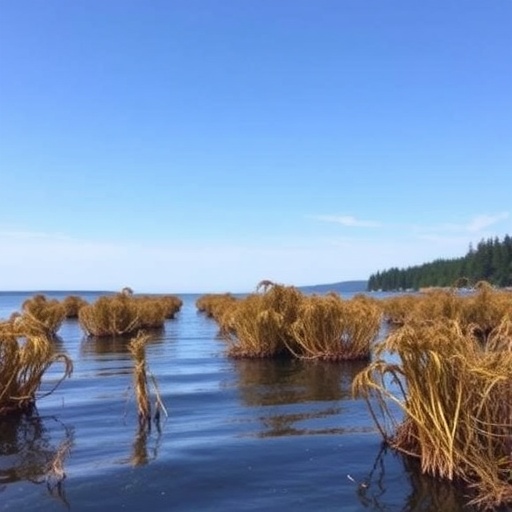
The vibrant kelp forests stretching along the coast of Maine are undergoing a profound transformation, driven by the relentless march of ocean warming. Recent research from Bigelow Laboratory for Ocean Sciences has illuminated the accelerating shift from dense kelp canopies to expansive carpets of turf algae in the Gulf of Maine, a change with far-reaching ecological repercussions. This shift is not merely cosmetic; it represents a fundamental reorganization of the coastal marine ecosystem, challenging long-held notions about habitat stability and biodiversity in temperate reef environments.
The study, published in the journal Ecology, delineates the mechanisms behind this rapid greening of the seafloor. Over the past decade, increased ocean temperatures have catalyzed both the decline of traditional kelp forests and the northward migration of multiple turf-forming algal species. These turfs, previously marginal components of the community, are now aggressively colonizing territories once dominated by giant kelp (Saccharina latissima), disrupting the ecological balance and diminishing the critical habitats essential for myriad marine organisms.
Senior Research Scientist Doug Rasher, leading the investigation, emphasizes that this ecological shift is unfolding in real-time. Their longitudinal data collection from 2021 to 2023 involved intensive monitoring at 11 coastal sites, providing a detailed picture of species composition changes and functional diversity loss. Rasher notes that understanding the drivers and consequences of this transformation is crucial for forecasting future ecosystem trajectories and developing adaptive management strategies to mitigate biodiversity loss.
Historically, kelp forests along the Gulf of Maine have been biodiversity hotspots and foundation species providing essential ecosystem services such as carbon sequestration, habitat complexity, and nutrient cycling. However, the encroaching turf algae represent a fundamentally different ecological state. Unlike the towering kelp, turf algal assemblages possess rapid nutrient turnover rates and high surface-to-volume ratios but lack the structural complexity needed to support diverse faunal communities. This homogenization of habitat structure threatens to undermine the resilience of the coastal marine ecosystems in the face of ongoing environmental stressors.
A surprising revelation from the study is the heterogeneous composition of these turf algal mats. Although they appear as uniform carpets to the casual observer, the turfs encompass a diverse mixture of species including native taxa, opportunistic southern species shifting poleward due to warming, and invasive species such as Dasysiphonia japonica, originally from the Pacific Ocean. This complex species assemblage is reshaping reef ecosystem functions in ways that are only beginning to be understood. The invasion of non-native species adds an additional layer of ecological unpredictability, potentially accelerating habitat modification and altering trophic dynamics.
Lead author and former PhD candidate Shane Farrell stresses the significance of unprecedented increases in native turf species even in areas where kelp forests currently thrive. This phenomenon could serve as an early warning signal for future ecosystem shifts further north, indicating that ocean warming is priming these habitats for continued change. The biophysical attributes of the turf algae, including reduced habitat heterogeneity and altered chemical environments, may have cascading effects influencing predator-prey relationships and energy transfer within the marine food web.
In addition to documenting these biological transitions, the study employs ecological modeling to tease apart environmental drivers facilitating turf proliferation. Warming temperatures emerge as a dual threat; they contribute directly to kelp mortality and indirectly facilitate turf dominance by easing the incursion of new algal species. Wave action and historical kelp loss further compound pressures on the reef ecosystems, suggesting a complex interplay of abiotic factors accelerating ecosystem reorganization. This multifactorial understanding marks a critical advance in forecasting regional ecosystem futures under climate change.
These findings underscore the urgency of integrating ecological monitoring with predictive modeling to guide conservation efforts. As Rasher expounds, disentangling the nuanced drivers of change equips resource managers with critical intelligence to anticipate shifts and develop targeted strategies to combat kelp forest degradation. Preserving the remaining kelp tracts, especially those further north still intact, requires swift and informed interventions to halt or reverse turf encroachment and maintain ecosystem services fundamental to marine biodiversity and coastal economies.
The research further highlights that the consequences of this shift extend beyond altered species compositions. Kelp forests, with their sizeable physical structures and high productivity, support commercially important fish and invertebrate populations. The replacement by turf algae, which provide limited nutrition and refuge, could precipitate declines in fishery yields and impact local livelihoods dependent upon marine resources. This ecological phase shift embodies an alarming feedback loop where climate-induced habitat loss exacerbates socio-economic vulnerabilities.
Moreover, the study presents an evocative illustration of how climate change can activate complex biological invasions, transforming species interactions and ecological networks. The presence of invasive turf algae not only replaces native kelp habitats but also modifies chemical and physical reef characteristics, potentially leading to novel ecological states that could be difficult to reverse. Understanding these dynamics is paramount to anticipating and managing the broader consequences of ocean warming on coastal ecosystems worldwide.
This research underscores a critical inflection point in the Gulf of Maine’s marine ecosystems. The rapid transition from kelp forests to turf reefs in response to warming is emblematic of larger global patterns where climate change is reshaping marine habitats at unprecedented rates. The insights gained herein provide a valuable template for future studies and conservation initiatives aiming to preserve marine biodiversity and the ecological functions upon which human societies depend.
In sum, the documented northward advance of turf algae coupled with kelp forest decline paints a stark picture of ecosystem vulnerability in the Anthropocene. This new research not only chronicles the biotic changes underway but also equips scientists and managers with the knowledge to anticipate and potentially mitigate further degradation. As ocean temperatures continue to climb, the fate of temperate rocky reefs hinges on our capacity to integrate science, policy, and community action to safeguard these vital underwater forests.
News Publication Date: 17-May-2026
Web References:
Ecology Journal Article DOI
Cite Scienmag News
Russell Cooper. (May 19, 2026). Rising Temperatures Drive Rapid Ecological Shifts and Decline of Kelp Forests Along Maine’s Coast. Scienmag. https://scienmag.com/rising-temperatures-drive-rapid-ecological-shifts-and-decline-of-kelp-forests-along-maines-coast/
Russell Cooper. "Rising Temperatures Drive Rapid Ecological Shifts and Decline of Kelp Forests Along Maine’s Coast." Scienmag, 19 May 2026, https://scienmag.com/rising-temperatures-drive-rapid-ecological-shifts-and-decline-of-kelp-forests-along-maines-coast/. Accessed 4 September 2026.
Russell Cooper. "Rising Temperatures Drive Rapid Ecological Shifts and Decline of Kelp Forests Along Maine’s Coast." Scienmag. May 19, 2026. https://scienmag.com/rising-temperatures-drive-rapid-ecological-shifts-and-decline-of-kelp-forests-along-maines-coast/


