


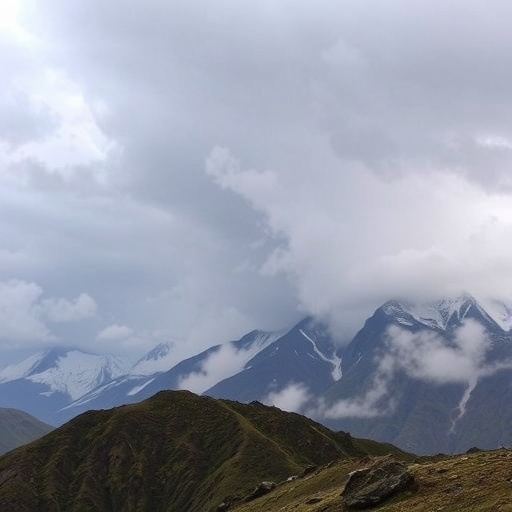
A groundbreaking study recently published in the journal Advances in Atmospheric Sciences has shed new light on the mechanisms by which intense convective storms over the Himalayas contribute to the hydrating of the lower stratosphere, a critical atmospheric layer influencing global climate dynamics. This research, orchestrated by PhD student LI Ming and Dr. WU Xue from the Institute of Atmospheric Physics at the Chinese Academy of Sciences, offers unprecedented insights into the role of gravity waves triggered by deep convective overshooting events in modulating stratospheric moisture levels.
Stratospheric water vapor plays an outsized role in Earth’s climate system, strongly affecting radiative transfer, ozone chemical cycles, and large-scale atmospheric circulation patterns. Despite its importance, the processes governing the injection and subsequent mixing of moisture into the stratosphere remain partly enigmatic, especially in the context of the complex orographic settings of the Himalayan region. This area is notably influential during the Asian summer monsoon, serving as a hotspot for the occurrence of powerful convective storms capable of breaching the tropopause.
Using a combination of high-resolution satellite observations—which offer an unparalleled vantage point from space—and sophisticated numerical atmospheric modeling that factors in the intricate topography of the Tibetan Plateau, the researchers were able to delineate the sequence of events leading to stratospheric moistening. Their analysis reveals that overshooting convective events over the southern Himalayan slopes initiate prominent gravity waves. These waves propagate upward and become unstable in the lower stratosphere, inducing wave breaking and turbulent mixing processes that facilitate the transfer of water vapor and ice particles from the troposphere into the stratosphere.
Significantly, the study underscores the role of gravity wave-enhanced wind shear in fostering the formation of enduring above-anvil cirrus plumes (AACPs). These cloud-like structures, found lingering well above the thunderstorm anvils, represent important reservoirs of ice and water vapor that continue to inject moisture into the lower stratosphere long after the parent storm dissipates. The AACPs essentially serve as persistent “conduits” for hydration, amplifying the initial moisture transported by the convective overshoot.
Dr. WU notes, “Our observations show that the contribution of these above-anvil cirrus plumes to stratospheric moisture levels is even more pronounced than the direct injection from storm tops. This finding challenges existing paradigms and identifies AACPs as critical indicators for diagnosing stratospheric water vapor influx.” This revelation suggests that the lower stratosphere is replenished not solely by rapid convective pulses but also by sustained post-convective cloud processes modulated by wave dynamics.
The methodology incorporated combined data from the CloudSat satellite, which provides radar profiling of cloud structures and atmospheric layers, integrated with numerical simulations that account for the fine-scale and orographically driven atmospheric phenomena characteristic of the Himalayan region. These simulations meticulously replicate the initiation, propagation, and dissipation of gravity waves tied to deep convection, offering a nuanced understanding of the interactions shaping troposphere-stratosphere exchange.
This research carries profound implications for global climate modeling and forecasting. Accurately representing the hydration of the lower stratosphere is essential for predicting ozone chemistry, radiative balance, and potentially the feedback loops involved in climate change. The Himalayan region’s unique contribution to this global mechanism necessitates detailed observation and modeling, precisely what this study begins to unravel.
Looking forward, the research team plans to deepen their investigation by harnessing multi-satellite datasets as well as ground-based observations, prominently including measurements from the Atmosphere Profiling Synthetic Observation System (APSOS) located near Lhasa, Tibet. APSOS, developed by their home institute in 2017, offers continuous, high-fidelity atmospheric profiling data from a high-altitude site, making it an invaluable asset for studying the intricate vertical coupling between tropospheric storms and the stratosphere.
By leveraging synergistic observational platforms alongside enhanced numerical models, the upcoming phase of this research aims to characterize cloud microphysical properties and the subtle interactions at the troposphere-stratosphere interface with greater precision. Understanding these cloud processes is pivotal not only for atmospheric science but also for improving predictive climatology in monsoon-affected regions.
This study enriches the scientific community’s comprehension of the intricate links between orography, convection, and atmospheric wave dynamics, and how these factors collectively influence the global atmospheric moisture budget. It propels forward our knowledge of how the Earth’s highest mountains continue to modulate climate patterns far beyond their geographical confines.
Moreover, the identification of above-anvil cirrus plumes as dominant agents of stratospheric moisture enhancement invites a reevaluation of cloud parameterizations in climate models, encouraging the inclusion of wave-cloud interactions and prolonged moisture transport mechanisms in these representations.
The implications extend further into atmospheric chemistry, as augmented water vapor levels in the stratosphere can impact the life cycle of ozone and the formation of polar stratospheric clouds—both crucial to stratospheric ozone depletion processes. Thus, this research indirectly feeds into understanding the health and stability of the ozone layer, an essential shield against harmful solar radiation.
Overall, the meticulous combination of observational evidence and advanced modeling techniques presented in this study pushes the frontier of atmospheric sciences, particularly in mountainous monsoon environments. It uncovers pathways through which regional convective phenomena influence global climatology, highlighting the Himalayas’ pivotal role as a wet gateway to the stratosphere.
News Publication Date: 18-May-2026
Web References: http://dx.doi.org/10.1007/s00376-025-5466-6
Cite Scienmag News
Russell Cooper. (May 19, 2026). New Study Uncovers How Himalayan Storms Hydrate the Upper Atmosphere. Scienmag. https://scienmag.com/new-study-uncovers-how-himalayan-storms-hydrate-the-upper-atmosphere/
Russell Cooper. "New Study Uncovers How Himalayan Storms Hydrate the Upper Atmosphere." Scienmag, 19 May 2026, https://scienmag.com/new-study-uncovers-how-himalayan-storms-hydrate-the-upper-atmosphere/. Accessed 5 September 2026.
Russell Cooper. "New Study Uncovers How Himalayan Storms Hydrate the Upper Atmosphere." Scienmag. May 19, 2026. https://scienmag.com/new-study-uncovers-how-himalayan-storms-hydrate-the-upper-atmosphere/


