


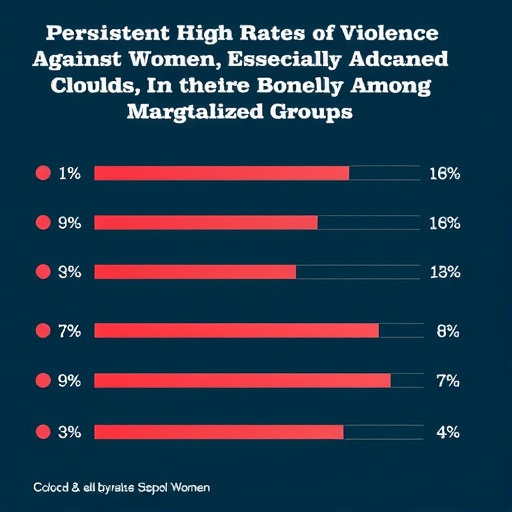
A comprehensive new study conducted by researchers at UC Berkeley’s School of Public Health has revealed stark and persistent racial disparities in rates of assault injuries among women in California, trends that have remained largely unchanged over the last two decades. The researchers, led by doctoral candidate Emily Liu, meticulously analyzed statewide hospitalization and mortality data spanning from 2005 to 2022 to uncover alarming insights into how violence disproportionately impacts certain racial and ethnic groups, most notably Black and multiracial women. This longitudinal analysis offers a rare and detailed lens into these disparities, moving beyond the limitations of police-reported data that often misclassify or omit marginalized populations.
The research highlights that Black women under the age of 65 bear the highest burden of violence, with assault injury rates 3.8 times greater than those reported among white women across all age groups. This pronounced disparity is not only a marker of systemic societal inequities but also a demonstration of how structural racism manifests in public health outcomes. The data indicates that, outside the younger age bracket, multiracial women experience the greatest risk of assault injuries beyond age 65. This shift exemplifies how vulnerability to violence evolves with age and underscores the necessity of age-specific and culturally tailored intervention strategies.
Emily Liu, whose work spearheads this extensive study, emphasized that these persistent disparities are a reflection of historical and ongoing systemic inequities. The stability of violence rates among women over an 18-year period suggests that conventional approaches to addressing violence lack the depth and consistency needed to effect widespread change. Liu expressed concern that current prevention efforts fail to engage with the root causes of violence related to structural and institutional factors, including economic disenfranchisement, housing instability, and limited access to health services, all disproportionately affecting minority communities.
Significantly, the use of hospital and mortality records granted researchers a crucial advantage over prior studies that depended heavily on police data. Police reports, susceptible to subjective interpretation and often inconsistent coding of race and ethnicity, frequently exclude or obscure the experiences of Indigenous and multiracial women by lumping them into generalized “other” categories. By contrast, hospital data, as self-reported by patients, today provides a more reliable and granular account of assault injuries, enabling a more accurate understanding of who is affected.
The staggering numbers underline the critical public health challenge ahead: from 2005 through 2022, there were over 763,000 recorded assault injuries in California that required hospitalization or resulted in death. Black women, constituting only 6.5% of the state’s female population, accounted for a disproportionate 22% of these injuries. They consistently experienced assault rates two to three times higher than all other racial and ethnic groups. These figures starkly illustrate the intersection of race, violence, and health, signaling urgent need for policy reforms and community-based initiatives that address inequity.
Despite these harsh statistics, researchers caution against interpreting the steady state of violence as a failure of all intervention programs. On the contrary, there are promising community-driven approaches that have shown localized success in violence reduction. Jennifer Ahern, a professor of epidemiology and senior author of the study, pointed out that while the study’s focus on aggregated data reveals worrying long-term trends, it might obscure progress achieved in certain areas through dedicated prevention efforts and grassroots initiatives.
Ahern stresses that effective solutions require comprehensive strategies aimed at dismantling the systemic underpinnings of violence, such as historic discriminatory housing policies like redlining, underinvestment in marginalized neighborhoods, and pervasive economic disparities. She stresses that although the problem is deeply entrenched, hope remains alive through the commitment of professionals and activists innovating culturally competent interventions that address societal and structural roots rather than symptoms alone.
This research contributes vital knowledge to a growing body of literature exploring health inequities in California. Previous work by Liu and colleagues has shed light on alarming trends in youth mental health, including a 75% rise in self-harm injury rates among multiracial adolescents since 2016. These interconnected findings emphasize the urgent need to dissect health disparities with nuanced metrics and robust, patient-centered data sources that accurately represent race and ethnicity.
The novel insights presented in this study underscore the value of hospital-based data to illuminate the complex dynamics of violence against women, particularly in racial and ethnic minority groups. The researchers hope that their rigorous statistical analysis will stimulate further investigations targeted at specific populations, fostering a deeper understanding of the multifactorial nature of violence. Such research can equip policymakers, public health officials, and community organizations with the evidence necessary to develop more precise, equitable, and effective violence prevention strategies.
Fundamentally, this work reveals that violence against women in California is not a random or isolated phenomenon but the result of historical injustices and sustained systemic racism that continuously shape disparities in health and safety outcomes. Liu’s findings call on stakeholders at every level—from local governments to federal agencies—to reimagine how violence prevention is conceptualized, funded, and enacted, urging prioritization of marginalized women who bear the heaviest burden.
As the conversation around public health and social justice evolves, this landmark study serves as both a sobering reminder of earlier failures and a catalyst for renewed commitment. The persistence of racial disparities in assault injuries despite years of interventions highlights the urgent need for more strategic, culturally informed, and long-term initiatives to protect the most vulnerable women in California. The hope lies in translating such robust epidemiological evidence into actionable policies that dismantle systemic barriers and foster safer communities for all women.
Cite Scienmag News
Ophelia Keating. (May 19, 2026). Persistent High Rates of Violence Against Women, Especially Among Marginalized Groups. Scienmag. https://scienmag.com/persistent-high-rates-of-violence-against-women-especially-among-marginalized-groups/
Ophelia Keating. "Persistent High Rates of Violence Against Women, Especially Among Marginalized Groups." Scienmag, 19 May 2026, https://scienmag.com/persistent-high-rates-of-violence-against-women-especially-among-marginalized-groups/. Accessed 5 September 2026.
Ophelia Keating. "Persistent High Rates of Violence Against Women, Especially Among Marginalized Groups." Scienmag. May 19, 2026. https://scienmag.com/persistent-high-rates-of-violence-against-women-especially-among-marginalized-groups/


