


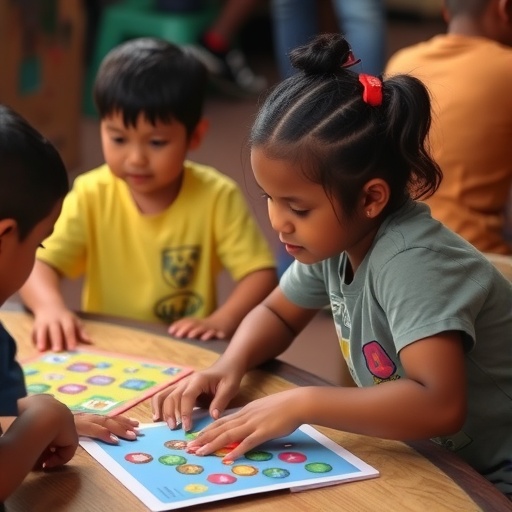
A simple game may be doing something far more consequential than keeping children occupied. In a study published in Communications Psychology, researchers report that a game-based intervention supported social-cognitive development among young children growing up in urban poverty in Brazil. The findings place play at the center of an urgent scientific and public-health question: how can early-childhood programs strengthen the mental and social abilities that help children understand other people, regulate their own behavior and cooperate in challenging environments?
The study, led by N.C. Andrade, C.F.d. Carvalho and L.R.A.d. Oliveira and colleagues, focuses on a developmental period when the foundations of social behavior are rapidly taking shape. Early childhood is marked by major changes in executive function, language, emotional regulation and perspective-taking. These abilities are not isolated skills. They work together when a child waits for a turn, interprets another person’s intention, recognizes that someone else may hold a different belief or adjusts behavior after a conflict. Scientists often group such capacities under the broad concept of social cognition, the set of mental processes that allows people to understand themselves and navigate relationships.
The research is especially significant because it examines these processes in urban poverty contexts, where children can face overlapping forms of adversity. Economic insecurity, crowded living conditions, exposure to violence, limited access to high-quality early education and chronic stress can all affect opportunities for learning and social interaction. Poverty does not determine a child’s developmental trajectory, and children in disadvantaged communities show substantial resilience. However, researchers increasingly emphasize that unequal environments can influence the quantity and quality of experiences through which cognitive and emotional skills develop. Interventions that are inexpensive, engaging and adaptable to local settings could therefore have an important role in reducing developmental inequalities.
Rather than treating learning as a purely academic exercise, a game-based intervention uses structured play to create repeated opportunities for children to practice social and cognitive behaviors. Games can require participants to follow rules, remember information, inhibit an impulsive response, anticipate another player’s actions and communicate about shared goals. In technical terms, these activities can recruit executive functions such as working memory and cognitive flexibility while also stimulating emotional and interpersonal processes. The key is not simply that children are playing, but that the game environment is intentionally designed to make particular developmental challenges understandable, motivating and repeatable.
This approach may be especially powerful in early childhood because play is a natural learning language. Young children often find abstract instructions difficult to absorb, but they can understand a concrete challenge immediately: wait for a signal, identify a pattern, help a teammate or change a strategy when the rules change. Each round creates feedback, and feedback allows children to connect actions with consequences without the experience feeling like a conventional test. When an adult guides the activity, moments of frustration or disagreement can become brief demonstrations of emotional regulation, negotiation and perspective-taking rather than simple disruptions.
The Brazilian study’s central contribution is its reported evidence that this type of intervention can promote social-cognitive development in communities facing socioeconomic disadvantage. The result matters because many developmental programs are evaluated in relatively well-resourced settings, where children may already have greater access to books, stable schooling, enrichment activities and specialist support. Demonstrating benefits in urban poverty contexts suggests that carefully designed games can function not only as educational tools but also as scalable developmental supports. It also challenges the assumption that effective interventions must be technologically sophisticated or expensive. In some circumstances, the most valuable ingredient may be a well-structured interaction that gives children repeated practice in thinking with and about other people.
The mechanisms behind such improvements are likely to be multidimensional. Rule-based play can strengthen inhibitory control, the ability to suppress a dominant but inappropriate response. Turn-taking and shared objectives can exercise behavioral regulation and cooperation. Games involving hidden information or changing perspectives may encourage children to distinguish their own knowledge from what another person knows. Social feedback can also help children refine emotion recognition and understand how actions affect peers. Over time, these experiences may support more sophisticated mental-state reasoning, including the ability to infer intentions, beliefs and feelings that are not directly visible.
The findings also carry a message for educators and policymakers. If game-based activities can be integrated into early-childhood classrooms, community centers or family programs, they may provide a practical way to strengthen development without removing children from their cultural and social environments. Such programs could be delivered by teachers or trained facilitators using locally appropriate materials, allowing communities to adapt activities to language, traditions and available resources. However, implementation would require more than distributing a game. Adult guidance, consistency, training and sensitivity to children’s individual needs are likely to influence whether an intervention produces meaningful benefits. A game that works in one setting may need modification before it can be transferred to another.
The study should also be interpreted within the broader standards of developmental science. Evidence that an intervention promotes social cognition does not mean that play alone can eliminate the effects of poverty or compensate for inadequate housing, nutrition, healthcare and education. Researchers will need to examine how durable the gains are, whether they translate into classroom behavior and peer relationships, and which children benefit most. Future work may also compare different types of games, identify the active ingredients responsible for change and follow participants over longer periods. Even with those questions still open, the research offers a compelling and highly shareable conclusion: when play is engineered around the science of learning, a child’s game can become a rehearsal space for cooperation, self-control and understanding another mind. In communities where developmental opportunities are often unequal, that rehearsal may be a small intervention with unusually large promise.
Cite Scienmag News
Glenn Wilkins. (August 12, 2026). Game-Based Program Boosts Social-Cognitive Development Among Children in Brazil’s Urban Poor Communities. Scienmag. https://scienmag.com/game-based-program-boosts-social-cognitive-development-among-children-in-brazils-urban-poor-communities/
Glenn Wilkins. "Game-Based Program Boosts Social-Cognitive Development Among Children in Brazil’s Urban Poor Communities." Scienmag, 12 August 2026, https://scienmag.com/game-based-program-boosts-social-cognitive-development-among-children-in-brazils-urban-poor-communities/. Accessed 3 September 2026.
Glenn Wilkins. "Game-Based Program Boosts Social-Cognitive Development Among Children in Brazil’s Urban Poor Communities." Scienmag. August 12, 2026. https://scienmag.com/game-based-program-boosts-social-cognitive-development-among-children-in-brazils-urban-poor-communities/


