


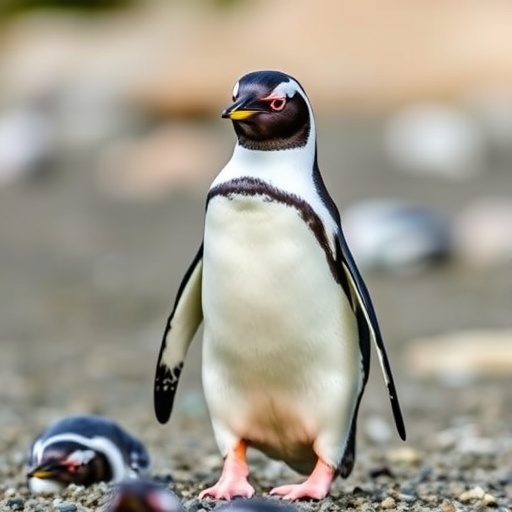
Climate change is widely regarded as an existential threat to countless species worldwide, disrupting established ecological processes and pushing many organisms beyond their adaptive limits. Among the diverse impacts, extreme heat events have emerged as a particularly lethal force, especially for species adapted to cold environments. The Gentoo penguin (Pygoscelis papua), native to the southernmost reaches of South America, exemplifies this vulnerability. However, new research from Argentina and the UK now reveals an unexpected adaptive response by these penguins that may buffer some of the worst consequences of rising temperatures. By advancing their breeding season, Gentoo penguins at Martillo Island in Tierra del Fuego are effectively avoiding the deadliest heat episodes, highlighting a rare silver lining to climate-induced phenological changes.
Phenology, the study of recurring biological events and their timing, offers a vital lens through which to assess ecological responses to climate change. Altered phenology, particularly shifts in breeding, migration, or flowering times, can either exacerbate or mitigate climate impacts depending on the species and environment involved. For the Gentoo penguins, whose reproductive success depends heavily on environmental conditions during sensitive nesting and chick-rearing periods, timing is crucial. Extreme heat can lead to chick mortality and increased adult stress, jeopardizing population viability. The study reveals that the penguins have progressively begun to initiate breeding earlier in the season, a shift that strategically sidesteps peak heat periods and improves chick survival rates.
This phenological advancement is far from trivial. It implies rapid behavioral plasticity or possibly microevolutionary changes within the Gentoo penguin populations exposed to warming trends. By initiating egg-laying and chick-rearing phases ahead of historically typical schedules, these penguins effectively minimize exposure of vulnerable offspring to critical heat stress. Such timing adjustments are likely responses to localized climatic cues, suggesting a remarkable degree of environmental sensitivity and behavioral adaptation. Field data from Martillo Island support these conclusions, illustrating a clear correlation between earlier breeding onset and reduced mortality during unprecedented heat events.
The consequences of extreme heat for cold-adapted species like Gentoo penguins are severe. Elevated temperatures increase the risk of thermal stress, dehydration, and hyperthermia in both adults and chicks. The physical vulnerability of chicks, which lack robust thermoregulation early in life, makes heatwaves particularly devastating. Moreover, higher temperatures can indirectly affect penguin populations by altering prey availability or increasing the prevalence of pathogens and parasites. By contrast, the observed advancement of breeding phenology serves as a buffer, mitigating these direct and indirect effects and enhancing reproductive success even under challenging climatic conditions.
Underlying these behavioral shifts is an intricate interplay of environmental signals and physiological mechanisms guiding penguin reproductive timing. Photoperiod, sea surface temperature, and food abundance are likely key factors influencing the decision to initiate breeding. As climate change alters these cues, penguins may recalibrate their internal timing mechanisms. The Martillo Island study highlights the species’ capacity to integrate and respond to such complex environmental changes, though the limits and long-term sustainability of these shifts remain uncertain. Continued monitoring is essential to elucidate whether this adaptive strategy can persist under accelerating climate change and additional anthropogenic pressures.
While this phenological adjustment offers a hopeful narrative, it also underscores the profound pressures species face to survive in rapidly transforming habitats. The Gentoo penguins’ shift to earlier breeding can be seen as a form of bet-hedging—altering life-history traits to reduce vulnerability to climatic extremes. However, such shifts may entail trade-offs, including potential mismatches with food resource peaks or increased predation risks if synchrony with other ecosystem processes is disrupted. These complexities highlight the nuanced nature of biological responses to climate perturbations, challenging simplistic assumptions about species resilience.
The findings from this study are pivotal for conservation and management strategies focused on Antarctic and sub-Antarctic wildlife. Recognizing the plasticity in breeding timing as a natural buffering mechanism enables more accurate projections of population trends under climate change scenarios. However, conservation efforts must also consider that phenological shifts may not be universally available or sufficient for all species at risk. Understanding species-specific responses, including the limits of behavioral flexibility, is critical for developing adaptive management plans that incorporate anticipated climate futures.
Moreover, this research contributes to broader ecological discourse on how climate change reshapes phenological patterns across taxa. Similar temporal shifts have been documented in a range of organisms from plants to insects to birds. Each case reveals unique challenges and opportunities for survival under changing conditions. The Gentoo penguin example from Argentina enriches this tapestry of knowledge, demonstrating how marine vertebrates inhabiting southern latitudes respond to thermal stresses differently than terrestrial or tropical species.
Technological advancements have played a key role in enabling such detailed phenological studies. Remote monitoring, temperature loggers, and long-term observational datasets form the backbone of contemporary ecological research. These tools allow scientists to track subtle, gradual changes in behavior that may otherwise go unnoticed. The Martillo Island research team harnessed these methodologies to document breeding phenology precisely and correlate it with environmental variables, providing robust evidence for climate-induced timing shifts.
Still, many questions remain unanswered. For instance, the genetic basis of phenological plasticity in Gentoo penguins is poorly understood. Determining whether these shifts reflect widespread behavioral flexibility or emerging evolutionary adaptations is crucial for predicting future resilience. Additionally, assessing the interplay between phenological changes and other stressors such as habitat loss, pollution, and human disturbance will better inform holistic conservation efforts. Interdisciplinary research bridging ecology, genetics, and climate science is therefore imperative.
The broader implications of this study extend beyond Gentoo penguins. They offer a template for investigating phenotypic plasticity as a coping mechanism in other vulnerable species confronting climate extremes. Identifying species capable of meaningful phenological adjustments can help prioritize conservation resources and design targeted interventions. Conversely, recognizing species with limited adaptive capacity alerts researchers and policymakers to those most in need of protective measures.
In sum, the Gentoo penguins’ shift to earlier breeding at Martillo Island represents a rare but significant example of how organisms may navigate the unprecedented challenges posed by a warming planet. It exemplifies nature’s remarkable potential for resilience through behavioral adaptation while simultaneously warning of the fragile balance underlying such responses. Continued research and conservation vigilance are essential to ensure that these natural coping mechanisms are not overwhelmed by the pace and magnitude of climate change.
News Publication Date: 20-May-2026
Web References: http://dx.doi.org/10.1371/journal.pone.0347877
Keywords
Climate change, Gentoo penguin, phenology, breeding season, extreme heat events, behavioral adaptation, Tierra del Fuego, thermal stress, reproductive success, marine ecology, conservation biology, phenotypic plasticity
Cite Scienmag News
Sloane Callahan. (May 20, 2026). Gentoo Penguins in Argentina Adapt to Extreme Heat by Shifting Breeding Season Earlier, Mitigating Deadly Temperature Risks. Scienmag. https://scienmag.com/gentoo-penguins-in-argentina-adapt-to-extreme-heat-by-shifting-breeding-season-earlier-mitigating-deadly-temperature-risks/
Sloane Callahan. "Gentoo Penguins in Argentina Adapt to Extreme Heat by Shifting Breeding Season Earlier, Mitigating Deadly Temperature Risks." Scienmag, 20 May 2026, https://scienmag.com/gentoo-penguins-in-argentina-adapt-to-extreme-heat-by-shifting-breeding-season-earlier-mitigating-deadly-temperature-risks/. Accessed 4 September 2026.
Sloane Callahan. "Gentoo Penguins in Argentina Adapt to Extreme Heat by Shifting Breeding Season Earlier, Mitigating Deadly Temperature Risks." Scienmag. May 20, 2026. https://scienmag.com/gentoo-penguins-in-argentina-adapt-to-extreme-heat-by-shifting-breeding-season-earlier-mitigating-deadly-temperature-risks/


