


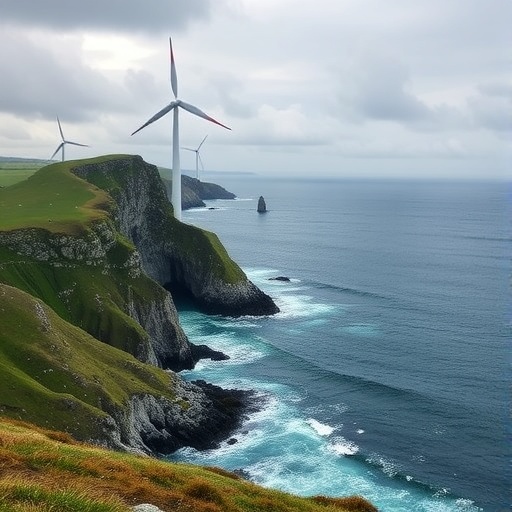
Offshore wind is often presented as one of the clearest routes toward a low-carbon energy system: turbines harvest powerful marine winds, produce electricity without direct combustion, and occupy far less land than many large-scale energy installations. But a new study suggests that the atmospheric consequences of building vast wind farms across the Northwest European shelf may extend beyond energy production. By altering the flow of air above the sea, future offshore wind farms could also influence where, when and how much rain reaches nearby coasts.
The research, published in Communications Earth & Environment, investigates the projected effects of offshore wind development on coastal precipitation across one of Europe’s most densely populated and economically important regions. The Northwest European shelf includes the shallow seas surrounding the United Kingdom, Ireland, the North Sea and neighboring continental coasts. These waters are already central to Europe’s renewable-energy plans, with thousands of turbines expected to be installed or expanded over coming decades. The study asks whether the cumulative presence of these structures could modify regional weather patterns in ways that matter for water resources, flooding, agriculture and climate adaptation.
Wind turbines extract kinetic energy from the atmosphere. As air passes through a large wind farm, the turbines slow the flow and generate turbulence, creating what scientists call a wind-farm wake. The wake can stretch for many kilometers, particularly under stable atmospheric conditions, when relatively cool air near the sea surface is capped by warmer air above. In such situations, vertical mixing is limited, allowing the disturbance created by the turbines to persist and spread downstream. The resulting changes in wind speed, turbulence and vertical motion can affect the transport of heat and moisture through the lower atmosphere.
Rain does not form simply because air contains water vapor. Moist air must usually rise, cool and condense into clouds, and the details of that process depend on atmospheric stability, wind direction, temperature contrasts and the location of weather systems. Offshore wind farms can influence these conditions by changing near-surface friction and redistributing momentum between different layers of the atmosphere. Even a modest alteration in the marine boundary layer—the lowest part of the atmosphere directly affected by the ocean surface—can shift the convergence of air or modify the uplift needed for cloud formation. These effects may then appear as changes in precipitation along the coast.
The study’s projections focus on the combined influence of future wind-farm development rather than treating each turbine as an isolated object. That distinction is important. Individual turbines produce small atmospheric disturbances, but arrays containing hundreds or thousands of machines can behave as a broad, roughened surface. When several wind farms are placed along prevailing airflow pathways, their wakes may interact, amplify or partially offset one another. The atmospheric response can also vary with season and weather regime. A storm crossing the North Sea will interact with turbines differently from a calm, stable winter night or a convective summer shower.
According to the analysis, the projected changes are not expected to create a simple blanket of wetter or drier conditions across northwestern Europe. Instead, the influence is likely to be spatially uneven, with precipitation responses depending on wind direction, the position of the farms and the atmospheric structure above them. Areas immediately downwind may experience altered moisture transport and vertical mixing, while some coastal locations could see changes in rainfall intensity or timing. This is a crucial finding for interpreting the research: the issue is not that offshore wind farms would control the region’s weather, but that large-scale development could subtly reshape existing precipitation patterns.
The potential consequences become more significant because the affected coastline is highly exposed and heavily developed. Cities, ports, transport networks, farmland and industrial zones line the shores around the European shelf. Many coastal communities already face rising sea levels, heavier rainfall extremes and growing pressure on drainage systems. A small average shift in precipitation may have limited practical importance in isolation, but changes in the location or intensity of rainfall could matter when they coincide with high tides, storm surges or saturated soils. For water managers and urban planners, understanding these secondary effects could become part of evaluating the wider footprint of renewable-energy infrastructure.
The researchers’ work also highlights the complexity of representing offshore wind farms in climate and weather models. A numerical model cannot simulate every blade and tower across thousands of square kilometers at the same resolution as the surrounding atmosphere. Scientists therefore use parameterizations, mathematical descriptions that represent the collective effects of turbines on momentum, turbulence and energy exchange. The reliability of the projections depends on how accurately these schemes capture wake behavior, atmospheric stability, sea-surface conditions and interactions between neighboring wind farms. Model resolution, the choice of future energy scenarios and natural climate variability all contribute to uncertainty.
That uncertainty does not make the findings irrelevant. Rather, it shows why offshore energy planning must be connected to atmospheric science. The same modeling frameworks used to estimate precipitation responses can help identify conditions under which wind-farm effects are strongest and determine whether impacts remain local or spread toward the coast. Better observations from research vessels, weather stations, aircraft, satellites and instruments mounted on offshore platforms could improve these estimates. Long-term monitoring would also help distinguish turbine-related signals from ordinary fluctuations caused by storms, seasonal circulation and broader climate change.
The expansion of offshore wind remains a central component of Europe’s strategy to reduce greenhouse-gas emissions, and the study does not suggest that renewable-energy development should be halted. Instead, it adds a new layer to the question of how such infrastructure should be designed. Future planning could consider the spacing and orientation of wind-farm clusters, prevailing wind pathways, sensitive coastal watersheds and regions already vulnerable to flooding. As offshore arrays grow from individual projects into interconnected industrial landscapes, their atmospheric influence may become an increasingly important part of environmental assessment. The message is not that turbines will suddenly rewrite Europe’s weather, but that the clean-energy transition is interacting with the atmosphere in ways scientists are only beginning to map.
Cite Scienmag News
Faith Mcneil. (August 12, 2026). Study projects future offshore wind farms’ effects on Northwest European coastal rainfall. Scienmag. https://scienmag.com/study-projects-future-offshore-wind-farms-effects-on-northwest-european-coastal-rainfall/
Faith Mcneil. "Study projects future offshore wind farms’ effects on Northwest European coastal rainfall." Scienmag, 12 August 2026, https://scienmag.com/study-projects-future-offshore-wind-farms-effects-on-northwest-european-coastal-rainfall/. Accessed 3 September 2026.
Faith Mcneil. "Study projects future offshore wind farms’ effects on Northwest European coastal rainfall." Scienmag. August 12, 2026. https://scienmag.com/study-projects-future-offshore-wind-farms-effects-on-northwest-european-coastal-rainfall/


