


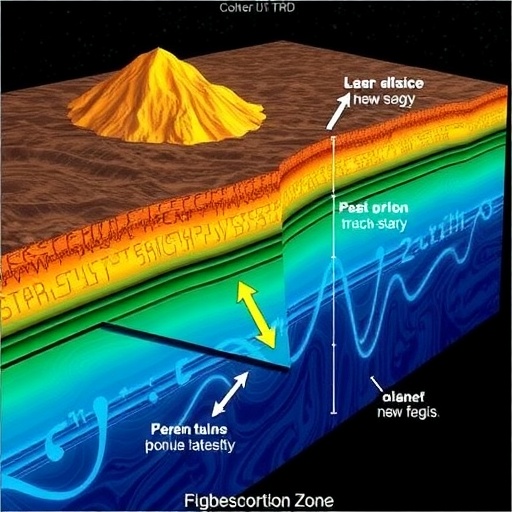
In the intricate and dynamic processes that govern our planet’s interior, subduction zones stand out as crucial realms where oceanic plates sink beneath continental or other oceanic plates. These zones are not only central to the recycling of Earth’s crust and mantle but also act as chemical and mineralogical crucibles, profoundly influencing the geochemical cycles of many elements, including precious metals like gold. A groundbreaking study by Patten, Peillod, Hector, and colleagues, published in Communications Earth & Environment, elucidates the enigmatic pathways and mechanisms controlling gold mobility in these subduction interfaces from the perspective of the descending slab itself.
Gold, a metal often celebrated for its rarity and intrinsic value, holds immense significance in geosciences as a tracer element for fluid-mediated processes within Earth’s crust and mantle. The mechanisms by which gold is mobilized, transported, and ultimately deposited remain incompletely understood, especially in complex subduction environments where multiple physical and chemical processes coincide. The research conducted by this team leverages advanced geochemical modeling combined with novel experimental data to unravel how gold is mobilized, focusing distinctly on the slab component of the subduction zone rather than the traditionally emphasized mantle wedge or crustal contributions.
The crux of the investigation lies in understanding how fluids generated by the dehydration of the subducting slab influence gold mobility. As oceanic lithosphere descends and experiences increasing pressure and temperature, hydrous minerals within it release fluids that carry metals. These slab-derived fluids can act as potent agents that dissolve, transport, and redeposit gold. By adopting a slab-centric perspective, Patten and colleagues bridge a crucial knowledge gap, elucidating the initial stages of fluid generation and metal mobilization before fluids interact with overlying mantle and crustal reservoirs.
Their research delves deeply into the mineralogical transformations occurring within the slab during subduction. The breakdown of hydrous phases such as chlorite, amphibole, and lawsonite liberates water rich in solutes, including gold-complexing ligands like sulfide species and halogens. These fluids have distinct physico-chemical properties that influence metal solubility, speciation, and transport capacity. By characterizing these slab fluids with unprecedented detail, the study predicts the conditions under which gold can be efficiently mobilized and highlights how subtle variations in pressure, temperature, and fluid composition dictate gold’s solubility and stability.
A seminal insight from this work is the recognition of gold’s intimate association with sulfur-bearing species in the slab fluids. Gold’s geochemical affinity for sulfur underlies its transport as gold-sulfide complexes, which significantly enhance gold solubility in aqueous solutions at elevated pressures and temperatures typical of subduction zones. These complexes allow gold to be carried in significant quantities over long distances within the Earth’s interior before precipitation occurs as conditions change. This mechanistic understanding reshapes long-held ideas regarding the spatial distribution of gold deposits linked with subduction-driven orogenic processes.
Further, the researchers identify thresholds in temperature and fluid composition that trigger gold precipitation from slab-derived fluids. As these fluids rise into cooler and less chemically aggressive environments of the mantle wedge or overlying crust, changes in redox state, pH, and ligand availability induce destabilization of gold complexes and drive nanoparticulate or vein-related gold deposition. This parsimonious model elegantly accounts for the spatial association of gold deposits with arc volcanic activity and metamorphic belts observed globally.
Using state-of-the-art analytical techniques, including high-pressure experimental petrology combined with thermodynamic modeling, the study constructs a comprehensive phase diagram depicting gold-bearing fluid evolution within subducting slabs. This diagram integrates mineral stability fields with fluid speciation and gold solubility metrics, offering a predictive framework for where and how gold becomes mobilized and concentrated. Such synthesis is a transformative contribution, equipping geoscientists to better target exploration efforts for gold and related metals.
The implications of these findings reverberate beyond Earth sciences, touching upon economic geology, mineral exploration, and even planetary processes. Understanding gold mobility in subduction zones informs models of ore genesis, potentially identifying new geological terranes favorable for gold concentration. Moreover, by establishing that the slab itself plays a central role in controlling metal fluxes, the study challenges existing paradigms that primarily focus on the mantle wedge and crust in metal sourcing.
Patten and colleagues also thoroughly discuss the feedback mechanisms linking gold mobility to other elemental cycles, such as sulfur, chlorine, and carbon. The interplay of these components within subduction fluids modulates not only the metal budget but also the geochemical environment conducive to ore formation. This holistic approach unites geochemical, mineralogical, and petrological data into a cohesive narrative, advancing a nuanced understanding of Earth’s internal metal economies.
Notably, the study’s integrative approach combines field observations with laboratory simulations, enabling direct comparison with natural samples from well-characterized subduction zones. This synergy enhances the robustness of their conceptual model and grounds theoretical predictions within empirical realities. The results resonate with geologists and geochemists seeking to decode the signatures of gold anomalies observed in arc magmatic provinces worldwide.
Ultimately, this research reframes the geodynamic context of gold mobility, emphasizing the descending slab as an active conveyor of metals. By elucidating the chemistry and physics of slab-derived fluids, the study reveals a hitherto underappreciated dimension of subduction zone metallogeny. Its implications suggest that the deep Earth’s recycling processes critically influence surface metal availability and distribution, with broad ramifications for resource sustainability and geological evolution.
As the authors conclude, unveiling the slab perspective not only enriches our fundamental understanding of mineral cycles but also enhances predictive capabilities for mineral exploration and hazard assessment in geologically active regions. The innovative methodologies and comprehensive insights offered by this investigation set a new benchmark for future research on subduction zone processes and the fate of critical metals in the Earth’s interior.
This seminal contribution thus opens new horizons at the confluence of geodynamics, geochemistry, and economic geology. It invites the scientific community to reexamine existing models and to integrate the slab’s role into broader conceptual frameworks of Earth’s tectonic and mineralogical evolution. By bridging micro-scale chemical phenomena with global-scale tectonic motions, Patten, Peillod, Hector, and collaborators drive forward a paradigm shift with lasting impact on Earth sciences and resource geology.
Cite Scienmag News
Violet Maxwell. (May 19, 2026). Gold Movement in Subduction Zones: The Slab View. Scienmag. https://scienmag.com/gold-movement-in-subduction-zones-the-slab-view/
Violet Maxwell. "Gold Movement in Subduction Zones: The Slab View." Scienmag, 19 May 2026, https://scienmag.com/gold-movement-in-subduction-zones-the-slab-view/. Accessed 4 September 2026.
Violet Maxwell. "Gold Movement in Subduction Zones: The Slab View." Scienmag. May 19, 2026. https://scienmag.com/gold-movement-in-subduction-zones-the-slab-view/


