


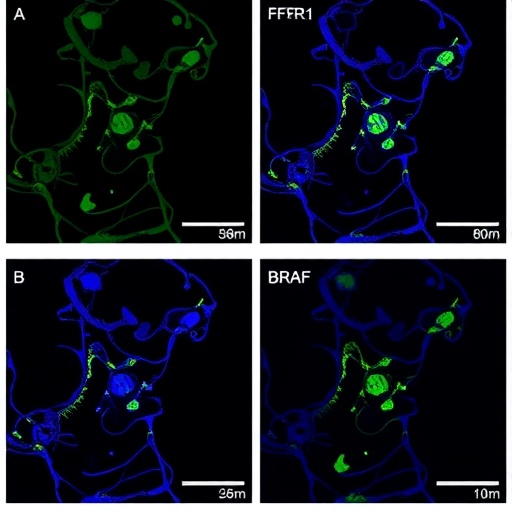
In a groundbreaking study poised to reshape the landscape of melanoma treatment, researchers have pinpointed a key molecular pathway responsible for intrinsic resistance to BRAF inhibitors—one of the frontline therapies against this formidable skin cancer. The investigation, led by Almoiliqy, Li, Jung, and colleagues, reveals that the fibroblast growth factor receptor 1 (FGFR1), rather than the previously suspected signaling molecules S6K1 and S6K2, serves as the critical driver of drug resistance. This discovery, published in Cell Death Discovery in 2026, ushers in fresh possibilities for enhancing the efficacy of melanoma therapies by targeting the elusive mechanisms that undermine treatment.
Melanoma, recognized for its aggressive nature and high mortality rate, often harbors mutations in the BRAF gene, particularly the V600E mutation, which hyperactivates the mitogen-activated protein kinase (MAPK) pathway to fuel unchecked tumor growth. BRAF inhibitors, specifically designed to block this pathway, have revolutionized therapeutic outcomes; however, the clinical benefit is frequently curtailed by innate resistance, rendering these agents less effective from the outset in many patients. Understanding the molecular culprits behind this resistance is therefore vital for improving survival rates.
Previous studies implicated S6 kinase isoforms 1 and 2 (S6K1/2), downstream effectors within the mammalian target of rapamycin complex 1 (mTORC1) pathway, as potential contributors to therapeutic evasion in melanoma. However, the current research compellingly demonstrates that inhibiting S6K1/2 fails to reverse resistance in BRAF-mutant melanoma cells, shifting scientific attention toward alternative, more influential pathways. This paradigm shift underscores the complexity of cancer cell signaling networks and the necessity of precise molecular targeting.
Central to the study’s findings is the identification of FGFR1, a receptor tyrosine kinase often associated with developmental processes but increasingly recognized for its oncogenic roles in various cancers. FGFR1 appears to sustain melanoma cell survival and proliferation independent of BRAF inhibition, effectively enabling tumor cells to bypass the cytotoxic effects of the drugs. This receptor mediates alternative growth signals, circumventing the blockade of the MAPK pathway and fostering drug resistance—a mechanism that had remained cryptic until now.
By employing a series of rigorous in vitro and in vivo experiments, the researchers meticulously dissected the signaling cascades involved. They revealed that FGFR1 activation stimulates downstream pathways such as the phosphoinositide 3-kinase (PI3K)/AKT axis, reinforcing melanoma cell viability even in the presence of BRAF inhibitors. This redundant signaling network provides cancer cells with a robust survival advantage, contributing to the intrinsic nature of resistance.
Further, the team’s analyses demonstrated that pharmacological inhibition or genetic knockdown of FGFR1 re-sensitized resistant melanoma cells to BRAF inhibitors. This key intervention significantly impaired tumor growth in preclinical models, suggesting that a combination therapy targeting both BRAF and FGFR1 may overcome intrinsic resistance and enhance treatment responses. Such dual-target strategies may represent the future of personalized medicine in melanoma care.
In addition to therapeutic implications, this study highlights the importance of precise biomarker identification. FGFR1 expression levels could potentially serve as predictive biomarkers to stratify patients more likely to experience BRAF inhibitor resistance. This stratification would allow clinicians to tailor treatment regimens more effectively, prioritizing combination therapies for those exhibiting high FGFR1 activity while sparing others from unnecessary toxicity.
Technically, the use of advanced molecular biology techniques including CRISPR-Cas9 gene editing, RNA interference, and phosphoproteomic profiling was instrumental in mapping the kinase-driven resistance landscape. These methodological innovations provided a clear mechanistic insight into how FGFR1-driven signaling sustains melanoma survival pathways despite targeted BRAF inhibition, exemplifying the power of integrative approaches in cancer research.
Notably, the study’s findings challenge earlier assumptions about the centrality of the mTORC1 pathway and its effectors S6K1/2 in mediating melanoma resistance. This could prompt the oncology research community to re-evaluate existing drug development strategies, avoiding therapies that target downstream components with limited impact on resistance mechanisms and focusing instead on upstream drivers like FGFR1.
Moreover, the discovery opens an intriguing avenue for the development of novel FGFR1 inhibitors already in clinical pipelines for other malignancies, enabling a faster translational pipeline for combination therapies tailored for melanoma patients. Cross-application of these agents could dramatically accelerate clinical trials and improve patient access to more effective treatments.
The ramifications of this research extend beyond melanoma alone. FGFR1 is implicated in therapeutic resistance and tumor progression in various cancers, suggesting a broader relevance and potential for cross-disciplinary impact. The elucidation of FGFR1’s role in drug resistance highlights a universal challenge in oncology: the adaptability of cancer cells through alternative survival pathways.
As this research gains visibility, it will likely stimulate a wave of investigations into FGFR1-mediated signaling in other contexts, including metastatic progression and immune evasion, potentially catalyzing innovative combinatorial approaches that integrate targeted therapy with immunomodulation.
In conclusion, the work led by Almoiliqy and colleagues marks a significant stride in understanding the molecular underpinnings of intrinsic resistance to BRAF inhibitors in melanoma. By conclusively identifying FGFR1 as the pivotal resistance driver, this study sets a new benchmark for translational research efforts aimed at overcoming the stubborn challenge of drug resistance in cancer therapy. The burgeoning prospect of combination treatments targeting both BRAF and FGFR1 offers renewed hope for enhancing patient outcomes and conquering melanoma’s resiliency.
The research heralds a new epoch where multidimensional targeting of cancer’s intricate signaling networks becomes routine, reaffirming the critical role of precision oncology. As scientists and clinicians work alongside pharmaceutical innovators, patients could witness transformative impacts from these mechanistic insights, cementing FGFR1 as a prime therapeutic target in the ongoing battle against melanoma.
Cite Scienmag News
Nathaniel Bowman. (May 19, 2026). FGFR1, Not S6K1/2, Fuels BRAF Resistance. Scienmag. https://scienmag.com/fgfr1-not-s6k1-2-fuels-braf-resistance/
Nathaniel Bowman. "FGFR1, Not S6K1/2, Fuels BRAF Resistance." Scienmag, 19 May 2026, https://scienmag.com/fgfr1-not-s6k1-2-fuels-braf-resistance/. Accessed 3 September 2026.
Nathaniel Bowman. "FGFR1, Not S6K1/2, Fuels BRAF Resistance." Scienmag. May 19, 2026. https://scienmag.com/fgfr1-not-s6k1-2-fuels-braf-resistance/


