


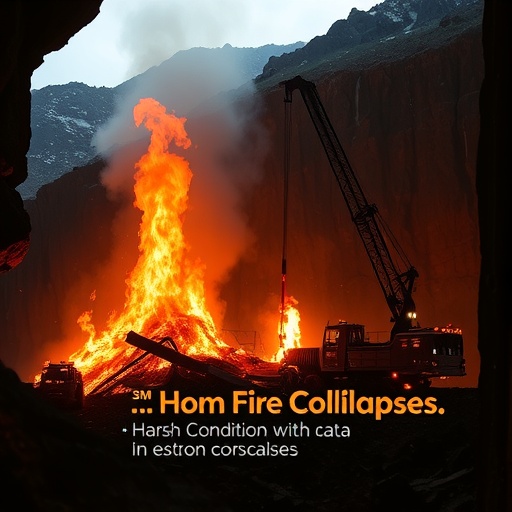
In recent years, the perilous nature of underground coal mine fires has drawn increasing attention due to their devastating environmental and structural consequences. A recent groundbreaking study by Hills, Tripathi, Singh, and colleagues, published in Communications Earth & Environment, has provided unprecedented insights into the extreme environmental conditions present within coal mine fire collapse structures. This research sheds light on the complex interplay of thermal, chemical, and mechanical processes that occur during and after such fires, revealing hazards that have far-reaching implications for mining safety, disaster mitigation, and environmental sustainability.
The study meticulously characterizes the conditions inside collapse zones created by underground coal fires, offering new understandings of how these fires alter subterranean environments. Coal mine fires, often persisting for years or even decades, generate intense heat and toxic gases, which can lead to the collapse of overlying strata. These collapse structures, often invisible at the surface, can create hazardous voids and pockets where extreme temperatures and noxious atmospheres persist, creating a unique microenvironment that challenges existing models of underground fire behavior.
What makes these collapsed structures particularly dangerous is their unpredictability. The researchers used an array of advanced sensor technologies and sampling methods to measure temperature, gas composition, and rock stability within active collapse zones. These measurements revealed temperature gradients exceeding several hundred degrees Celsius, combined with elevated concentrations of carbon monoxide, sulfur dioxide, methane, and hydrogen sulfide. Such conditions not only pose grave risks to humans but also catalyze complex chemical reactions that further destabilize the geological matrix.
The study emphasizes the interplay between thermal stress and geological fracturing, showing how heat from burning coal weakens rock layers, leading to sudden and catastrophic collapses. This knowledge is crucial for developing early warning systems. By understanding how heat propagates and influences rock integrity, mining operators and emergency planners can better predict collapse events, reducing the risk of fatalities and infrastructural damage. These results open avenues for remote sensing and geophysical monitoring strategies tailored specifically for fire-affected mining zones.
Chemically, the fire-induced atmospheres inside these collapsed structures are particularly hostile. The paper highlights the role of combustion byproducts such as radicals and acidic gases, which corrode mineral surfaces and alter rock chemistry. The interaction between these chemicals and rock minerals can lead to the formation of secondary mineral phases, further affecting rock cohesion. This evolving chemical environment undermines structural stability in ways previously unaccounted for in standard geological hazard assessments.
By integrating multidisciplinary observational data with numerical simulations, the authors have reconstructed how collapse processes evolve over time. Their models indicate that these collapse structures can grow dynamically as underground fires progress, suggesting that danger zones may expand unpredictably. This evolving risk requires adaptive management approaches rather than static safety zones, underscoring the need for continuous monitoring and flexible response protocols in mining operations.
In addition to safety implications, the study touches on the broader environmental impact of coal mine fires and their collapse structures. Persistent emissions from these sites contribute significantly to local and regional air pollution, adding to greenhouse gas concentrations and acid rain precursors. The researchers advocate for policymakers to consider these persistent pollution sources when formulating environmental regulations related to mining and land reclamation.
The ecological consequences are profound. Vegetation above these collapse zones often exhibits stunted growth or dies off entirely due to soil contamination and heat stress, disrupting local ecosystems. The study suggests that rehabilitation efforts need to account for the sub-surface toxic and thermal conditions documented—efforts focused solely on surface remediation may be insufficient to restore ecological health fully.
Moreover, the team’s findings are expected to influence global coal mining practices, particularly in regions prone to spontaneous combustion. By elucidating the environmental extremes encountered in these hidden collapse structures, the paper opens a discussion about the design of mine ventilation, fire suppression technology, and post-fire land management. Mining corporations may need to implement new standards for monitoring and mitigating underground fires to comply with evolving safety and environmental requirements.
This research also contributes to understanding ancient coal fires in abandoned mines, some of which have burned uncontrollably for decades, threatening nearby communities and ecosystems. The detailed characterization of collapse conditions provides crucial data for long-term risk assessments and rehabilitation plans for legacy mining sites worldwide. It highlights the necessity of international cooperation in addressing these transboundary environmental hazards.
The methodologies pioneered in this study, especially the combination of in-situ measurements with remote sensing and computer simulations, provide a template for future research into other subsurface fire and collapse phenomena beyond coal mining. This approach could be adapted to study wildfires beneath peatlands or volcanic thermal events, broadening the scope of earth systems science by bridging surface and subsurface perspectives.
In summary, the paper by Hills and colleagues represents a major advance in our understanding of the hidden, extreme environments created by coal mine fires and their collapse structures. The findings have the potential to transform how the mining industry manages fire-related hazards, informing more effective safety protocols and environmental protection measures. Ultimately, their comprehensive exploration of this perilous phenomenon offers a roadmap for safer and more sustainable mining and land reclamation practices amid ongoing global energy and environmental challenges.
As coal fires continue to flare in numerous mining regions, the urgency to address the complex hazards detailed in this study becomes apparent. The dynamic, chemically reactive, and thermally extreme conditions inside collapse voids underscore the difficulty of containing these fires and protecting workers and communities. Moving forward, interdisciplinary collaborations that combine geology, environmental science, chemistry, and engineering will be vital to mitigate these hidden dangers beneath our feet.
The revelations contained in this research call for immediate attention from regulatory agencies, mining companies, and environmental groups aiming to curb the long-term impacts of coal mine fires. By deepening the scientific community’s comprehension of these extreme environments, Hills et al. pave the way for technologies designed to detect, monitor, and ultimately extinguish fires below the earth’s surface, reducing their disastrous human and environmental toll.
Cite Scienmag News
Violet Maxwell. (May 18, 2026). Harsh Conditions Inside Coal Mine Fire Collapses. Scienmag. https://scienmag.com/harsh-conditions-inside-coal-mine-fire-collapses/
Violet Maxwell. "Harsh Conditions Inside Coal Mine Fire Collapses." Scienmag, 18 May 2026, https://scienmag.com/harsh-conditions-inside-coal-mine-fire-collapses/. Accessed 3 September 2026.
Violet Maxwell. "Harsh Conditions Inside Coal Mine Fire Collapses." Scienmag. May 18, 2026. https://scienmag.com/harsh-conditions-inside-coal-mine-fire-collapses/


