


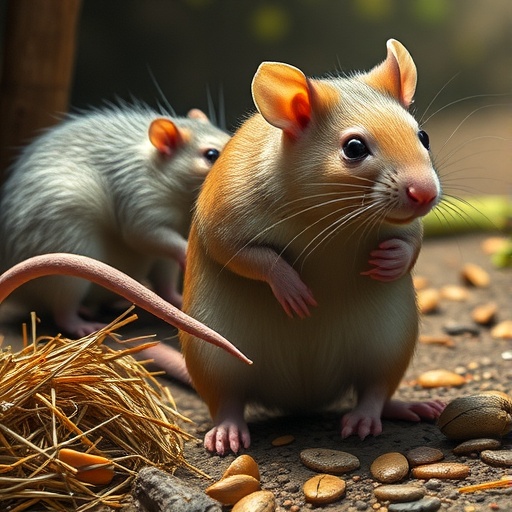
In the intricate dance of survival, foraging stands as a fundamental behavior observed across countless species, from microscopic organisms to humans. The choices made while foraging—deciding when to exploit a resource patch or move on to explore new ones—have profound implications for energy efficiency and overall fitness. Recent groundbreaking research by Scholey, Apps, and Humphries challenges long-held assumptions about the deterministic nature of these decisions. Their study uncovers the stochastic, or probabilistic, elements that underpin patch foraging in both humans and rats, revealing a surprising layer of complexity that reshapes our understanding of decision-making in natural environments.
For decades, ecologists and behavioral scientists have utilized optimal foraging theory to model the seemingly rational strategies animals employ in patch foraging scenarios. According to classical models, foragers should stay in a food patch until the resource intake rate declines below the average gain expected from the environment, a principle often described via the marginal value theorem. However, empirical observations have consistently shown variability in patch residence times and choices that deviate from these optimal predictions. The research led by Scholey and colleagues probes this variability with a novel experimental and analytical approach, focusing on stochastic decision processes rather than deterministic cost-benefit calculations alone.
At its core, the study draws a fascinating parallel between humans and rodents, two species separated by vast evolutionary distances but linked through fundamental survival behaviors. Using a series of rigorously designed foraging tasks, the team quantified how individual subjects—whether human participants or laboratory rats—decide to leave resource patches. These tasks simulated environments with fluctuating reward rates and embedded uncertainties, conditions that closely mimic natural foraging landscapes. Crucially, the researchers introduced stochastic models of choice, where randomness is not noise but an inherent feature driving decision variability.
One of the striking revelations from the research is the identification of intrinsic randomness influencing patch departure decisions. Rather than strictly adhering to a fixed threshold in exploitative gain, subjects displayed a probabilistic tendency to switch behaviors. This stochasticity was not merely a result of sensory or motor noise but appeared to be a strategic element embedded within the cognitive architecture of foraging decisions. Such randomness might confer evolutionary advantages by preventing predictable exploitation patterns, thus allowing for better adaptation to dynamic environments where resource availability can be erratic and competitive pressures high.
The neurobiological underpinnings of this stochastic decision-making offer fertile ground for further exploration. Previous studies have implicated the anterior cingulate cortex (ACC) and midbrain dopaminergic systems in mediating foraging behavior and value assessment. Scholey et al. suggest that fluctuating neural activity and probabilistic firing patterns could instantiate the randomness observed at the behavioral level. This introduces a compelling avenue linking computational models of stochastic choice with the biophysical properties of neural circuits, potentially advancing our understanding of how the brain balances exploitation and exploration.
Interestingly, the team’s cross-species approach underscored similar stochastic patterns in rats, underscoring the evolutionary conservation of such mechanisms. Rats, often used as model organisms for decision-making studies, exhibited patch residence times and departure variability consistent with the stochastic choice paradigm. This finding positions stochastic foraging behavior as a fundamental biological principle, not merely a quirk of complex human cognition but an adaptive trait across mammals.
From a methodological standpoint, the research employed sophisticated statistical frameworks, including Markov decision processes and probabilistic choice modeling, to dissect the contribution of randomness to foraging choices. By fitting models to behavioral data across numerous trials and environments, the researchers were able to delineate between deterministic heuristics and stochastic components. This rigorous approach ensures robustness in the conclusions drawn and lays a foundation for integrating stochastic models into broader ecological and behavioral paradigms.
Beyond academic curiosity, these insights have wide-reaching implications. In robotics and artificial intelligence, algorithms inspired by natural foraging strategies are increasingly critical for autonomous exploration and resource management. Incorporating stochasticity into decision-making protocols could enhance adaptability and resilience in artificial agents, enabling them to perform optimally in uncertain and dynamic real-world environments. Scholey et al.’s findings thus bridge biological theory and technological innovation.
Moreover, the recognition of inherent randomness in decision processes invites a re-examination of how we interpret variability in human behavior more generally. Often dismissed as noise or irrationality, stochastic choice components may reflect sophisticated probabilistic computations optimized for survival. This perspective can reshape fields from psychology to behavioral economics, where incorporating stochastic models might better capture the complexity of human decision-making under uncertainty.
The research also prompts intriguing questions about individual differences. While the study focused on generalized patterns across species, variability between individuals—and potentially between contexts—could influence the degree of stochasticity employed. Understanding these nuances could illuminate the interplay between genetic, developmental, and environmental factors shaping decision strategies, with implications for mental health, learning, and adaptive behaviors.
Another fascinating implication concerns the evolutionary pressures favoring stochastic decision-making. In rapidly changing environments, predictable behavior can be exploited by competitors or predators, making randomness a valuable strategy to maintain unpredictability and flexibility. Thus, stochastic choice may represent an evolutionarily stable strategy balancing exploitation of known resources and exploration for new opportunities.
In sum, Scholey, Apps, and Humphries offer a transformative perspective on patch foraging, highlighting the centrality of stochastic choice in driving behavioral variability in both humans and rats. Their findings challenge deterministic views and underscore the probabilistic nature of survival strategies at a fundamental level. By bridging disciplines—from behavioral ecology to neuroscience and computational modeling—the study opens exciting paths for research and application alike.
As our environments continue to grow in complexity and unpredictability, understanding the stochastic components of decision-making will be increasingly crucial. Whether for designing smarter machines, developing better therapeutic interventions for decision-making disorders, or unraveling the mysteries of animal behavior, embracing randomness may be the key to unlocking adaptive intelligence in both biological and artificial systems.
This remarkable study pushes the boundaries of our understanding, reminding us that beneath the apparent chaos of everyday choices lies an elegant, probabilistic logic honed by millions of years of evolution. Stochastic choice, once viewed as mere noise, now emerges as a fundamental driver of adaptive behavior, shaping how creatures great and small navigate the challenges of life’s grand foraging game.
Cite Scienmag News
Glenn Wilkins. (May 19, 2026). Stochastic Choice Fuels Foraging Variability in Humans, Rats. Scienmag. https://scienmag.com/stochastic-choice-fuels-foraging-variability-in-humans-rats/
Glenn Wilkins. "Stochastic Choice Fuels Foraging Variability in Humans, Rats." Scienmag, 19 May 2026, https://scienmag.com/stochastic-choice-fuels-foraging-variability-in-humans-rats/. Accessed 4 September 2026.
Glenn Wilkins. "Stochastic Choice Fuels Foraging Variability in Humans, Rats." Scienmag. May 19, 2026. https://scienmag.com/stochastic-choice-fuels-foraging-variability-in-humans-rats/


