


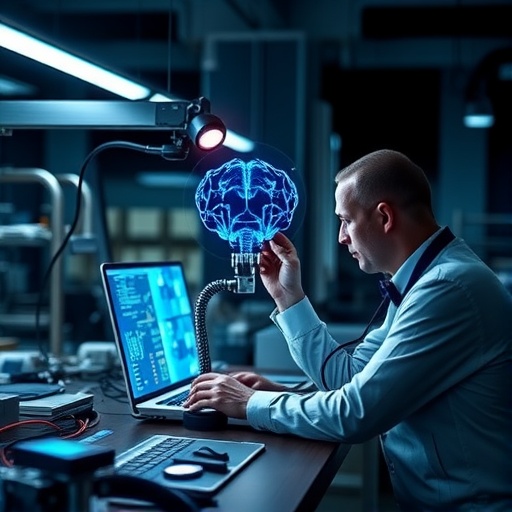
In the rapidly evolving landscape of manufacturing, the integration of autonomous systems has become a critical frontier for technological innovation. At the forefront of this advancement is the pioneering work conducted by Margadji and Pattinson, whose 2026 study, published in Nature Communications, introduces an unprecedented hybrid reasoning framework designed to elevate the capabilities of autonomous perception, explanation, and decision-making in complex manufacturing environments. This approach marks a transformative shift, promising to enhance efficiency, adaptability, and intelligence in automated industrial processes.
Manufacturing facilities today are becoming increasingly complex, with assets ranging from highly specialized robotic arms to intricate sensor networks that collectively monitor and adjust production workflows in real time. Despite impressive progress in automation, one of the enduring challenges has been enabling machines not only to perceive and react but to understand and explain their environment in a manner analogous to human cognition. Margadji and Pattinson’s hybrid reasoning framework addresses this gap by merging symbolic reasoning with data-driven machine learning techniques, thereby creating a system that can interpret raw sensory input, infer latent causality, and autonomously plan effective courses of action with remarkable precision.
At the core of this hybrid system lies a dual-layered approach that harmonizes the strengths of classical symbolic AI — celebrated for its interpretability and logical structure — with the adaptive, pattern-recognition prowess of contemporary machine learning algorithms. Symbolic reasoning enables the system to construct and manipulate formal representations of manufacturing tasks, components, and workflows, while machine learning models provide perceptual robustness and the ability to generalize from vast datasets. This synergy allows the autonomous agent to not only detect and classify components but to infer functional relationships and anticipate downstream effects of its actions.
One of the breakthrough capabilities demonstrated by the framework is its dynamic perception mechanism. The system integrates multiple sensor modalities — including high-definition visual input, tactile feedback, and acoustic signals — to develop comprehensive situational awareness. Through probabilistic fusion techniques, it synthesizes these disparate data streams into a coherent state estimate of the manufacturing environment. This holistic perception capacity is critical in handling noisy or incomplete data, a common challenge on bustling factory floors where unforeseen anomalies frequently occur.
Beyond perception, the framework excels in providing explanatory insights that clarify the rationale behind autonomous decisions. By maintaining explicit symbolic models of the manufacturing process and critical causal links, the system can produce justifications for its actions that are interpretable by human operators. This transparency is essential for building trust and facilitating human-machine collaboration, especially important in safety-critical industrial settings. It also supports streamlined troubleshooting by highlighting how detected anomalies influence subsequent operational choices.
The autonomous decision-making element of this hybrid system amplifies manufacturing agility and reduces dependence on human intervention. Leveraging symbolic planners augmented with predictive models learned from historical operational data, the system can craft robust action plans that optimize task sequences, minimize downtime, and adapt in real time to emergent conditions. For example, when a tool failure is detected, the system not only halts affected processes but dynamically reroutes workloads and adjusts machine parameters to maintain production continuity – all while communicating its rationale to supervisory staff.
Underpinning this technological leap is a rigorous methodology wherein the symbolic knowledge base is structured as a formal ontology encompassing domain-specific concepts such as machine states, product specifications, and process constraints. This ontology acts as the backbone for reasoning and explanation generation. Concurrently, neural architectures trained on extensive sensor datasets enable high-fidelity recognition of physical components and anomaly patterns, creating an end-to-end feedback loop that continuously refines both perception and reasoning accuracy.
Margadji and Pattinson’s work also emphasizes the importance of scalable learning strategies that allow the hybrid reasoning framework to evolve with the manufacturing environment. As factories introduce new machinery or alter workflows, the system can incorporate fresh data to update its models and ontologies without requiring exhaustive reprogramming. This adaptability is fueled by transfer learning techniques and incremental symbolic updating, ensuring that autonomous actions stay relevant and effective as operational contexts shift.
In practice, the deployment of this hybrid reasoning technology has the potential to revolutionize sectors beyond discrete manufacturing, including complex assembly lines, chemical processing, and even additive manufacturing. Its capacity to explain decisions and seamlessly blend human and machine reasoning makes it a cornerstone for next-generation smart factories — environments characterized by heightened collaboration, predictive maintenance, and near-zero downtime.
Furthermore, by endowing machines with human-like explanatory depth, the framework promises profound safety and compliance benefits. Autonomous systems imbued with explanatory faculties can better adhere to stringent regulatory standards by providing accessible audit trails and clarifying their compliance with operational protocols. This capability facilitates certification processes and nurtures greater acceptance of AI-driven automation in heavily regulated industries.
The computational demands of this hybrid approach are non-trivial, requiring efficient algorithms and hardware capable of real-time processing. Margadji and Pattinson have addressed this by integrating lightweight symbolic reasoners optimized for edge computing, paired with compact neural networks that operate effectively on embedded platforms. This balance allows deployment directly on factory-floor equipment rather than relying exclusively on centralized cloud resources, thereby reducing latency and enhancing security.
Industry leaders are already expressing keen interest in this hybrid reasoning model, recognizing its potential to deepen AI’s role as a proactive problem solver rather than a mere automated executor. The system embodies an intelligent partner capable of sensing, understanding, and innovating within manufacturing workflows — a capability that represents a significant stride toward fully autonomous smart factories of the future.
The research team is also exploring extensions of this hybrid reasoning approach to collaborative human-robot teams, where machines equipped with transparent reasoning can better anticipate human intentions and provide contextual assistance. This human-centric perspective ensures that automation technologies amplify rather than diminish human expertise, fostering safer and more efficient workplaces.
As manufacturing ecosystems grow ever more interconnected and complex, hybrid reasoning frameworks like the one developed by Margadji and Pattinson will become indispensable. Their ability to synthesize symbolic knowledge with data-driven perception equips autonomous systems with a nuanced form of intelligence that aligns closely with the demands of modern industry.
Ultimately, this groundbreaking research not only propels the technological frontier but reshapes conceptual understandings of autonomous action in manufacturing. By bridging rational explanation and adaptive perception, the approach provides a blueprint for machines that are not only capable but comprehensible — a prerequisite for widespread adoption and transformative impact.
As the industry moves forward, the implications of this work will resonate far beyond traditional manufacturing settings, influencing fields such as autonomous vehicles, intelligent infrastructure, and complex system control. Hybrid reasoning heralds an era where machines think more like humans while operating at superhuman speed and precision, delivering unprecedented productivity and reliability.
Margadji and Pattinson’s contribution thus stands as a landmark achievement in AI research and industrial engineering. Their hybrid reasoning framework sets a new standard for intelligent autonomous systems, blending the best of symbolic and data-driven paradigms to unlock powerful new capabilities for perception, explanation, and action in manufacturing.
Cite Scienmag News
Denise Maddox. (May 19, 2026). Hybrid Reasoning Boosts Manufacturing Perception and Autonomy. Scienmag. https://scienmag.com/hybrid-reasoning-boosts-manufacturing-perception-and-autonomy/
Denise Maddox. "Hybrid Reasoning Boosts Manufacturing Perception and Autonomy." Scienmag, 19 May 2026, https://scienmag.com/hybrid-reasoning-boosts-manufacturing-perception-and-autonomy/. Accessed 3 September 2026.
Denise Maddox. "Hybrid Reasoning Boosts Manufacturing Perception and Autonomy." Scienmag. May 19, 2026. https://scienmag.com/hybrid-reasoning-boosts-manufacturing-perception-and-autonomy/


