


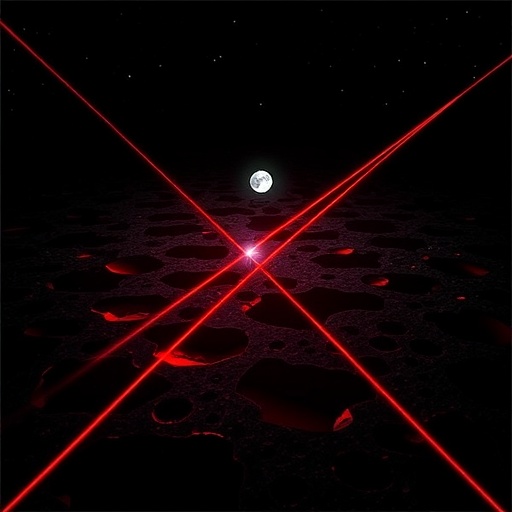
In the silent, shadowed craters of the Moon’s south pole—a realm colder and darker than any place in our solar system—physicists have found what could become a game-changing environment for the next generation of ultra-precise lasers. These permanently shadowed regions, where sunlight never penetrates, plunge to temperatures as low as 50 kelvins, creating an almost pristine vacuum landscape unparalleled on Earth. It is in these lunar abysses that Jun Ye and his colleagues envision installing a groundbreaking optical silicon cavity, the cornerstone for producing an ultrastable laser of unprecedented stability and precision.
A laser anchored to an optical silicon cavity is not just any light source. Its defining characteristic is a nearly unwavering frequency—a fantastically stable color of light achieved when photons resonate perfectly within the distance confined by two mirrors at the cavity’s ends. Stability here means the distance between these mirrors must remain absolute; any vibrations or temperature fluctuations that alter this distance would drastically affect the laser’s consistency. With terrestrial environments rife with noise, thermal expansions, and vibrations, Earth-bound laboratories must employ elaborate and expensive mechanisms such as cryostats to control such disturbances. The Moon’s south polar craters naturally overcome these challenges with frigid temperatures and an ultra-high vacuum, making them idyllic natural laboratories for this ultra-stable laser technology.
The scientific ingenuity behind this concept lies in exploiting the lunar environment’s unique physical conditions, drastically reducing the thermal jitter that affects the mirrors within the silicon cavity. At a baseline temperature of approximately 50 K, the silicon block’s mirrored surfaces jitter far less than they would on Earth. Moreover, the vacuum inside these shadowed craters exceeds lunar surface vacuum by orders of magnitude, eliminating the noise from residual particles and sound waves that might otherwise strike the cavity and subtly shift the mirror separation. Intriguingly, by radiating residual heat into the deep cold of space, the cavity could be passively cooled to an astonishing 16 K without intricate cooling devices—reaching a temperature where silicon’s thermal expansion coefficient virtually vanishes. This equilibrium guarantees that the distance photons travel inside the cavity isn’t perturbed by minute temperature variations.
Once deployed within a crater’s eternal twilight, the optical silicon cavity would pair with a commercially available laser, positioned either at the crater’s rim or within its shaded depths. By channeling a fraction of the laser’s light into the cavity, the laser frequency locks onto one of the cavity’s resonant frequencies, essentially pinning the laser’s “color” to a single, unmoving wavelength. This resonance lock not only enhances frequency stability manifold but also ensures the laser becomes a beacon of temporal precision. The practical applications are diverse and transformative. Most immediately, such a lunar laser could provide a GPS-like navigational framework for spacecraft touring the Moon, especially aiding landings in the notoriously low-illumination polar regions, which pose significant challenges for existing navigational systems.
But the ambitions do not stop there. Aligning multiple such lunar lasers could enable extraordinarily precise distance measurements across the lunar surface, unlocking capabilities far beyond current technologies. With distances measured at resolutions unimaginable today, these instruments could detect subtle perturbations caused by gravitational waves—ripples in space-time foretold by Einstein’s general relativity but only recently observed. These waves might subtly alter the distances between the lunar objects, and such a network of lasers could serve as a novel, moon-based gravitational wave observatory, offering new windows into astrophysical phenomena and testing fundamental physics in a regime distinct from Earth-based observatories.
Another transformative application involves time itself. This laser system could synchronize with atomic clocks aboard satellites orbiting the Earth or Moon, creating the backbone for the first optical atomic clock off our planet. Optical atomic clocks, which measure time with staggering precision by tuning lasers to frequency transitions in atoms, currently hold the record for the most accurate timekeeping on Earth. Establishing similar timekeeping on the Moon would enable a stable and accurate lunar time scale, critical for scientific experiments, navigation, and communication in future space missions. These clocks would allow for ultrafine measurement of the passage of time, revolutionizing how we coordinate lunar activities and possibly laying the groundwork for deep-space navigation.
The physical hardware of the silicon optical cavity is remarkably compact—small enough to fit inside an Artemis mission spacecraft prepared for lunar deployment. As study co-author Wei Zhang from NASA’s Jet Propulsion Laboratory explains, the device would be preassembled on Earth and designed to unfold its radiation panels during deployment to maximize passive cooling once placed within a permanently shadowed crater. Deployment would likely involve astronauts remotely or mechanically operating lunar rovers to precisely position the cavity in the harsh and dim lunar terrain. This synergy between human operation and robotic precision reflects the cutting-edge approaches NASA foresees for the Artemis mission, addressing both logistical challenges and operational reliability.
Despite the technical and environmental challenges inherent in lunar polar exploration, co-author Yiqi Ni of Lunetronic highlights the critical importance of these permanently shadowed regions. Besides offering an ideal setting for the silicon cavity, these craters harbor valuable water-ice deposits and other resources crucial for sustainable human presence on the Moon. The dual significance of these zones, both scientifically and resource-wise, underscores their pivotal role in humanity’s lunar ambitions and spaceship homesteading.
Looking forward, Ni estimates a phased rollout of the silicon optical cavity technology: a demonstration in low-Earth orbit within two years, followed by a lunar surface deployment in three to five years, ultimately culminating in cavity installation within permanently shadowed craters. Such efforts will necessitate collaborative initiatives across agencies, integrating expertise and facilitating the necessary technological advancements to make these aspirations realities.
The premise for this lunar laser springs from visionary brainstorming by Jun Ye, a physicist deeply versed in the intricacies of laser and precision measurement technologies. Initially, the idea seemed far-fetched, yet the more Ye and his team understood the lunar environment, the more the concept revealed itself as not just viable but exceptionally appropriate. The natural advantages of the Moon’s shadowed regions offer unparalleled conditions for a super-stable laser that could leapfrog decades of Earth-bound technology constraints.
Ultimately, a lunar optical silicon cavity and the laser system it supports could herald a new era in space exploration and fundamental physics. It stands to inaugurate an infrastructure for a lunar time scale, provide the backbone for Earth-Moon optical communications, facilitate new forms of satellite-based space imaging and distance measurement, and serve as the foundation for extraterrestrial optical atomic clocks. These technologies could become catalysts for innovations in navigation, gravitational research, and timekeeping that ripple far beyond the Moon, impacting space science, astrophysics, and quantum technologies broadly.
In essence, the Moon’s deepest shadows may illuminate humanity’s path forward, offering an exquisite natural laboratory where light and time harmonize in ways Earth-bound labs can only dream of. The ultrastable silicon cavity laser concept not only exemplifies creative scientific thinking but also embodies the spirit of exploration pushing the boundaries of where precision physics can thrive. As Artemis missions prepare for their journey, the prospect of embedding such sophisticated instruments into the lunar environment marks a significant leap toward transforming the Moon from a distant rock into a thriving hub for cutting-edge science and technology.
Cite Scienmag News
Denise Maddox. (May 18, 2026). Aiming for the Moon: Ultrastable Lasers in Lunar Craters Could Revolutionize Navigation, Precision Timing, and Scientific Discovery. Scienmag. https://scienmag.com/aiming-for-the-moon-ultrastable-lasers-in-lunar-craters-could-revolutionize-navigation-precision-timing-and-scientific-discovery/
Denise Maddox. "Aiming for the Moon: Ultrastable Lasers in Lunar Craters Could Revolutionize Navigation, Precision Timing, and Scientific Discovery." Scienmag, 18 May 2026, https://scienmag.com/aiming-for-the-moon-ultrastable-lasers-in-lunar-craters-could-revolutionize-navigation-precision-timing-and-scientific-discovery/. Accessed 4 September 2026.
Denise Maddox. "Aiming for the Moon: Ultrastable Lasers in Lunar Craters Could Revolutionize Navigation, Precision Timing, and Scientific Discovery." Scienmag. May 18, 2026. https://scienmag.com/aiming-for-the-moon-ultrastable-lasers-in-lunar-craters-could-revolutionize-navigation-precision-timing-and-scientific-discovery/


