


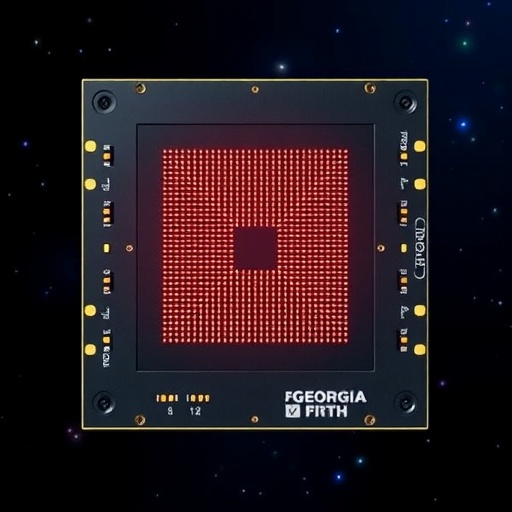
As humanity sends spacecraft deeper into the cosmos, the necessity for onboard data processing and storage grows ever more critical. The sheer scale of information collected by these missions—ranging from surface scans of extraterrestrial terrains to real-time environmental readings—demands advanced computing technologies with robust memory capabilities. Central to this technological evolution is NAND flash memory, a mainstay in terrestrial devices such as smartphones and laptops, revered for its high storage capacity and low power consumption. However, the rigors of space—especially the relentless bombardment of ionizing radiation—pose a formidable challenge to the integrity of NAND flash memory, threatening data reliability and mission success.
Recognizing this vulnerability, researchers at the Georgia Institute of Technology have pioneered a novel type of NAND flash memory designed to endure the extreme space radiation environment. This breakthrough leverages the principles of ferroelectricity, exploiting materials that intrinsically maintain a permanent, spontaneous electric polarization. Unlike conventional NAND flash, which stores data by confining electrical charges in microscopic cells, ferroelectric NAND stores information as the directional polarization of the material itself. This foundational difference imbues the memory with a vastly superior resilience against radiation-induced data corruption.
The pivotal material underpinning this advancement is ferroelectric hafnium oxide, a silicon-compatible compound whose ferroelectric properties were only discovered about fifteen years ago. Since then, Prof. Asif Khan and his team have been delving into its potential applications, culminating in the realization of ferroelectric memory architectures capable of withstanding environments laden with ionizing radiation. The breakthrough came when their fabricated devices underwent rigorous radiation exposure testing—an effort led by Ph.D. candidate Lance Fernandes in collaboration with experts at Pennsylvania State University.
Testing results revealed that the ferroelectric NAND flash memory could endure radiation doses as high as one million rads (radiation absorbed dose), an exposure level equivalent to enduring a hundred million X-rays. This capability represents a thirtyfold increase in radiation tolerance compared to traditional charge-trapping NAND flash technology. To put this in perspective, most spacecraft electronics need to tolerate radiation doses ranging from a few thousand to a few hundred thousand rads depending on their orbital environment, with deep space missions pushing the threshold close to one million rads. Thus, this new ferroelectric NAND technology more than satisfies these stringent requirements.
The resilience is attributed to the fundamentally different data storage mechanism. In traditional NAND flash, radiation-induced charge displacement leads to bit errors and file corruption. Ferroelectric memory, conversely, relies on the directional alignment of dipoles within the crystal lattice—a polarization state less susceptible to ionizing radiation damage. This inherent robustness paves the way for dependable, high-density memory in space applications, allowing spacecraft to process and store vast datasets autonomously, a crucial factor as artificial intelligence assumes greater responsibility for on-board data analysis.
Professor Khan emphasized the significance of this milestone: “Conventional flash memory dependably fails when exposed to space radiation because the charges within the memory cells are displaced, corrupting the data. Our ferroelectric NAND flash instead stores information through polarization states, which remain stable even under extreme ionizing radiation.” This striking distinction underscores the promise ferroelectric memory holds not only for space exploration but potentially for other radiation-rich environments on Earth and beyond.
The capacity for ferroelectric NAND flash to maintain integrity under such punishing conditions unlocks myriad avenues for future space technologies. Orbital satellites, planetary probes, and crewed missions venturing to distant celestial bodies like Jupiter’s moons require dependable, radiation-hard electronics to process sensor data, support autonomous navigation and communication, and handle AI computations that reduce reliance on Earth. The durability and reliability of ferroelectric memory, demonstrated through rigorous laboratory and field testing, directly contribute to mission safety and success.
Preparing the ferroelectric NAND devices involved advanced fabrication techniques carried out in Georgia Tech’s state-of-the-art cleanroom facilities. These specialized environments enable the precise layering and material deposition required to integrate ferroelectric stacks atop silicon substrates, ensuring compatibility with existing semiconductor manufacturing processes. Following fabrication, the devices underwent coordinated testing at Pennsylvania State University, where dosimetry tools exposed them to simulated space radiation levels far exceeding operational expectations.
The interdisciplinary nature of this work underscores the importance of collaboration between materials scientists, electrical engineers, and radiation physicists. By combining expertise in ferroelectric materials, semiconductor device engineering, and ionizing radiation effects, the researchers have addressed a complex challenge that bridges basic science and applied technology. Importantly, the research received support from DARPA and the Department of Defense, highlighting the strategic value of developing radiation-hardened electronics for national security applications in addition to space exploration.
Looking ahead, the implications of ferroelectric NAND flash memory extend beyond mere radiation tolerance. Its potential for low-power operation coupled with high-speed data access complement the requirements of cutting-edge AI workloads, further positioning this technology as a key enabler in the next generation of spacecraft data systems. As the boundaries of human and robotic space travel continue to expand, memory technologies capable of meeting exacting standards for resilience, capacity, and energy efficiency will be indispensable.
In summary, the development of ferroelectric NAND flash memory represents an extraordinary leap forward in spacecraft electronics, marrying high-density data storage with unparalleled radiation hardness. This innovation equips future missions with the capacity to reliably store and process data deep in space, empowering instruments and AI systems to function without interruption despite relentless cosmic radiation. With the ongoing refinement of ferroelectric materials and scalable device architectures, the vision of enduring, intelligent space systems is now within reach—ushering in a new era of exploration and discovery.
Web References:
- Georgia Tech Cleanroom Facility: https://matter-systems.gatech.edu/cleanroom/micronano-fabrication-facility
- Published article in Nano Letters: https://pubs.acs.org/doi/10.1021/acs.nanolett.5c05947
References:
Fernandes, L., Wodzro, S., Venkatesan, P., Ravikumar, P., Lee, M.-Y., Shon, M., Chakraborty, D., Song, T., Kang, S., Soliman, S., Tian, M., Yeager, J., Adler, J., Chen, J., Wang, Z., Wolfe, D., Yu, S., Padovani, A., Datta, S., Ray, B., & Khan, A. (2026). Enabling Radiation Hardness in Solid-State NAND Storage Utilizing a Laminated Ferroelectric Stack. Nano Letters, 26(10), 3390-3397. DOI: 10.1021/acs.nanolett.5c05947.
Keywords
Ferroelectric memory, NAND flash, radiation hardness, space electronics, hafnium oxide, silicon-compatible memory, ionizing radiation, data storage, artificial intelligence, semiconductor fabrication, Gamma radiation tolerance, cosmic radiation resilience.
Cite Scienmag News
Denise Maddox. (May 18, 2026). Georgia Tech Researchers Unveil Innovative NAND Flash Storage Technology for Deep Space Missions. Scienmag. https://scienmag.com/georgia-tech-researchers-unveil-innovative-nand-flash-storage-technology-for-deep-space-missions/
Denise Maddox. "Georgia Tech Researchers Unveil Innovative NAND Flash Storage Technology for Deep Space Missions." Scienmag, 18 May 2026, https://scienmag.com/georgia-tech-researchers-unveil-innovative-nand-flash-storage-technology-for-deep-space-missions/. Accessed 3 September 2026.
Denise Maddox. "Georgia Tech Researchers Unveil Innovative NAND Flash Storage Technology for Deep Space Missions." Scienmag. May 18, 2026. https://scienmag.com/georgia-tech-researchers-unveil-innovative-nand-flash-storage-technology-for-deep-space-missions/


