


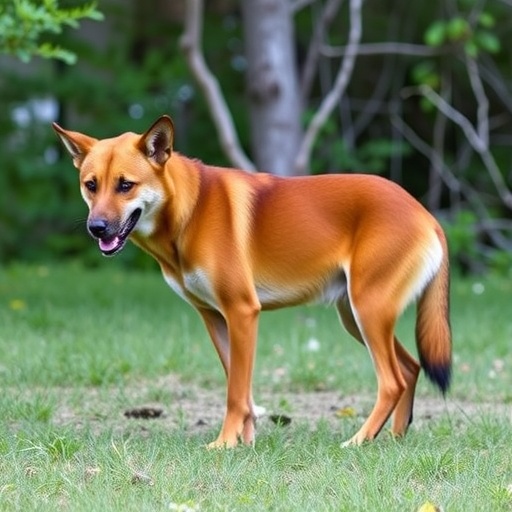
In a groundbreaking study that reshapes our understanding of Australia’s free-roaming canines, a team of researchers from the University of Adelaide has unveiled compelling genetic evidence revealing the true ancestry of these animals often mischaracterized as mere “wild dogs.” Utilizing a novel genetic testing methodology, this new research demonstrates that the vast majority of the free-roaming dogs scattered across the Australian landscape possess a predominant heritage rooted in dingoes rather than domestic dogs. This discovery not only challenges long-standing perceptions but also has profound implications for conservation policy and management strategies targeted at these iconic canines.
The study, spearheaded by the Australian Centre for Ancient DNA and the Environment Institute, analyzed genetic material collected from over 300 free-roaming canines nationwide. By employing a cutting-edge assay calibrated with pre-colonial dingo DNA as an authentic reference, the research team effectively disentangled the complex admixture patterns between indigenous dingoes and European domestic dogs, which had historically muddled genetic analyses. Strikingly, the results demonstrated that on average, only 11.7 percent of the DNA in these populations originated from domestic dogs. This finding sharply contrasts with prior studies that reported conflicting degrees of hybridization, primarily because they lacked a robust baseline for dingo ancestry.
Regionally, the extent of domestic dog ancestry varies, with the southeastern parts of Australia, particularly Victoria and New South Wales, bearing higher proportions of European dog genetics. Conversely, remote northern and western regions house canines with much lower domestic dog gene flow, preserving a more genetically pure dingo lineage. These geographic genetic differences underscore the influence of historical human settlement patterns and ecological landscapes in shaping the current genetic mosaic of Australia’s wild canines.
Dr Yassine Souilmi, the senior author of the study, emphasized the importance of using pre-colonial dingo DNA as a reference standard. “Previous genetic tests gave us a contradictory picture,” Dr. Souilmi explained. “By incorporating true ancestral dingo DNA from ancient samples, our study effectively resolved these discrepancies and confirmed that the vast majority of free-roaming canines are overwhelmingly dingo in their genetic makeup.” This advance leverages ancient DNA technology that can detect subtle signals of admixture often undetectable by conventional genetic testing techniques, enabling unprecedented resolution in ancestry inference.
The ramifications of these findings extend significantly into the realms of species classification and ecological management. For decades, the term “wild dog” has been ubiquitously applied to free-roaming canines without appreciating the biological and cultural nuances inherent to dingoes. Dr Souilmi highlighted that “a predominantly dingo individual is fundamentally different from a stray domestic dog,” pointing out the necessity of nuanced, culturally sensitive management strategies. Recognizing dingoes as distinct biological entities rather than generic wild canines invites rethinking current policies, many of which have been premised on a misconception that all free-roaming dogs are invasive or feral.
Integral to this revised approach is the recognition of the deep cultural significance dingoes hold for Indigenous Australian communities. These communities have long regarded dingoes as companions and kin, with relationships spanning thousands of years. The research advocates for future management frameworks to be regionally tailored and developed in collaboration with Indigenous stakeholders, ensuring that conservation efforts honor both the ecological role and cultural heritage of dingoes. Such partnerships could facilitate conservation models that integrate traditional ecological knowledge with contemporary science.
A technological breakthrough that enabled the broad-scale application of this study’s findings is the development of a highly cost-effective and accurate genetic test requiring relatively few DNA markers. Co-first author Shyamsundar Ravishankar emphasized this advance, stating, “Our test works reliably with a limited number of markers, making ancestry screening affordable for routine use.” Previously, comprehensive genome sequencing was prohibitively expensive for widespread monitoring, limiting data collection. This streamlined approach allows wildlife agencies to embed ancestry screening into regular surveillance programs, ensuring informed decision-making based on precise genetic insights without large financial burdens.
Further genetic analysis delineated eight genetically distinct dingo populations across Australia, including two newly identified groups inhabiting northern and central regions. This subdivision adds complexity to the population structure of dingoes, shedding light on their evolutionary trajectories and adaptive diversity. Of particular concern is the genetic diversity seen in southeastern populations, which, after adjusting for domestic dog ancestry, are markedly less diverse than populations in northern and central Australia. This diminished genetic variability could predispose these populations to greater vulnerability in the face of environmental changes and disease pressures.
The Mallee (Big Desert) dingoes of northwestern Victoria present a remarkable case with even lower ancestral diversity than the notoriously small and isolated K’gari (Fraser Island) population. This finding underlines the urgency for targeted conservation efforts focused on preserving genetic diversity within these populations, critical for their long-term viability. Co-first author Nhi Chau Nguyen remarked that “removing the domestic dog genetic component alters our understanding; while domestic dog DNA may inflate genetic variability metrics, it simultaneously diminishes essential dingo-specific genetic traits that confer regional uniqueness.”
Tracing back through historical timelines, the research confirmed that gene flow from European domestic dogs into dingo populations surged during the mid-20th century, peaking notably in the 1960s. This timing correlates with a period marked by rapid post-war human population growth and intensified agricultural activity in southeastern Australia, factors likely facilitating increased encounters and hybridization between dingoes and domestic dogs. This historic influx of dog genes complicates the genetic landscape and poses challenges for conservationists attempting to preserve the dingo’s genetic integrity.
Importantly, the study’s advanced genetic assays open up promising avenues for ongoing monitoring and management of dingo populations. By reliably distinguishing hybrid individuals from predominantly dingo ones, conservation efforts can be more precisely focused, minimizing unnecessary culling of genetically pure dingoes and aligning actions with ecological and cultural realities. The integration of ancient DNA data alongside modern genetic sampling exemplifies a sophisticated approach that can serve as a model for wildlife management globally.
In conclusion, this pioneering research recasts Australia’s free-roaming canines in a new light—emphasizing their dingo heritage rather than framing them as feral domestic dogs. The findings advocate for regionally sensitive, scientifically informed, and culturally respectful stewardship of these animals. They challenge outdated stereotypes and contribute robust genetic evidence that may ultimately transform conservation paradigms, ensuring that dingoes continue to thrive as a cornerstone of Australia’s natural and cultural heritage.
News Publication Date: [Not provided in the source content]
Web References:
- DOI: 10.1111/con4.70052
References:
- Original research article published in Conservation Letters
Cite Scienmag News
William Thompson. (May 14, 2026). Predominantly Dingoes Make Up Most of Australia’s ‘Wild Dog’ Population. Scienmag. https://scienmag.com/predominantly-dingoes-make-up-most-of-australias-wild-dog-population/
William Thompson. "Predominantly Dingoes Make Up Most of Australia’s ‘Wild Dog’ Population." Scienmag, 14 May 2026, https://scienmag.com/predominantly-dingoes-make-up-most-of-australias-wild-dog-population/. Accessed 4 September 2026.
William Thompson. "Predominantly Dingoes Make Up Most of Australia’s ‘Wild Dog’ Population." Scienmag. May 14, 2026. https://scienmag.com/predominantly-dingoes-make-up-most-of-australias-wild-dog-population/


