


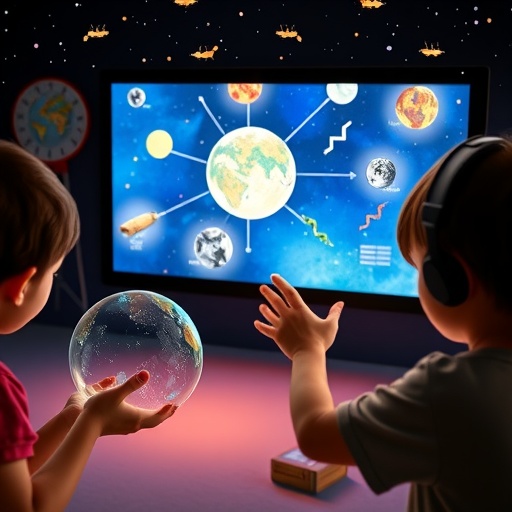
In a groundbreaking advancement at the intersection of immersive technology and early childhood education, researchers from Flinders University, Australian Catholic University (ACU), and Zhejiang Normal University have unveiled compelling evidence supporting the transformative power of augmented reality (AR) smart glasses in primary science education. This pioneering study explores how AR, particularly when integrated through smart glasses, revolutionizes learning experiences by fostering heightened engagement, social collaboration, and deeper cognitive development in young learners, with profound implications for the future of education technology.
The investigation centered around the deployment of an innovative AR Immersive Visual Learning Environment (AR-IVLE) that combines AI-powered smart glasses with iPads and Apple TVs to orchestrate a seamless, multi-modal learning experience. Unlike conventional touchscreen devices or bulky 3D glasses, these smart glasses provide adaptive, real-time feedback tailored to each individual’s learning preferences, creating a uniquely personalized educational journey. This breakthrough was trialed with 84 Year 1 and 2 students alongside five teachers in a Victorian junior primary school, enabling a comprehensive examination of AR’s practical impact on classroom dynamics and learning outcomes.
Within the trial, students donned AR smart glasses to explore virtual lessons about ants and their nest-building behaviors—content notoriously difficult to convey through traditional instructional methods. The glasses allowed learners to physically move around and interact with hyperrealistic 3D models of ant colonies, offering multiple perspectives on the structure and roles within the colony. This immersive interaction empowered students to engage kinesthetically and visually in ways previously unattainable, fostering an intuitive grasp of complex biological concepts by blending sensory inputs with active play.
Group engagement was amplified as non-participating students followed the AR experience in real-time on iPads, enabling them to observe, discuss, and collaborate with peers who wore the glasses. This setup transformed the classroom into a dynamic environment of shared exploration, enhancing social interaction and cooperative learning. Students were observed verbally directing each other’s focus towards elements like the queen ant or worker ants, effectively utilizing the AR environment as a springboard for communication and teamwork.
Quantitative and qualitative analyses revealed dramatic increases in student engagement when AR smart glasses were employed, surpassing the attention levels associated with typical tablet-based activities. Elevated energy, creativity, and focused participation characterized the AR sessions, signaling a marked departure from the passive consumption often linked to traditional digital tools. Furthermore, students using the AR-IVLE or smart glasses exhibited enriched problem-solving abilities and produced more complex and thoughtful science reflections and work, indicating that immersive technology facilitates not just engagement but also deeper understanding.
From a pedagogical standpoint, this study underscores the importance of integrating multisensory and multimodal strategies to accommodate diverse learning styles. The AI-driven AR glasses dynamically adapt instructional content based on individual responses, effectively modulating cognitive load to optimize knowledge acquisition. Such personalized feedback mechanisms represent a leap forward from static digital resources, positioning AR as a crucial asset in attaining differentiated instruction in inclusive classrooms.
The researchers emphasized the scalability potential of their AR-IVLE system, noting that syncing the AR glasses with accessible consumer technologies like iPads and Apple TVs democratizes access and encourages broader adoption in educational settings. This integration supports varied teaching approaches, blending traditional group discussions with immersive individual experiences to foster a balanced and engaging classroom atmosphere. It represents a model for future classroom tech ecosystems designed to harmonize multiple devices into coherent educational workflows.
Although the initial findings are promising, the research team advocates for more extensive longitudinal studies across multiple school sites and diverse socio-economic contexts to validate and generalize these outcomes. They highlight the necessity to separate the novelty effects of emerging technology from genuine long-term engagement, suggesting future investigations with prolonged deployment periods and reduced researcher involvement to assess sustained learning impacts and behavioral shifts.
The technology itself, loaned for the trial by AR Pioneer company ROKID, included six pairs of state-of-the-art AR smart glasses alongside custom-developed teaching resources. This collaboration between academia and industry illustrates the synergistic possibilities of applied research and commercial innovation, creating user-centric educational tools aligned with real classroom needs. It also sets a precedent for ethically grounded experimental design, as full compliance with institutional review boards was maintained with informed consent from all participants and their guardians.
The implications of this study extend beyond science education, potentially transforming pedagogical paradigms across subject areas by promoting a learner-centered approach reinforced with interactive, immersive technology. By harnessing the power of AI-enhanced AR, educators can craft highly engaging lessons that accommodate multiple intelligences and learning modalities, thus addressing long-standing challenges in early childhood education related to motivation and content retention.
Looking forward, the researchers envision a future where AR smart glasses become a standard component within early education classrooms, enabling young learners to seamlessly explore complex concepts through virtual interaction. Coupled with group activities and digital collaboration platforms, these immersive technologies are poised to redefine active learning by promoting curiosity, critical thinking, and social skills in tandem with core academic knowledge.
In conclusion, the findings from this landmark observational study herald a new era of immersive, adaptive educational technology that precisely aligns with the cognitive and social needs of early learners. As AR smart glasses continue to evolve, they offer unprecedented opportunities to elevate science education and inspire the next generation of curious minds through innovative, interactive experiences that break traditional boundaries of classroom learning.
News Publication Date: 6-Mar-2026
Web References:
- https://link.springer.com/article/10.1007/s10956-026-10299-4
- https://www.tandfonline.com/doi/full/10.1080/10494820.2025.2590602#d1e1660
References:
Gretchen Geng, Kathy Green, Amanda Telford, Yue Zhu. “Engaging Young Minds: How Smart Augmented Reality Glasses Transform Learning Experiences in AR smart glasses Immersive Virtual Learning Environments (AR smart glasses IVLE).” Journal of Science Education and Technology, Springer Nature, March 2026, DOI: 10.1007/s10956-026-10299-4.
Cite Scienmag News
Courtney Benton. (May 14, 2026). Igniting Curiosity: How Augmented Reality Boosts STEM Learning for Kids. Scienmag. https://scienmag.com/igniting-curiosity-how-augmented-reality-boosts-stem-learning-for-kids/
Courtney Benton. "Igniting Curiosity: How Augmented Reality Boosts STEM Learning for Kids." Scienmag, 14 May 2026, https://scienmag.com/igniting-curiosity-how-augmented-reality-boosts-stem-learning-for-kids/. Accessed 4 September 2026.
Courtney Benton. "Igniting Curiosity: How Augmented Reality Boosts STEM Learning for Kids." Scienmag. May 14, 2026. https://scienmag.com/igniting-curiosity-how-augmented-reality-boosts-stem-learning-for-kids/


