


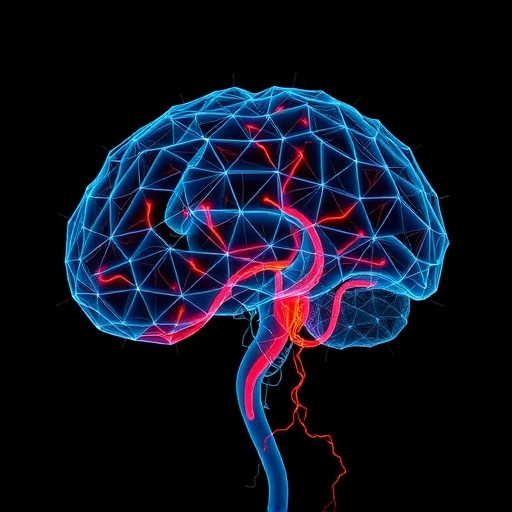
In a groundbreaking study published in Translational Psychiatry this May, researchers have unveiled a novel and intricate mechanism through which the cerebellum influences social behavior. The detailed investigation spearheaded by Fujita, Zhu, Tsuji, and colleagues elucidates how perineuronal nets (PNNs) modulate neuronal activity within cerebellar nuclei neurons, ultimately orchestrating complex social interactions. This finding opens a new frontier in understanding the cerebellum’s non-motor functions, particularly its less explored but highly significant role in social cognition.
Historically, the cerebellum has been predominantly associated with motor coordination and balance. However, accumulating evidence suggests its involvement extends beyond motor control to cognitive and affective domains. This study leverages advanced neurobiological techniques to explore the microstructural configurations within the cerebellar nuclei, focusing on PNNs—specialized extracellular matrix structures that envelop neurons and regulate synaptic plasticity and neuronal excitability. These nets have garnered increasing interest for their role in fine-tuning neural circuits critical for behavior modulation.
The researchers employed a multidisciplinary approach combining molecular biology, electrophysiology, and behavioral assays to dissect the contributions of PNNs in cerebellar nuclei neurons. By selectively disrupting PNNs, they observed significant alterations in the firing patterns of cerebellar output neurons. These electrophysiological changes corresponded with notable disruptions in social behaviors, demonstrating a causal link between PNN integrity and social functioning. This link challenges conventional paradigms that have previously marginalized cerebellar contributions to social neuroscience.
Intriguingly, the study delineates how PNNs serve as regulatory scaffolds that maintain a delicate balance in neuronal excitability necessary for appropriate social responses. The degradation of PNNs led to hyperexcitability in cerebellar output neurons, which in turn propagated aberrant signals to interconnected brain regions such as the prefrontal cortex and limbic structures. These areas are traditionally implicated in social behavior and emotional processing, highlighting a dynamic cerebellar-cortical dialogue mediated by PNN-regulated neural activity.
A pivotal aspect of this research lies in its use of genetically engineered animal models to selectively manipulate PNN components within cerebellar nuclei neurons. By employing enzymatic digestion techniques to degrade PNNs, the investigators demonstrated reversible impairments in social recognition and interaction. Such deficits mimic behavioral phenotypes observed in neurodevelopmental disorders, including autism spectrum disorder (ASD), where social dysfunction is a core symptom. This raises compelling prospects for targeting PNNs in therapeutic interventions.
The electrophysiological recordings revealed that PNN removal disturbs the inhibitory-excitatory balance that cerebellar neurons require to synchronize their output signals effectively. This disturbance impairs the cerebellum’s ability to precisely modulate downstream pathways involved in higher-order behavioral regulation. The researchers noted specific changes in the timing and frequency of neuronal firing, suggesting PNNs act as crucial modulators for temporal fidelity in cerebellar signaling.
Beyond the cellular and circuit-level insights, the behavioral analyses provided an essential bridge linking molecular mechanisms to overt social phenotypes. The subjects with disrupted PNNs exhibited reduced preference for social novelty and impaired social memory. These behaviors are quantifiable measures commonly used to assess social cognition, emphasizing the translational relevance of cerebellar PNNs in brain disorders marked by social deficits.
Moreover, the study underscores the cerebellum’s integrative role across distributed neural networks. It posits that PNN-mediated regulation within cerebellar nuclei is critical for the cerebellum to influence large-scale brain circuits involved in socio-emotional processing. This integrated perspective challenges the traditional compartmentalization of brain regions and supports a more holistic neural network model for social behavior regulation.
Importantly, the researchers highlight the dynamic nature of PNNs as modulators rather than static anatomical features. The capacity of PNNs to be remodeled in an activity-dependent manner suggests a plastic substrate that could be leveraged for experience-dependent refinement of social behavior. This insight introduces exciting possibilities for interventions that could restore or enhance social capabilities by targeting extracellular matrix components.
This research also raises important questions about the developmental timeline of PNN formation in cerebellar nuclei neurons and its implications for critical periods of social learning. Understanding when and how PNNs mature could reveal windows of vulnerability or opportunity for therapeutic intervention, particularly in neurodevelopmental disorders that manifest during early life stages.
Collectively, the findings presented by Fujita and colleagues provide compelling evidence that PNNs play a pivotal role in harnessing cerebellar output to regulate social behavior. It invites a reassessment of the cerebellum’s place in the neural architecture of cognition and social interaction. The convergence of molecular, electrophysiological, and behavioral data paints an integrative picture of how extracellular matrix components influence complex brain functions.
In the broader context of neuroscience, this study exemplifies the importance of looking beyond classical brain regions traditionally linked to social behavior. The cerebellum, once thought to be a mere coordinator of movement, emerges here as a crucial modulator of neuronal circuits that underpin social engagement. The discovery of PNNs’ role opens a window into novel research pathways and potential treatment modalities for social dysfunction.
Future research avenues inspired by this work may explore pharmacological agents or gene therapies aimed at modulating PNN composition or stability. Additionally, investigating how environmental factors and sensory experiences influence PNN dynamics could deepen our understanding of cerebellar roles in social plasticity across the lifespan. These investigations will expand the translational impact of this seminal study.
Ultimately, this pioneering research not only deepens our understanding of the cerebellar contribution to social behaviors but also exemplifies how intricate neural microenvironments orchestrate the emergent properties of brain function. It establishes a foundation for innovative explorations into the molecular underpinnings of social cognition and their perturbations in neuropsychiatric conditions.
Cite Scienmag News
Glenn Wilkins. (May 14, 2026). Cerebellar Perineuronal Nets Shape Social Behavior Circuitry. Scienmag. https://scienmag.com/cerebellar-perineuronal-nets-shape-social-behavior-circuitry/
Glenn Wilkins. "Cerebellar Perineuronal Nets Shape Social Behavior Circuitry." Scienmag, 14 May 2026, https://scienmag.com/cerebellar-perineuronal-nets-shape-social-behavior-circuitry/. Accessed 4 September 2026.
Glenn Wilkins. "Cerebellar Perineuronal Nets Shape Social Behavior Circuitry." Scienmag. May 14, 2026. https://scienmag.com/cerebellar-perineuronal-nets-shape-social-behavior-circuitry/


