


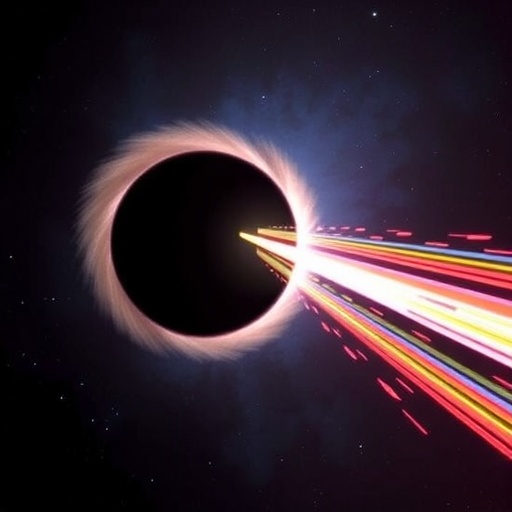
In an unprecedented breakthrough, astronomers led by Curtin University have harnessed the power of Earth-spanning radio telescopes to capture the intricate dynamics of jets emanating from black holes. These jets, colossal streams of energized particles, are now quantified with remarkable precision, revealing insights into how black holes influence their cosmic surroundings and shape the universe’s large-scale structure. This pioneering research centers around Cygnus X-1, the first confirmed black hole paired with a supergiant star in a binary system, whose jets display power rivaling the output of 10,000 Suns.
Astrophysicists have long postulated that jets launched by black holes play a critical role in distributing energy across galaxies, yet measuring their true power has remained elusive. The approach taken by this research team involved utilizing an array of interconnected radio telescopes spread across vast distances, a technique known as Very Long Baseline Interferometry (VLBI). This method allowed them to produce detailed images of the black hole’s jets being deflected and shaped by the intense stellar winds from its companion supergiant star. The resulting observations captured the jets’ movements with extraordinary clarity as they were pushed and bent in response to these winds.
Decoding this interaction required meticulous analysis. By quantifying the strength of the stellar wind and examining how dramatically it altered the jet trajectory, researchers calculated the instantaneous kinetic power coursing through the jets. This direct measurement is a significant leap from prior methods that could only estimate average jet power over millions of years, thus obscuring the transient phenomena critical to understanding jet behavior and black hole energetics in real time. The ability to measure jet power instantaneously opens new avenues for accurately linking the energy processes occurring near black holes with their broader impact on galactic environments.
Another key revelation from the study is the velocity of Cygnus X-1’s jets, clocked at approximately half the speed of light, or roughly 150,000 kilometers per second. This measurement settles decades of debate among scientists regarding the jets’ relativistic speeds, a fundamental property influencing how energy and matter disperse into the surrounding cosmos. The jets’ speed, combined with their immense power, highlight how black holes act not only as cosmic vacuum cleaners but as dynamic engines that profoundly affect their galactic neighborhoods.
The research benefited from the synergy between ground-based radio observatories and theoretical models simulating jet dynamics in binary systems. The observed “dancing jets,” as dubbed by lead author Dr. Steve Prabu, exhibit complex patterns of deflection and oscillation caused by the supergiant’s powerful stellar wind—a force capable of bending these streams of particles with remarkable fluidity. This novel observation confirms that the environment around black holes is incredibly dynamic, where interactions between black hole outflows and companion star winds produce observable variations in jet direction.
Understanding the fraction of energy channeled into jets versus other forms of emission is crucial for astrophysical modeling. Dr. Prabu emphasizes that their findings show about 10% of the gravitational energy released as matter is accreted by the black hole is expelled through these jets. This proportion has been utilized as an assumption in large-scale cosmological simulations aimed at reproducing galaxy evolution but lacked definitive observational confirmation until now. This empirical grounding is vital for refining models that seek to replicate how feedback from black holes regulates star formation and galactic growth.
Professor James Miller-Jones, co-author of the study, points out the transformative potential of this technique for future research. Traditional measurements averaged jet power on timescales so vast that they masked instantaneous variations correlated to accretion activity, which is often erratic. The capability to link jet power variations with simultaneous X-ray emissions from hot infalling matter around the black hole provides a more nuanced and accurate portrait of the complex physical processes governing black hole feeding and feedback.
The implications extend beyond stellar-mass black holes like Cygnus X-1. Because the fundamental physics governing jet formation appear to scale across many orders of magnitude in black hole mass, this method and its findings serve as a calibration benchmark for understanding supermassive black holes anchoring distant galaxies. With next-generation radio telescopes such as the Square Kilometre Array (SKA) under construction in Australia and South Africa, astronomers anticipate detecting jets from millions of black holes across the cosmos. The anchored measurement of jet power from Cygnus X-1 will critically enhance the interpretation of such distant observations, sharpening our understanding of black hole feedback mechanisms on a universal scale.
Black hole jets are increasingly recognized as vital mechanisms delivering energy and momentum back into the interstellar medium. These outflows regulate gas cooling and star formation rates, influencing the lifecycle of galaxies and their evolution over cosmic time. The direct observational evidence of jet power and velocity provided by this study represents a fundamental advancement toward unraveling how black holes contribute to the grand architecture of the universe.
Collaboration among institutions spanning multiple continents enriched the study, with partners from the University of Oxford, University of Barcelona, University of Wisconsin-Madison, University of Lethbridge, and the Institute of Space Science contributing complementary expertise and facilities. This international consortium underscores the global effort required to push the frontiers of astrophysics and deepen our understanding of the enigmatic phenomena surrounding black holes.
Published in the journal Nature Astronomy, the paper titled “A jet bent by a stellar wind in the black hole X-ray binary Cygnus X-1” presents these findings with comprehensive data and rigorous analysis. The DOI link to the article provides full access to the scientific report, inviting the broader research community to explore and build upon these transformative insights into black hole physics.
This achievement, spearheaded by the Curtin Institute of Radio Astronomy and the International Centre for Radio Astronomy Research, marks a new chapter in observational astrophysics. It highlights the power of combining innovative observational techniques with theoretical modeling to unveil the complex interplay between black holes and their environments—a key to deciphering the cosmos’s deepest mysteries.
News Publication Date: 16-Apr-2026
Web References:
https://www.nature.com/articles/s41550-026-02828-3
https://dx.doi.org/10.1038/s41550-026-02828-3
References:
Prabu, S., Miller-Jones, J. C. A., et al. “A jet bent by a stellar wind in the black hole X-ray binary Cygnus X-1.” Nature Astronomy, 16 April 2026.
Keywords
Black holes, Cygnus X-1, relativistic jets, stellar winds, radio astronomy, VLBI, jet power measurement, black hole feedback, accretion physics, galactic evolution, Square Kilometre Array, astronomical observations
Cite Scienmag News
Grant Pearson. (April 16, 2026). Black Hole’s ‘Dancing Jets’ Unveil Immense Cosmic Power. Scienmag. https://scienmag.com/black-holes-dancing-jets-unveil-immense-cosmic-power/
Grant Pearson. "Black Hole’s ‘Dancing Jets’ Unveil Immense Cosmic Power." Scienmag, 16 April 2026, https://scienmag.com/black-holes-dancing-jets-unveil-immense-cosmic-power/. Accessed 4 September 2026.
Grant Pearson. "Black Hole’s ‘Dancing Jets’ Unveil Immense Cosmic Power." Scienmag. April 16, 2026. https://scienmag.com/black-holes-dancing-jets-unveil-immense-cosmic-power/


