


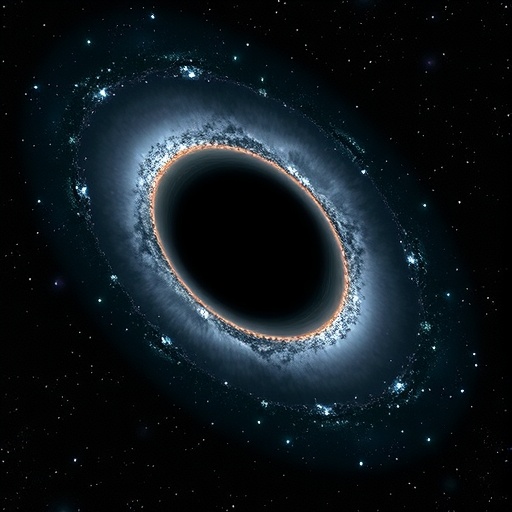
Supermassive black holes represent some of the universe’s most fascinating and enigmatic phenomena. Found at the centers of nearly all massive galaxies, including our own Milky Way, these objects hold masses millions to billions of times that of our Sun. Despite their immense gravitational pull, they remain invisible, emitting no light and revealing themselves only through the influence they exert on nearby stars and gas. At the core of our galaxy resides Sagittarius A*, a supermassive black hole weighing approximately four million solar masses. Understanding these celestial giants is challenging, but a new study sheds unprecedented light on one of the few observable interactions involving supermassive black holes: the catastrophic disruption of stars.
The process by which a star is consumed by a black hole is far from instantaneous. When a star ventures too close, the black hole’s immense gravitational forces do not simply swallow it whole. Instead, the star is torn apart by intense tidal forces, stretching and compressing it into an elongated stream of stellar debris. This debris stream eventually wraps around the black hole, a dynamic that only arises under the framework of Einstein’s General Theory of Relativity, highlighting the limits of Newtonian gravity in describing such extreme events. As portions of the stream collide with each other, energy is released in bursts, and the debris gradually spirals inward, accreting onto the black hole itself. These violent interactions generate prodigious amounts of radiation, at times briefly outshining the combined light of the host galaxy—a transient phenomenon known as a tidal disruption event, or TDE.
TDEs provide a rare window into black holes that otherwise remain cloaked in darkness. By examining the light curves—the brightness variations over time—of these flares, astronomers can infer crucial details about the black holes wielding such destructive power. Factors such as the mass and spin of the black hole imprint subtle signatures on the evolution of the flare. However, a longstanding challenge in this field has been capturing the complex fluid dynamics of the debris disruption and accretion with sufficient fidelity in theoretical models and numerical simulations.
Recent advances in high-resolution computational techniques have revolutionized the field, particularly through the application of smoothed particle hydrodynamics (SPH). This method treats the star’s gas as a swarm of countless interacting particles that obey the laws of hydrodynamics as expressed by the Navier-Stokes equations—the same principles governing fluid flow in everyday phenomena like water in a pipe. A research team led by Lucio Mayer at the University of Zurich, with significant contributions from Syracuse University physics professor Eric Coughlin, executed simulations containing tens of billions of SPH particles, producing the most detailed and realistic models of star disruption to date. Their work reveals that rather than dispersing turbulently, the debris stream maintains coherence and follows highly predictable, narrow orbits around the black hole, ultimately colliding with itself in a manner consistent with long-standing theoretical predictions.
Prior simulations, limited by lower resolution, often misrepresented the structure of the debris stream. These earlier models produced excessive scattering of the gas and artificially high dissipation of energy through fluid interactions. The sheer computational power harnessed by this team, especially through the use of graphics processing units (GPUs) on modern supercomputers, has overcome these limitations, allowing researchers to observe the subtleties of debris dynamics. This breakthrough enables a much clearer understanding of the initial collision that produces the flare and the subsequent gradual accretion.
Beyond confirming expected behaviors, these new simulations highlighted the critical influence of the black hole’s spin on the tidal disruption process. A spinning supermassive black hole induces complex warping of spacetime, generating an effect known as nodal precession. This phenomenon causes the orbital plane of the circling debris stream to shift and tilt over time, potentially causing the stream to miss colliding with itself during initial orbits. Instead of a single outright collision, the debris may circle multiple times before finally intersecting, delaying the onset of the bright flare by days or even weeks.
This spin-induced delay helps explain the puzzling diversity seen in observed TDEs. Each event produces flares with unique temporal and luminosity profiles—some brighten rapidly and fade swiftly, while others evolve more gradually, and some follow unusual patterns that defy easy categorization. While variations in black hole mass explain some differences, these cutting-edge models suggest spin and its orientation relative to the incoming star’s orbit play decisive roles in shaping the observed signatures. Orientation effects can cause significant variation in how and when the debris streams intersect, creating a rich tapestry of flare behaviors that have long challenged researchers.
The implications extend beyond merely explaining observational diversity. By carefully analyzing TDE light curves and considering spin effects, astronomers may unlock new methods to measure fundamental black hole properties such as angular momentum, breaking a critical barrier in astrophysics. These insights move us closer to decoding the hidden lives of supermassive black holes, which, despite their obscurity, exert profound influence on galactic evolution and cosmic structure.
As computational power and simulation techniques continue to evolve, so too will our understanding of these cosmic cataclysms. Coupled with increasingly sensitive telescopes and space observatories, researchers expect to capture more TDEs in greater detail, providing more empirical data to test and refine theoretical models. Each new event adds pieces to the puzzle, sharpening a picture of black hole interactions that are as violent as they are illuminating.
In short, tidal disruption events represent a unique natural laboratory for investigating the extreme physics near supermassive black holes. Through the destruction of stars, these invisible giants briefly announce their presence with brilliant bursts of light, their hidden attributes exposed by the behavior of the ripped-apart stellar debris. The groundbreaking simulations from this international collaboration have transformed our theoretical framework, revealing the critical role of black hole spin and coherence in the debris stream, and opening new pathways to understanding some of the universe’s darkest enigmas.
This research underscores the power of combining theoretical astrophysics, cutting-edge computational methods, and high-performance computing to tackle cosmic mysteries. As we continue to peer into the depths of galactic centers, we gain not only knowledge about black holes themselves but also insights into the vast processes that shape galaxies and the broader universe. The story of stars falling victim to supermassive black holes is no longer one of mere destruction but of revelation—a tale in which violent demise becomes a beacon illuminating the dark hearts of galaxies.
News Publication Date: Not specified in the content.
Web References:
- Original study in The Astrophysical Journal Letters: https://iopscience.iop.org/article/10.3847/2041-8213/ae4748
- Eric Coughlin’s faculty page: https://artsandsciences.syracuse.edu/people/faculty/eric-coughlin/
References: The Astrophysical Journal Letters article as above.
Keywords
Supermassive Black Holes, Tidal Disruption Events, Stellar Debris Streams, Black Hole Spin, Nodal Precession, Smoothed Particle Hydrodynamics, General Relativity, High-Resolution Simulations, Accretion Physics, Astrophysical Jets, Galaxy Evolution, Computational Astrophysics
Cite Scienmag News
Grant Pearson. (April 14, 2026). How Black Holes Illuminate the Darkness. Scienmag. https://scienmag.com/how-black-holes-illuminate-the-darkness/
Grant Pearson. "How Black Holes Illuminate the Darkness." Scienmag, 14 April 2026, https://scienmag.com/how-black-holes-illuminate-the-darkness/. Accessed 4 September 2026.
Grant Pearson. "How Black Holes Illuminate the Darkness." Scienmag. April 14, 2026. https://scienmag.com/how-black-holes-illuminate-the-darkness/


