


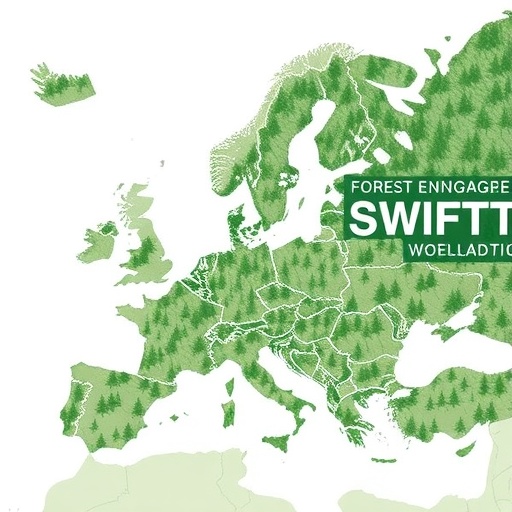
In a groundbreaking leap for forestry management, the SWIFTT platform harnesses the power of Copernicus Sentinel satellite data integrated with advanced machine learning algorithms to revolutionize how forest health is monitored and preserved. This innovative platform enables foresters to detect early signs of distress in tree populations, map various forms of forest damage, and strategize interventions more efficiently than ever before. From pinpointing dieback to assessing windthrow destruction and wildfire risks, SWIFTT combines high-resolution remote sensing with artificial intelligence to offer a comprehensive, real-time forest surveillance system.
The core strength of SWIFTT lies in its capacity to process multispectral satellite imagery continuously, using sophisticated machine learning models trained to recognize subtle anomalies indicative of different threats. These models analyze spectral signatures linked to specific stressors such as spruce bark beetle infestations, mechanical damages from storms, or the aftermath of wildfires. By translating complex satellite datasets into actionable intelligence, the platform sends timely alerts to foresters detailing threat type, severity, estimated volume of at-risk trees, and affected forest area, enabling prioritization of resources and field efforts.
Foresters engage with the SWIFTT platform by registering their forest parcels, which grants access to automated analyses that monitor threat development across monitored zones. This dynamic system recalibrates predictions as new satellite passes and field data come in, significantly enhancing the precision of early-warning capabilities. Through this synergy of remote sensing and ground truth validation, SWIFTT allows forest managers to transition from reactive to proactive strategies, thereby mitigating damage before it escalates.
One of the platform’s notable innovations is its integration with a mobile application designed to support forestry operations directly in the field. This app guides users with GPS-assisted mapping to the exact locations of detected anomalies, drastically reducing search time during inspections. Foresters can then verify threats on-site and upload observational data, which feeds back into the machine learning pipeline to refine the models continuously. This iterative approach ensures ever-improving accuracy and relevance of the system’s outputs.
SWIFTT not only detects and maps existing damage but actively supports forest restoration efforts by facilitating coordinated sanitary cuts and deadwood removals. By efficiently identifying and prioritizing affected areas, the platform helps conserve ecosystem diversity and promotes forest resilience, crucial in the face of climate change–induced stressors. Its emphasis on sustainable forest management aligns with broader environmental goals, supporting biodiversity and carbon sequestration initiatives.
Commercialization of the SWIFTT platform is spearheaded by Timbtrack, a key partner committed to scalability and cross-border collaboration within Europe. The platform is designed to serve a wide range of users including local forest managers, large forestry enterprises, and governmental authorities. By standardizing data-driven forestry practices across national boundaries, SWIFTT fosters an interconnected network of forest protection bolstered by shared technology and expertise.
The technological underpinnings of SWIFTT are the result of a multi-disciplinary consortium that brought together expertise in climate risk, artificial intelligence, earth observation, and forestry science. Partners such as AXA Climate, Da Vinci Labs, and the Leibniz University Hannover contributed to developing the AI frameworks and validating the analytical models using vast datasets that include precise georeferenced field observations. This comprehensive collaboration ensured the platform is robust, scientifically grounded, and tailored to real-world forestry challenges.
SWIFTT is funded through a prestigious Horizon Europe grant, awarded for projects advancing the European Green Deal by leveraging Earth observation data and AI technologies. Supported by the European Union Agency for the Space Programme (EUSPA), the consortium received €2.8 million to develop and deploy the platform between 2022 and 2026. This initiative underscores Europe’s commitment to environmental innovation and sustainable resource management via cutting-edge space technologies.
Ariane Kaploun, Head of Nature-based Solutions at AXA Climate and coordinator of the SWIFTT project, emphasizes the transformational impact of this collaboration. She notes that combining satellite data with artificial intelligence creates a state-of-the-art toolset for forestry professionals to anticipate and respond swiftly to emergent threats. The successful integration of varied expertise across Europe exemplifies how partnerships can accelerate technological adoption for environmental stewardship.
As climate change continues to amplify risks such as pest outbreaks, extreme weather events, and wildfires, platforms like SWIFTT become indispensable tools for preserving forest ecosystems. Their ability to deliver timely, precise, and actionable intelligence empowers stakeholders to protect natural capital while supporting economic forestry activities. The ongoing development and refinement of SWIFTT promise enhanced resilience and sustainability for Europe’s diverse forest landscapes.
In summary, the SWIFTT platform represents a paradigm shift in forest management by converging satellite Earth observation, machine learning, and mobile technology. Its comprehensive approach addresses the pressing need to detect, mitigate, and manage forest health threats with unprecedented accuracy and speed. As it scales up and integrates into European forestry practices, SWIFTT is poised to become a critical player in safeguarding forests for future generations.
News Publication Date: Not provided.
Keywords
Forest management, satellite data, machine learning, Copernicus Sentinel, forest health, pest detection, windthrow mapping, wildfire risk, AI in forestry, environmental monitoring, EU Green Deal, SWIFTT platform.
Cite Scienmag News
Grant Pearson. (April 15, 2026). Horizon Europe’s SWIFTT Project Delivers Copernicus-Driven Forest Management Tool to Safeguard EU Woodlands. Scienmag. https://scienmag.com/horizon-europes-swiftt-project-delivers-copernicus-driven-forest-management-tool-to-safeguard-eu-woodlands/
Grant Pearson. "Horizon Europe’s SWIFTT Project Delivers Copernicus-Driven Forest Management Tool to Safeguard EU Woodlands." Scienmag, 15 April 2026, https://scienmag.com/horizon-europes-swiftt-project-delivers-copernicus-driven-forest-management-tool-to-safeguard-eu-woodlands/. Accessed 3 September 2026.
Grant Pearson. "Horizon Europe’s SWIFTT Project Delivers Copernicus-Driven Forest Management Tool to Safeguard EU Woodlands." Scienmag. April 15, 2026. https://scienmag.com/horizon-europes-swiftt-project-delivers-copernicus-driven-forest-management-tool-to-safeguard-eu-woodlands/


