


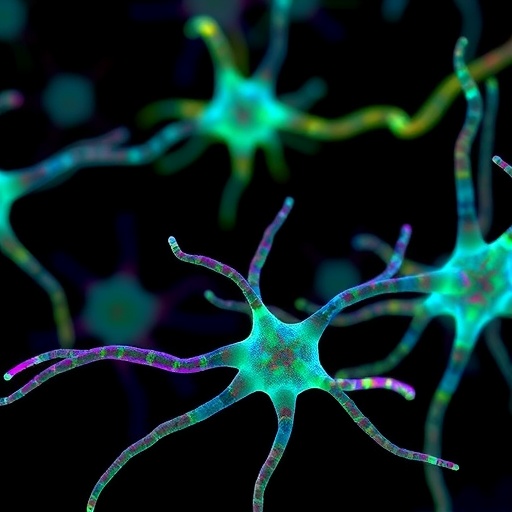
Northwestern University engineers have achieved a remarkable breakthrough in the realm of neuromorphic engineering by printing artificial neurons that are capable of not just mimicking the human brain—they can directly communicate with it. This pioneering development, detailed in a recent publication in the journal Nature Nanotechnology, introduces flexible and cost-effective devices that produce electrical signals strikingly realistic enough to stimulate living brain cells. When tested using tissue slices from mouse brains, these artificial neurons successfully triggered biological responses, marking a significant advancement in creating electronics with true biocompatibility.
Traditional silicon-based computing platforms rely on billions of rigid, identical transistors configured in a flat, two-dimensional landscape. This uniformity and physical rigidity starkly contrast with the human brain’s sophisticated architecture, which thrives on heterogeneity, flexibility, and three-dimensional complexity. The brain’s dynamic networks involve diverse neuron types operating in concert and constantly remodeling connections to facilitate learning and adaptation. These fundamental differences have long presented challenges for engineers attempting to replicate brain-like computing on conventional hardware.
The Northwestern team approached this challenge by focusing on soft, printable materials that more accurately replicate the brain’s structural and electrical behaviors. Central to their approach are innovative electronic inks composed of nanoscale flakes of molybdenum disulfide (MoS₂), a semiconductor, coupled with graphene, a highly conductive material. These inks were deposited onto flexible polymer substrates using a cutting-edge technique known as aerosol jet printing—a process that allows for high precision and scalability. Notably, rather than eliminating the stabilizing polymer within the inks, which was previously considered an obstacle, the researchers ingeniously harnessed its partial decomposition to enhance neuronal function.
This partial polymer decomposition, driven by passing electrical current through the device, results in a conductive filament formation localized in a narrow spatial region. This confined current pathway produces sudden, neuron-like electrical responses that are rich in complexity. Unlike other artificial neurons that generate simplistic, singular pulses, these printed devices can reproduce a variety of signaling patterns found in biological neurons—ranging from single spikes and continuous firing to bursting sequences. This complexity is vital because it allows each artificial neuron to encode more information and execute sophisticated functions. The implication is a reduction in the total number of components needed for brain-inspired computing systems, translating into significant gains in efficiency.
To validate the bio-reactivity of their work, the researchers collaborated closely with neurobiology experts who tested the artificial neurons on cerebellar tissue slices from mice. The artificially produced voltage spikes closely matched the timing and duration of biological neuronal spikes, successfully inducing activity in living neurons and activating neural circuits in a manner akin to natural brain signaling. This unprecedented temporal fidelity signifies a new frontier in neural interface technology, where artificial neurons function on the same scale and with the same nuance as living ones.
Previous efforts to develop artificial neurons often suffered from timing mismatches—either spiking too slowly or too quickly—limiting their practical interfacing with biological systems. By contrast, this new class of memristive artificial neurons delivered signals in the optimal temporal range, thereby facilitating effective communication with real neurons. This characteristic bridges a longstanding gap in the field and underpins future applications in neuroprosthetics, brain-machine interfaces, and advanced neurostimulation therapies.
Beyond biological interfacing, the energy demands of current artificial intelligence systems have prompted an urgent search for more power-efficient computing hardware. Brain-inspired computing holds promise precisely because the human brain operates at an unparalleled energy efficiency—consuming orders of magnitude less power than conventional digital computers. The Northwestern team’s innovation aligns with this goal, offering additive manufacturing that not only reduces material waste but also diminishes energy consumption during device fabrication and operation.
The environmental implications of this technology are profound. Present-day AI data centers consume gigawatts of power and employ substantial cooling systems, exerting enormous strain on global energy and water resources. The scaling of AI technologies is increasingly constrained by power and thermal management limitations. By moving towards neuromorphic hardware that functions more like the brain, researchers hope to drastically lower these environmental costs, making AI more sustainable in the long term.
In addition to advances in energy efficiency and biocompatibility, the printing technique itself holds key benefits. Aerosol jet printing enables intricate patterning of nanoscale materials on flexible polymers, so devices can potentially conform to biological tissues or even wearable electronics. This opens a realm of possibilities for next-generation prosthetics that seamlessly integrate with the nervous system or for developing compact, flexible computing platforms mimicking brain-like functionality.
Researchers foresee their technology significantly impacting various sectors, including medical devices that restore senses like hearing and vision, as well as robotics and AI systems needing adaptable, low-power neural computation. The rich signaling repertoire of these fabricated neurons, mimicking real neural networks’ dynamics, means artificial neural circuits can perform more nuanced, multifaceted processing tasks traditionally out of reach for rigid silicon circuits.
The publication, titled “Printed MoS₂ memristive nanosheet networks for spiking neurons with multi-order complexity,” represents not just an incremental advance but a reimagining of how artificial neurons are constructed and operated. Supported by the U.S. National Science Foundation, this research highlights the importance of interdisciplinary collaboration spanning materials science, neurobiology, and nanotechnology.
By integrating nanoscale semiconducting and conducting materials within soft polymer matrices, and leveraging controlled chemical transformations during operation, the Northwestern team has redefined what artificial neurons can achieve. Their work underscores an emerging paradigm where imperfections in materials—rather than obstacles—are harnessed as design features, enabling electronics that truly emulate the intricacies of the brain.
As AI systems continue to evolve amidst growing energy and complexity challenges, brain-inspired computing devices such as these printed artificial neurons offer a path forward that blends efficiency, adaptability, and seamless interface with biological systems. This marriage of advanced materials, innovative fabrication techniques, and deep biological insight promises a future where computers don’t simply imitate the brain—they communicate and cooperate with it.
News Publication Date: 15-Apr-2026
Web References: http://dx.doi.org/10.1038/s41565-026-02149-6
Keywords
Neurons, Neuronal synapses, Electronics, Computer architecture, Artificial intelligence, Nanomaterials
Cite Scienmag News
Cassandra Pierce. (April 15, 2026). 3D-Printed Neurons Connect with Living Brain Cells in Breakthrough Study. Scienmag. https://scienmag.com/3d-printed-neurons-connect-with-living-brain-cells-in-breakthrough-study/
Cassandra Pierce. "3D-Printed Neurons Connect with Living Brain Cells in Breakthrough Study." Scienmag, 15 April 2026, https://scienmag.com/3d-printed-neurons-connect-with-living-brain-cells-in-breakthrough-study/. Accessed 3 September 2026.
Cassandra Pierce. "3D-Printed Neurons Connect with Living Brain Cells in Breakthrough Study." Scienmag. April 15, 2026. https://scienmag.com/3d-printed-neurons-connect-with-living-brain-cells-in-breakthrough-study/


