


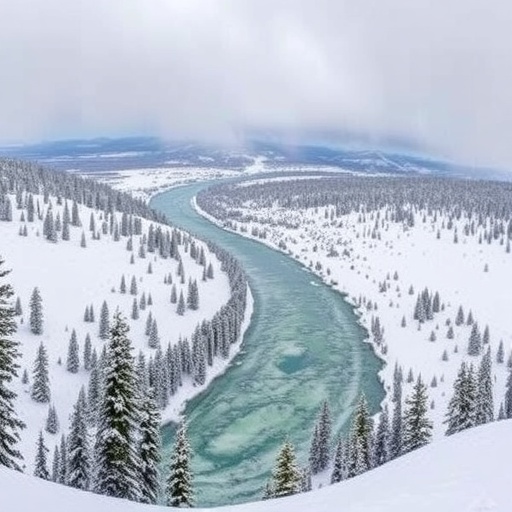
As the Western United States confronts shifting patterns in climate, a new study sheds light on a less-discussed yet critically important consequence: the accelerated movement of water through landscapes due to increased rain and diminished snowpack. This phenomenon not only reshapes hydrological cycles but also portends serious repercussions for summer water availability and quality—issues that strike at the core of ecological stability, agriculture, and human consumption.
The intricate relationship between snowpack and water availability has long been a pivot for water resource management in the West. Typically, snow acts as a natural reservoir, slowly releasing meltwater over spring and summer months, ensuring sustained streamflow during dry periods. However, with climatic warming driving less snowfall and more rain, the established timing and storage of water within ecosystems are being disrupted. Recent winters have mirrored these future conditions, markedly reducing snow accumulation despite overall precipitation remaining stable or even elevated.
At the heart of this research is the concept of “water transit time”—the duration between precipitation infiltrating the soil and its emergence as streamflow. This metric, crucial for understanding water availability and ecosystem health, has received less attention compared to snowpack volumes and timing. By leveraging state-of-the-art hydrologic modeling coupled with empirical isotopic sampling from the Naches River basin in Washington, a team led by Zach Butler from Oregon State University has revealed that these water transit times are speeding up significantly, projecting an average increase in flow velocity of approximately 18% by the latter half of the century.
Such acceleration carries multifaceted consequences. Rapid transit of water reduces the residence time in soil and subsurface layers, curtailing the natural filtration and biogeochemical processes that mitigate contaminant loads. High-flow events can thus become spikes of pollutants entering waterways, compromising water quality. Conversely, prolonged storage during low-flow periods might concentrate contaminants, further endangering aquatic ecosystems and human health.
The ecological ramifications extend to native fish species such as salmon and trout, which rely on stable, cool summer streamflows for spawning and survival. Reduced summer water volumes, a byproduct of faster winter runoff and diminished snowpack storage, threaten their fragile habitats. Furthermore, human communities depending on these waters for agriculture and drinking supplies could face water scarcity, necessitating urgent adaptation in water management strategies.
The Naches River basin, a critical component of the larger Yakima and Columbia River systems, serves as a telling example. Due to its sensitivity to climatic fluctuations and significant previous snowfall declines, it has witnessed a shift in peak discharge timings towards earlier springs. Research projections indicate a 16% reduction in snow coupled with a 25% increase in rain by mid-century, underscoring the hydrologic transformation underway in this region.
Addressing these changes requires robust methodologies. Traditional approaches to estimating water transit times involve tracking chemical tracers like stable isotopes in precipitation and runoff. While precise, this process is labor-intensive and geographically limited due to logistical constraints. The innovative integration of isotopic data with advanced hydrologic simulation models in this study has enabled retrospective and predictive analyses of transit times, offering a scalable framework applicable to other vulnerable watersheds beyond the Pacific Northwest.
The implications of these findings resonate globally. Approximately one-sixth of the world’s population depends on snowmelt-fed water sources, a figure that positions this challenge within a broader planetary context. In the western U.S. alone, over half of the annual water runoff originates from snowmelt, highlighting the critical nature of understanding transit time dynamics amid rapidly shifting climatic regimes.
To synthesize these insights into actionable knowledge, researchers emphasize the necessity of incorporating water transit time metrics into water resource assessments and management. Traditional planning that focuses predominantly on snowpack volumes and timing may overlook the complex subsurface and surface processes influencing water delivery. This study advocates for a paradigm shift that integrates hydraulic residence times to better anticipate and mitigate the hydrological impacts of climate change.
This research also brings a timely reminder that climatic models must account for changing precipitation modalities—shifts from snow to rain—and their compound effect on hydrologic systems. The coupling of observational data with robust modeling advances the precision of future water availability forecasts, informing both regional ecosystem conservation and the sustainability of human water use.
Looking forward, this integrated modeling and sampling framework sets a new standard for examining climate change effects on hydrological cycles. Beyond the Naches basin, this approach can be adapted to mountainous regions worldwide, many of which are susceptible to similar shifts in snow-rain balance. The findings serve as a clarion call for researchers, policymakers, and water managers to invest in understanding and adapting to the nuanced hydrologic transformations underway.
In closing, Butler and colleagues’ work underscores a vital nexus: climate-driven shifts not only reshape the quantity of water available but also how quickly it traverses through ecosystems, with profound implications for water quality, ecological vitality, and human welfare. With accelerated transit times already manifesting, proactive and science-driven management strategies are imperative to safeguard water resources in an increasingly uncertain future.
News Publication Date: Not specified in the source
Web References:
References:
- Butler, Z., et al. (Year). Study on impact of climate change on water transit times in the Naches River basin. Scientific Reports. DOI: 10.1038/s41598-026-46539-1.
- Additional references linked from the original article (not fully specified here)
Cite Scienmag News
Russell Cooper. (April 16, 2026). Study Finds Warmer Winters and Snow Drought Accelerate Flows, Threatening Western U.S. Water Supply. Scienmag. https://scienmag.com/study-finds-warmer-winters-and-snow-drought-accelerate-flows-threatening-western-u-s-water-supply/
Russell Cooper. "Study Finds Warmer Winters and Snow Drought Accelerate Flows, Threatening Western U.S. Water Supply." Scienmag, 16 April 2026, https://scienmag.com/study-finds-warmer-winters-and-snow-drought-accelerate-flows-threatening-western-u-s-water-supply/. Accessed 4 September 2026.
Russell Cooper. "Study Finds Warmer Winters and Snow Drought Accelerate Flows, Threatening Western U.S. Water Supply." Scienmag. April 16, 2026. https://scienmag.com/study-finds-warmer-winters-and-snow-drought-accelerate-flows-threatening-western-u-s-water-supply/


