


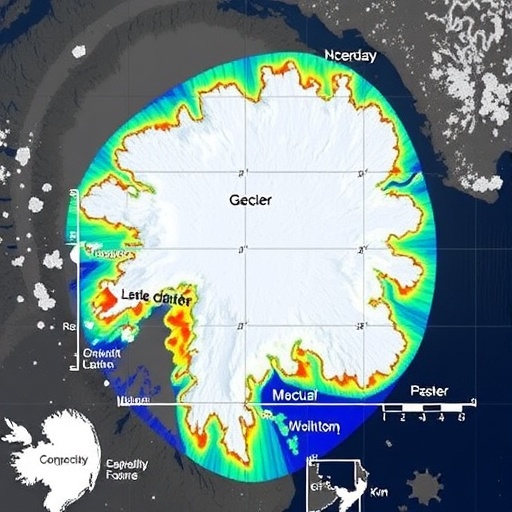
When colossal chunks of ice calve from Greenland’s tidewater glaciers and crash into the ocean, the event is not just a dramatic spectacle witnessed by satellites but also a subtle tremor registered by the Earth itself. Recent research unveiled at the 2026 Seismological Society of America Annual Meeting reveals that global seismic networks can indeed detect these calving events, but only when the ice fractures reach a substantial size. This breakthrough offers promising insights into monitoring glacier dynamics and understanding the complex feedbacks driving ice loss in a warming world.
Glacial calving, the process where massive ice blocks detach from the glacier’s edge and plunge into the sea, serves as a key mechanism for ice mass loss in Greenland. These events generate seismic energy akin to small to moderate earthquakes, producing surface waves that ripple through the Earth’s crust. Adrian Borsa, a geophysics professor at the Scripps Institution of Oceanography, explains that while these seismic signals are detectable globally, only the larger calving episodes—equivalent to earthquakes with magnitudes between roughly 3.9 and 5.5—leave a pronounced imprint strong enough to be caught by seismic arrays. Such events correspond to calving areas ranging from 0.3 up to 1.8 square kilometers, highlighting that smaller calving instances remain elusive to seismometers.
The challenge, however, lies in the temporal precision and spatial accuracy with which these calving events are identified. Satellite imagery excels at spatial resolution, offering nearly perfect geolocation of glacier fractures by comparing successive images of the same glacier front. Yet, their temporal resolution falls short, as satellites can only narrow down event timings to within two or three days and cannot always distinguish between multiple calving instances occurring in rapid succession. Seismic methods complement this by providing exceptional temporal resolution, capturing calving activity separated by mere hours, though primarily for larger, seismically-perceptible events.
This complementary nature of satellite observations and seismic detection forms a powerful toolkit for glaciologists. With global warming accelerating ice loss in polar regions, monitoring the frequency, size, and triggers of calving events is vital for predicting future sea-level rise and assessing potential regional impacts, such as glacially induced tsunamis. The seismic networks, especially arrays like the U.S. Array that was operational across the United States in 2019, have provided valuable datasets to track these phenomena on Greenland’s west coast. Applying this data to identify calving events helps build a more comprehensive catalog that integrates both the detailed spatial data from satellites and the high-time resolution seismic recordings.
Interestingly, the research team notes an unexpected decoupling between the seismic magnitude of calving events and their calving area or volume. Their analysis found little to no correlation beyond the existence of a threshold size required for seismic detection. This indicates that the efficiency with which energy from ice detachment converts to seismic energy varies greatly between glaciers, potentially influenced by factors such as the distance from the calving front to the grounding line or the dynamics of the dislodged ice block’s motion in water. These glacier-specific properties make seismic signals a complex proxy for estimating calving size on their own.
Looking ahead, the researchers aim to harness these integrated datasets to forecast calving events before they occur. Advanced imaging techniques now allow scientists to monitor sea ice and melange—compacted mixtures of sea ice and icebergs—that buffer glacier fronts, as well as record the instantaneous velocities of glaciers feeding into the calving fronts. This combination of variables is thought to be part of a feedback mechanism controlling calving behavior, where changes in sea ice conditions and glacier flow rates influence the likelihood and timing of ice mass loss.
Detecting calving events seismically remains challenging because the signals they produce often emerge gradually from background seismic noise rather than manifesting as clearly defined earthquake-like body-wave phases. Wenyuan Fan, a geophysics professor at Scripps and a co-author on the study, highlights that these characteristics complicate traditional identification methods. The seismic signature tends to be subtle and requires innovative approaches, such as machine learning algorithms, to distinguish calving-related tremors from other seismic sources.
At the same annual meeting, cutting-edge research was presented focusing on employing artificial intelligence to improve glacier-related seismic event detection. Fengzhou Tan, a Scripps postdoctoral researcher, discussed how machine learning techniques are revolutionizing the search for subtle seismic signals generated by glacier activity across Greenland. Meanwhile, seismologist Thanh-Son Phạm from Australian National University showcased a novel calving detection algorithm tailored to regional surface wave data, specifically designed for West Antarctica’s Thwaites Glacier, a region notorious for its rapid ice loss and global sea level implications.
These advancements underscore the evolving landscape of glaciological seismology, where state-of-the-art computational and observational methods converge to unravel the complexities of how glaciers fracture and lose mass. The ability to detect, catalog, and potentially forecast calving events in near-real time holds transformative potential for climate science, offering a window into the behavior of one of Earth’s most critical cryospheric components.
By bridging satellite observations that excel at spatial mapping with seismic datasets providing unparalleled temporal detail, scientists are constructing a more holistic picture of glacial calving dynamics. This multifaceted approach not only deepens scientific understanding but also enhances predictive capabilities, equipping policymakers and coastal communities with better tools to mitigate the impacts of sea-level rise triggered by accelerating ice mass loss.
In sum, the research presented at the 2026 Seismological Society of America Annual Meeting marks a significant stride in glaciology and seismology alike. As climate change drives increased frequency and scale of glacial calving around the globe, discerning these tremorous signals against the Earth’s seismic background noise becomes ever more crucial. The fusion of seismic detection and satellite imaging will undoubtedly play a central role in the ongoing quest to monitor and understand the intimately connected processes shaping our planet’s icy frontiers.
News Publication Date: 2026
Web References:
- https://meetings.seismosoc.org/
- https://seismosoc.secure-platform.com/a/gallery/rounds/47/details/14155
- https://seismosoc.secure-platform.com/a/gallery/rounds/47/details/14094
Keywords
Glacial calving, Greenland ice sheet, seismic detection, satellite imagery, surface seismic waves, glacier dynamics, sea level rise, machine learning, cryoseismology, glacier monitoring, climate change, cryosphere
Cite Scienmag News
Grant Pearson. (April 16, 2026). Integrating Seismic and Satellite Data to Monitor Glacier Calving in Greenland. Scienmag. https://scienmag.com/integrating-seismic-and-satellite-data-to-monitor-glacier-calving-in-greenland/
Grant Pearson. "Integrating Seismic and Satellite Data to Monitor Glacier Calving in Greenland." Scienmag, 16 April 2026, https://scienmag.com/integrating-seismic-and-satellite-data-to-monitor-glacier-calving-in-greenland/. Accessed 3 September 2026.
Grant Pearson. "Integrating Seismic and Satellite Data to Monitor Glacier Calving in Greenland." Scienmag. April 16, 2026. https://scienmag.com/integrating-seismic-and-satellite-data-to-monitor-glacier-calving-in-greenland/


