


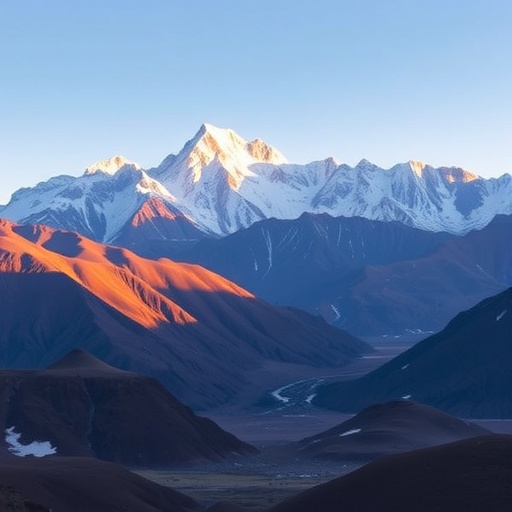
The Tibetan Plateau, often dubbed the “Roof of the World,” is renowned for its vast expanses of ice, snow, and permafrost, creating one of the largest cryospheric regions on Earth. This extreme environment, characterized by low temperatures and limited nutrient availability, harbors microbial communities uniquely adapted to such harsh conditions. Yet, these isolated bacterial populations are revealing unexpected complexities, especially concerning their resistance to antibiotics—a feature traditionally associated with clinical or human-impacted ecosystems. A groundbreaking study has now illuminated how environmental forces and genetic heritage merge to shape antibiotic resistance within bacteria from this frozen frontier, challenging our understanding of resistance development beyond conventional hotspots.
Investigators led by Mao, G., Ma, Q., Zhang, Z., and colleagues, in a comprehensive analysis published in Communications Earth & Environment, have provided compelling evidence that antibiotic resistance in cryospheric bacteria is shaped not only by environmental selection pressures but also through vertical inheritance, the transmission of resistance traits from parent to offspring. This dual mode of persistence and dissemination of resistance genes in the Tibetan Plateau’s microbial communities underscores the complexity of microbial evolution in extreme environments previously thought to be largely insulated from anthropogenic influence.
The research team embarked on an unprecedented collection of bacterial samples from diverse cryospheric habitats across the Tibetan Plateau. These locations included glacial surfaces, permafrost layers, and snowfields, each presenting distinct selective pressures such as UV radiation exposure, nutrient scarcity, and cold stress. By employing advanced metagenomic sequencing and high-throughput antibiotic susceptibility testing, the scientists were able to paint a detailed map of resistance determinants that paints a nuanced picture of microbial survival strategies under extreme conditions.
One of the most striking revelations was the detection of antibiotic resistance genes (ARGs) in microbial populations residing in pristine environments far from direct human contact or clinical antibiotic application. This finding hints at the deep evolutionary roots and ecological roles of resistance mechanisms, which may have originally evolved as defense strategies against naturally occurring antibiotics or environmental stressors. The persistence of these ARGs in isolated cryospheric bacteria suggests that selective pressures in the environment, such as competition with other microbes and exposure to natural antimicrobial compounds, can foster resistance independently of anthropogenic antibiotic use.
Furthermore, the study highlights the role of vertical inheritance—where offspring inherit resistance genes from parent bacteria—as a critical mechanism maintaining these traits across generations in the frozen wilderness. Unlike horizontal gene transfer, which is frequently implicated in the rapid spread of antibiotic resistance in clinical settings, vertical transmission emphasizes the enduring presence and evolution of resistance traits within stable, isolated microbial lineages. This introduces new dimensions to how scientists understand the evolutionary dynamics of resistance in non-clinical environments.
Environmental selection pressures on the Tibetan Plateau are especially intense. Extreme cold, desiccation, and cycles of freeze-thaw exert substantial stress on microbial cells, likely influencing resistance gene maintenance. The research posits that resistance genes may confer survival advantages beyond antibiotic defense, such as protection against oxidative stress or facilitating cellular repair mechanisms—functions that become critical under the relentless environmental rigors of cryospheric ecosystems. Consequently, ARGs may be co-opted for multiple ecological roles, pairing survival under harsh abiotic conditions with a legacy of ancient antibiotic resistance.
Intriguingly, the study documents genetic signatures indicating limited horizontal gene transfer among Tibetan Plateau microbes in contrast to bacterial communities in more temperate, human-impacted regions. This finding suggests that while environmental selection actively maintains ARGs, opportunities for their lateral movement are constrained, likely due to physical isolation and harsh conditions that reduce microbial interactions. Hence, vertical inheritance dominates, reinforcing the evolutionary stability of resistance genes in these niche microbial populations.
The implications of this research extend well beyond microbial ecology into global health and environmental monitoring spheres. The presence of ARGs in remote cryospheric environments challenges current paradigms that primarily associate resistance propagation with clinical misuse of antibiotics. Instead, it highlights that natural environments serve as reservoirs and evolutionary laboratories for antibiotic resistance, complicating efforts to track and mitigate the spread of resistance globally.
Moreover, the Tibetan Plateau’s cryosphere might act as a repository of ancient resistance genes, which could re-enter anthropogenic ecosystems through microbial migration or environmental perturbations such as glacial melt induced by climate change. This possibility underscores the potential impacts of global warming on the mobilization of resistance determinants from natural reservoirs, adding another layer to the urgent discourse on the environmental dimensions of antimicrobial resistance.
Mao and colleagues’ multi-disciplinary approach combined genomic analyses with ecological contextualization, bridging gaps between microbiology, evolution, and environmental science. Their methodology sets a precedent for future investigations into how isolated ecosystems maintain and shape microbial traits relevant to public health, notwithstanding their apparent detachment from urbanized or agricultural influences.
The study also prompts a reevaluation of cryospheric microbial ecology, shifting the narrative from isolated extremophiles to dynamic communities undergoing evolutionary processes akin to more studied habitats. Understanding the selective forces and inheritance mechanisms underlying antibiotic resistance in such ecosystems is critical to grasping the full scope of microbial adaptation in the Anthropocene.
Lastly, these findings necessitate a broader environmental perspective in antibiotic resistance surveillance. They emphasize the need to incorporate hidden or understudied natural reservoirs into global monitoring frameworks to preempt and mitigate the threat posed by emergent resistance genes that could compromise future antimicrobial efficacy.
In sum, the investigative journey across the icy expanses of the Tibetan Plateau delivers a profound insight: antibiotic resistance is a multifaceted phenomenon, deeply embedded in microbial life’s evolutionary tapestry. It transcends human activities, rooted in environmental selection and the enduring legacy of genetic inheritance. This revelation adds urgency to the global scientific community’s efforts to unravel the complexities of resistance evolution and develop holistic strategies that encompass environmental, clinical, and evolutionary dimensions.
Cite Scienmag News
Gavin Prescott. (April 15, 2026). Environmental and Vertical Forces Drive Tibetan Plateau Antibiotic Resistance. Scienmag. https://scienmag.com/environmental-and-vertical-forces-drive-tibetan-plateau-antibiotic-resistance/
Gavin Prescott. "Environmental and Vertical Forces Drive Tibetan Plateau Antibiotic Resistance." Scienmag, 15 April 2026, https://scienmag.com/environmental-and-vertical-forces-drive-tibetan-plateau-antibiotic-resistance/. Accessed 3 September 2026.
Gavin Prescott. "Environmental and Vertical Forces Drive Tibetan Plateau Antibiotic Resistance." Scienmag. April 15, 2026. https://scienmag.com/environmental-and-vertical-forces-drive-tibetan-plateau-antibiotic-resistance/


